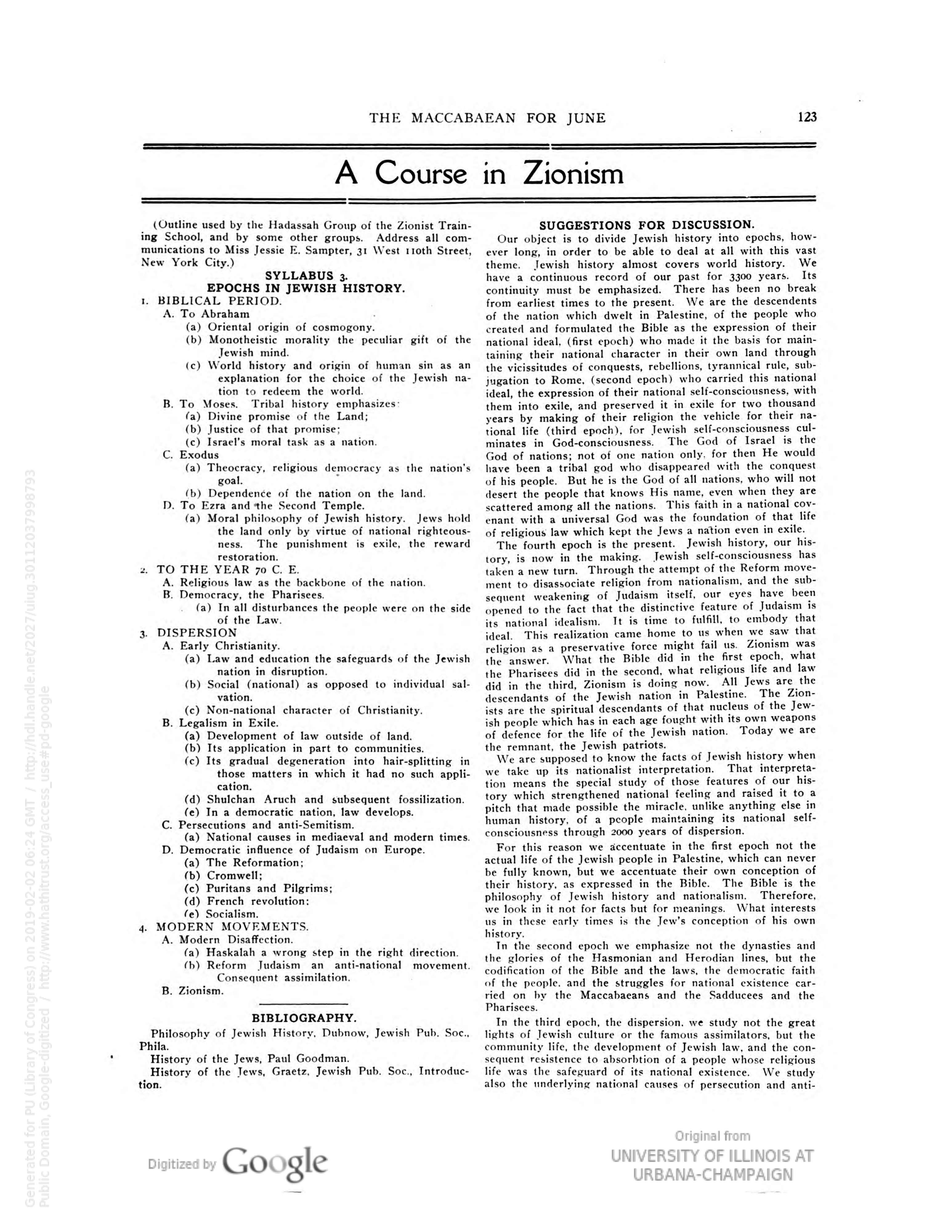
Semitism, the prejudice against aliens without a land, and the fear of Jewish cultural, economic, and racial domination. Also, the democratic national ideal of the Jew, and whatever indirect influence it may have had upon the national and democratic development of Europe.
Lastly, in the fourth epoch, we study not the Jewish philanthropic institutions of the past century, which have made of us almost a huge charitable organization, but we study the Reform movement, the Haskalah movement, and Zionism, each as a reaction of Jewish national impulse to modern
conditions, to the nationalist movements of Europe. When the Maskilim in Russia separated Jewish learning and the Hebrew language from religion, when the Reformers in Germany separated Jewish religion from national tradition, this separating process served to emphasize the central fact of Jewish nationality. By dividing the ancient unity of Jewish life, which for 3000 years had taken for granted its religion, its learning, and its nationality, we came only the better to understand its elements.
The London "Nation" on Zionism
The London "Nation," one of the most influential journals of opinion in England, published, on May 1st, the following editorial comment on Zionism:
“The Gentile world has been at small pains to understand the real point of Zionism. It was intelligible enough to us all that Jews should turn with longing and passion to the thought of finding some free soil, t0 which they could direct the refugees from the humiliations and oppressions of the Ghetto and the Pale. If on that free soil they could erect some kind of national state, the ambition, we thought, was natural, though somewhat Utopian. But when the problem was stated in these crude terms, the answer of common sense was only too obvious. The refugees from the shadows and terrors of the Eastern Ghetto do not turn to Zion at all. Their New Jerusalem is on the banks of the Hudson, and they are satisfied’ to become citizens of a Republic which welcomes and absorbs them. Even if one could imagine in Palestine a material well-being which could compete with the allurements of the New World, what fraction of Russian lewry could it accommodate? To the Zionist the very certainty that the population of the Eastern Ghettos would more and more abandon the land of bondage to settle in America was an additional reason for building up a national centre in Palestine.
“The life of the Ghetto might be degrading and perilous. There the Jew wore, from childhood to old age, the badge of hopeless servitude; his economic existence was straitened; the avenues to learning and progress were closed, and the terror of overt persecution was never absent for long. But in this hostile environment he remained a Jew. Precisely because he was repelled by an intolerant Christianity, he kept his own religious and national traditions. Here the ambition of an able man was still to devote his mind, perhaps in poverty, certainly in obscurity, to a life of study and contemplation. The traditional lore survived, and Hebrew was still the learned tonene. When the Ghetto-bred youth merged into the spacious life of the States, it was a secular and international atmosphere which welcomed and engulfed him. Mr. Zangwill has dramatized the process in his deeply interesting play, ‘The Melting Pot,' but his sympathetic acceptance of the merging of the Jew in a new cosmopolitan society, a nation with no racial basis, is not the attitude of all patriotic Jews.
"Zionism is a large reaction against this whole process of assimilation, and the idea of a return of some fraction of the race to Palestine is only a means to an end. The end is that the Jew everywhere should retain his racial self-consciousness, and with it the self-respect which every man loses in some degree who strives to seem what he is not. It views with a mingled contempt and regret the Jew of whom his Christian friends will say, that 'one would never guess that he was a Jew.' It seeks to arrest the decay of that racial pride which alone can preserve the special intellectual and
social significance of Judaism. The world would be much the poorer if it were to mean the withdrawal of the best minds in the younger generation of Jews from intellectual and social movements which ought to have no exclusive basis in racial or religious particularism. It does not mean this, or it will not mean it, when it has passed the stage of a rather combative protest. On the contrary, it will mean that the Jew who enters these movements will bring with him what is of more worth than his individual capacity, his share of tremendously educative racial experience. Nor do we think that this self-respecting Neo-Judaism is likely to foster anti-Semitism; on the contrary, that ugly tendency is always excited by its suspicions of the concealed Jew.
“It is an integral part of the doctrine of this revived Judaism that the Jewish race, like every other nationality, must possess a homeland. Somewhere the tradition must acquire a mass-consciousness, somewhere this religion, which is, above all else, ethical and social, must stand embodied in a society which observes it. The function of the Ghetto in conserving it is ceasing to operate. The dispersion of the Jewish race is a fact which nothing can alter, but, as Mr. Leon Simon argues in a recent pamphlet on ‘Zionism,' even a dispersed race can retain its identity if it has somewhere a home, as the Irish race, the world over, retains its individuality by its common attraction to Ireland. A restored Palestine would become a place of pilgrimage, but, above all, it would become a centre of education. A lewislhı University at Jerusalem would do for judaism what the Sorbonne and Bologna did for the Christian world in the Dark Ages, what the Azhar did for Islam. It would permit at once the consolidation and the diffusion of a national culture. In its early stages, when Turkey seemed on the point of dissolution, Zionism laid stress on the creation of a Jewish State in Palestine, under international guarantees. The Turkish revolution forced the aspect of the programme into the background. It is conceivable that the issue of the present war may revive it.