Jews in the War.
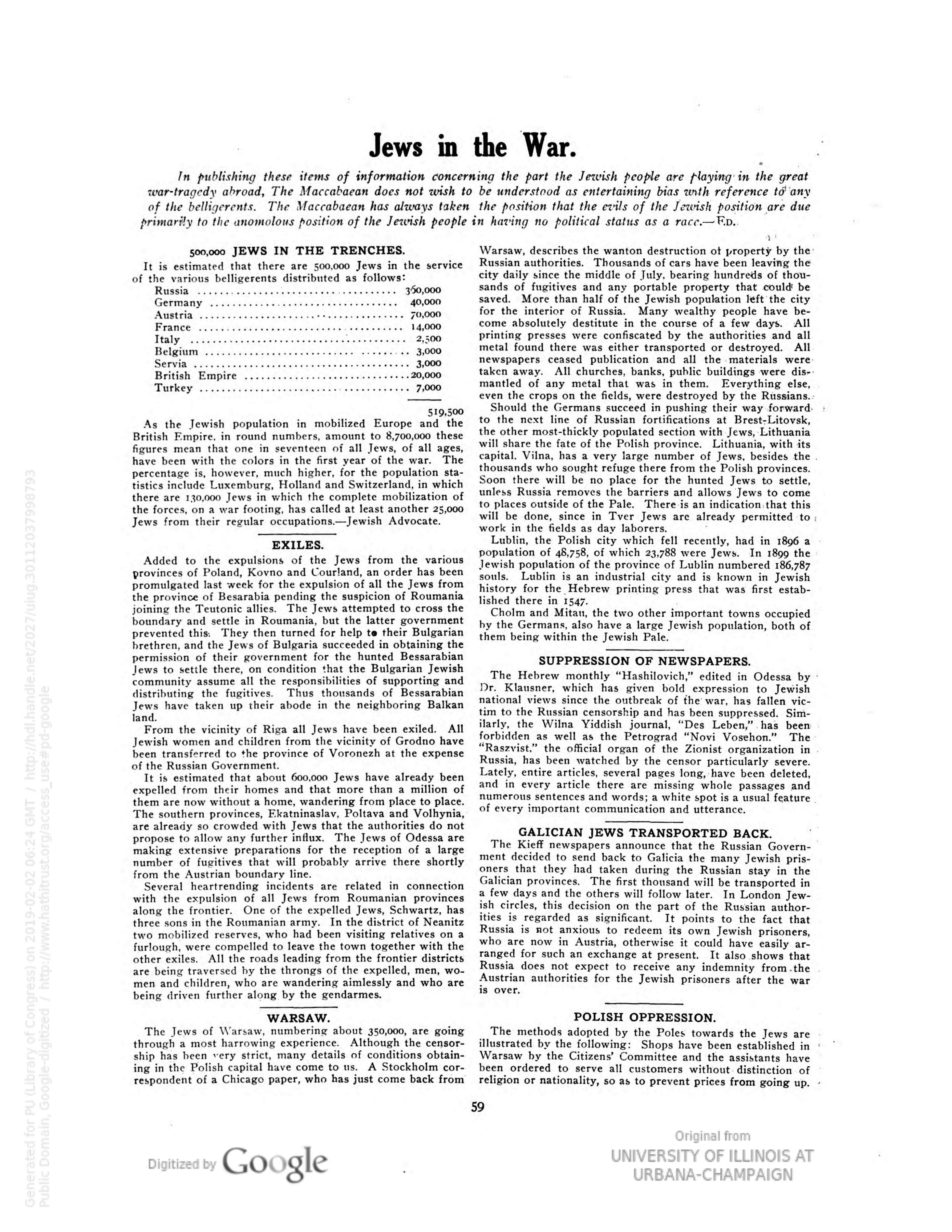
In publishing these items of information concerning the part the Jewish people are flaying in the great war-tragedy abroad, The Maccabaean does not wish to be understood as entertaining bias with reference to any of the belligerents. The Maccabaean has always taken the position that the evils of the Jewish position are due primarily to the anomolous position of the Jewish people in having no political status as a race.—F.D.
500,000 JEWS IN THE TRENCHES.
It is estimated that there are 500,000 Jews in the service of the various belligerents distributed as follows:
519,500
As the Jewish population in mobilized Europe and the British Empire, in round numbers, amount to 8,700,000 these figures mean that one in seventeen of all Jews, of all ages, have been with the colors in the first year of the war. The percentage is, however, much higher, for the population statistics include Luxemburg, Holland and Switzerland, in which there are 130,000 Jews in which the complete mobilization of the forces, on a war footing, has called at least another 25,000 Jews from their regular occupations.—Jewish Advocate.
EXILES.
Added to the expulsions of the Jews from the various provinces of Poland, Kovno and Courland, an order has been promulgated last week for the expulsion of all the Jews from the province of Besarabia pending the suspicion of Roumania joining the Teutonic allies.. The Jews attempted to cross the boundary and settle in Roumania, but the latter government prevented this: They then turned for help te their Bulgarian brethren, and the Jews of Bulgaria succeeded in obtaining the permission of their government for the hunted Bessarabian Jews to settle there, on condition that the Bulgarian Jewish community assume all the responsibilities of supporting and distributing the fugitives. Thus thousands of Bessarabian Jews have taken up their abode in the neighboring Balkan land.
From the vicinity of Riga all Jews have been exiled. All Jewish women and children from the vicinity of Grodno have been transferred to the province of Voronezh at the expense of the Russian Government.
It is estimated that about 600,000 Jews have already been expelled from their homes and that more than a million of them are now without a home, wandering from place to place. The southern provinces, Ekaterinaslav, Poltava and Volhynia, are already so crowded with Jews that the authorities do not propose to allow any further influx. The Jews of Odessa are making extensive preparations for the reception of a large number of fugitives that will probably arrive there shortly from the Austrian boundary line.
Several heartrending incidents are related in connection with the expulsion of all Jews from Roumanian provinces along the frontier. One of the expelled Jews, Schwartz, has three sons in the Roumanian army. In the district of Neanitz two mobilized reserves, who had been visiting relatives on a furlough, were compelled to leave the town together with the other exiles. Allthe roads leading from the frontier districts are being traversed by the throngs of the expelled, men, women and children, who are wandering aimlessly and who are beine driven further along by the gendarmes.
WARSAW.
The Jews of Warsaw, numbering about 350,000, are going through a most harrowing experience. Although the censorship has been very strict, many details of conditions obtaining in the Polish capital have come to us. A Stockholm correspondent of a Chicago paper, who has just come back from
Warsaw, describes the wanton destruction ot property by the' Russian authorities. Thousands of cars have been leaving the city daily since the middle of July, bearing hundreds of thousands of fugitives and any portable property that could‘ be saved. More than half of the Jewish population left the city for the interior of Russia. Many wealthy people have become absolutely destitute in the course of a few days. All printing presses were confiscated by the authorities and all metal found there was either transported or destroyed. All newspapers ceased publication and all the materials were taken away. All churches, banks, public buildings were dis-: mantled of any metal that was in them. Everything else, even the crops on the fields, were destroyed by the Ruüssians.-
Should the Germans succeed in pushing their way forward to the next line of Russian fortifications at Brest-Litovsk, the other most-thickly populated section with Jews, Lithuania will share the fate of the Polish province. Lithuania, with its capital, Vilna, has a very large number of Jews, besides the thousands who sought refuge there from the Polish provinces. Soon there will be no place for the hunted Jews to settle, unless Russia removes the barriers and allows Jews to come to places outside of the Pale. There is an indication that this will be done, since in Tver Jews are already permitted to work in the fields as day laborers.
Lublin, the Polish city which fell recently, had in 1896 a population of 48,758, of which 23,788 were Jews. In 1899 the Jewish population of the province of Lublin numbered 186,787 souls. Lublin is an industrial city and is known in Jewish history for the Hebrew printing press that was first established there in 1547.
Cholm and Mitau, the two other important towns occupied by the Germans, also have a large Jewish population, both of them being within the Jewish Pale.
SUPPRESSION OF NEWSPAPERS.
The Hebrew monthly "Hashilovich," edited in Odessa by Dr. Klausner, which has given bold expression to Jewish national views since the outbreak of the war, has fallen victim to the Russian censorship and has been suppressed. Similarly, the Wilna Yiddish journal, "Des Leben," has been forbidden as well as the Petrograd "Novi Vosehon." The "Raszvist," the official organ of the Zionist organization in Russia, has been watched by the censor particularly severe. Lately, entire articles, several pages long, have been deleted, and in every article there are missing whole passages and numerous sentences and words; a white spot is a usual feature of every important communication and utterance.
GALICIAN JEWS TRANSPORTED BACK.
The Kieff newspapers announce that the Russian Government decided to send back to Galicia the many Jewish prisoners that they had taken during the Russian stay in the Galician provinces. The first thousand will be transported in a few days and the others will follow later. In London Jewish circles, this decision on the part of the Russian authorities is regarded as significant. It points to the fact that Russia is not anxious to redeem its own Jewish prisoners, who are now in Austria, otherwise it could have easily arranged for such an exchange at present. It also shows that Russia does not expect to receive any indemnity from the Austrian authorities for the Jewish prisoners after the war is over.
POLISH OPPRESSION.
The methods adopted by the Poles towards the Jews are illustrated by the following: Shops have been established in Warsaw by the Citizens' Committee and the assistants have been ordered to serve all customers without distinction of religion or nationality, so as to prevent prices from going up.