Norman Hapgood on Zionism
A VERY interesting series of articles on Zionism by Norman Hapgood has recently appeared in Harper's Weekly. With profound insight and in his usually sympathetic manner, Mr. Hapgood, in very simple but exquisite style, vividly pictures to us the never ending sufferings of the Jews, the torment of two thousand years of persecution. "Is there no reason for the persistence of this Jew-baiting?" Mr. Hapgood asks. To this question he finds a ready answer.
It is the Jew’s will-to-live; his continuous effort to develop himself along his own peculiar lines despite unfavorable environments and abnormal conditions. “The Jew,” says Mr. Hapgood, “declined a course that was open to him. If he had been more absorbable he might have been amalgamated and long ago lost from sight. His numbers being small in comparison he would have left no mark in the resultant mixture. He preferred racially to remain alive. He had developed a significant civilization centuries before your ancestors and mine emerged hairy from their forest lairs. .. . There was in him something persistent beyond reasoning. There was deep in his very being an objection to disappearance. If it be a crime to avoid suicide, the Jew was guilty.”
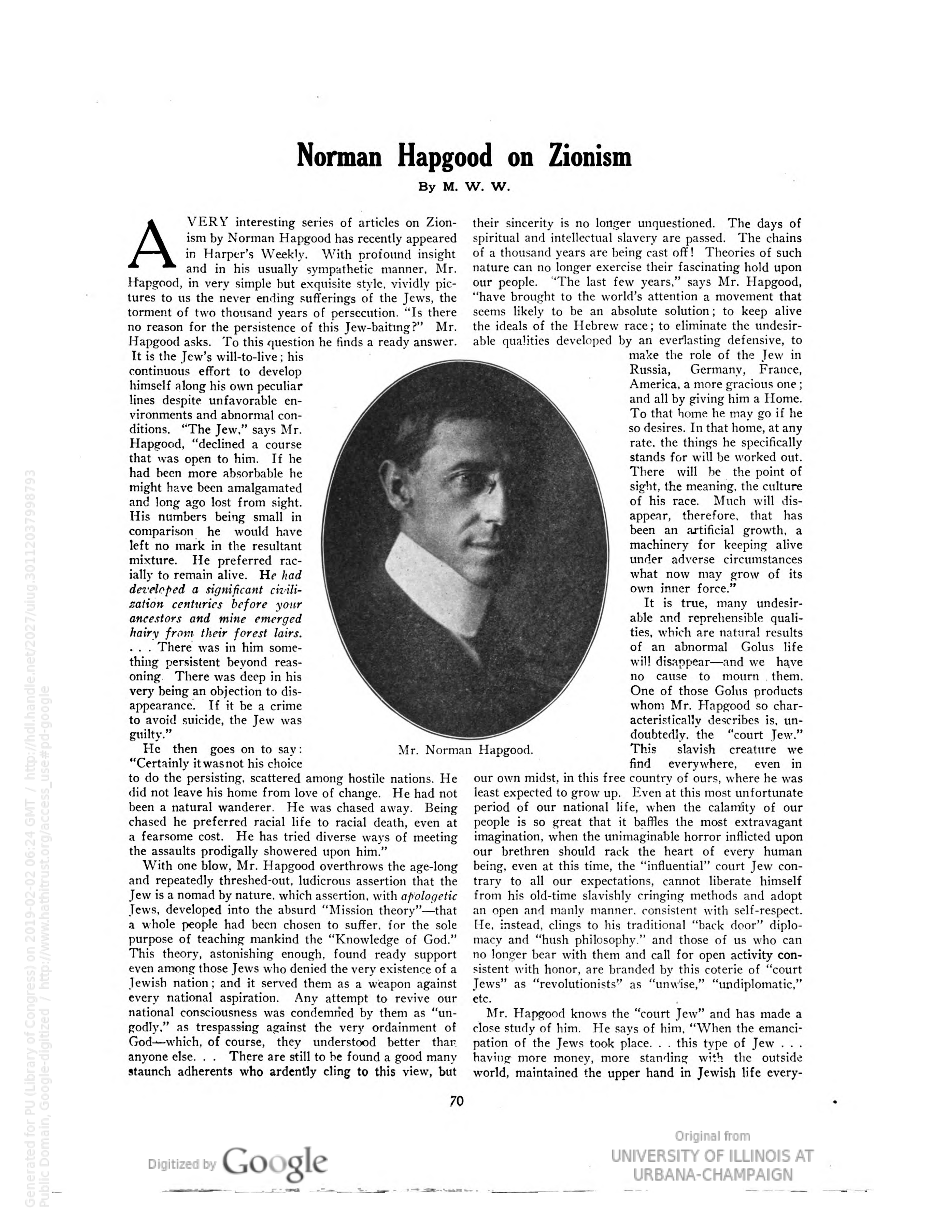
He then goes on to say: Mr. Norm “Certainly it was not his choice to do the persisting, scattered among hostile nations. He did not leave his home from love of change. He had not been a natural wanderer. He was chased away. Being chased he preferred racial life to racial death, even at a fearsome cost. He has tried diverse ways of meeting the assaults prodigally showered upon him.”
With one blow, Mr. Hapgood overthrows the age-long and repeatedly threshed-out, ludicrous assertion that the Jew is a nomad by nature, which assertion, with apologetic Jews, developed into the absurd “Mission theory”—that a whole people had been chosen to suffer, for the sole purpose of teaching mankind the “Knowledge of God.” This theory, astonishing enough, found ready support even among those Jews who denied the very existence of a Jewish nation; and it served them as a weapon against every national aspiration. Any attempt to revive our national consciousness was condemned by them as “ungodly.” as trespassing against the very ordainment of God--which, of course, they understood better than anyone else... There are still to be found a good many staunch adherents who ardently cling to this view, but
their sincerity is no longer unquestioned. The days of spiritual and intellectual slavery are passed. The chains of a thousand years are being cast off! Theories of such nature can no longer exercise their fascinating hold upon our people. “The last few years,” says Mr. Hapgood, “have brought to the world’s attention a movement that seems likely to be an absolute solution; to keep alive the ideals of the Hebrew race; to eliminate the undesirable qualities developed by an everlasting defensive, to
make the role of the Jew in Russia, Germany, France, America, a more gracious one; and all by giving him a Home. To that home he may go if he so desires. In that home, at any rate, the things he specifically stands for will be worked out. There will be the point of sight, the meaning, the culture of his race. Much will disappear, therefore, that has been an artificial growth, a machinery for keeping alive under adverse circumstances what now may grow of its own inner force."
It is true, many undesirable and reprehensible qualities, which are natural results of an abnormal Golus life will disappear and we have no cause to mourn them. One of those Golus products whom Mr. Hapgood so characteristically describes is, undoubtedly, the "court Jew." This slavish creature we find everywhere, even in
our own midst, in this free country of ours, where he was least expected to grow up. Even at this most unfortunate period of our national life, when the calamity of our people is so great that it baffles the most extravagant imagination, when the unimaginable horror inflicted upon our brethren should rack the heart of every human being, even at this time, the “influential” court Jew contrary to all our expectations, cannot liberate himself from his old-time slavishly cringing methods and adopt an open and manly manner. consistent with self-respect. He, instead, clings to his traditional “back door” diplomacy and “hush philosophy.” and those of us who can no longer bear with them and call for open activity consistent with honor, are branded by this coterie of “court Jews” as “revolutionists” as “unwise,” “undiplomatic,” etr.
Mr. Hapgood knows the "court Jew" and has made a close study of him. He says of him, "When the emancipation of the Jews took place. . . . this type of Jew . . . having more money, more standing with the outside world, maintained the upper hand in Jewish life every-