Solomon Schechter’s Personality
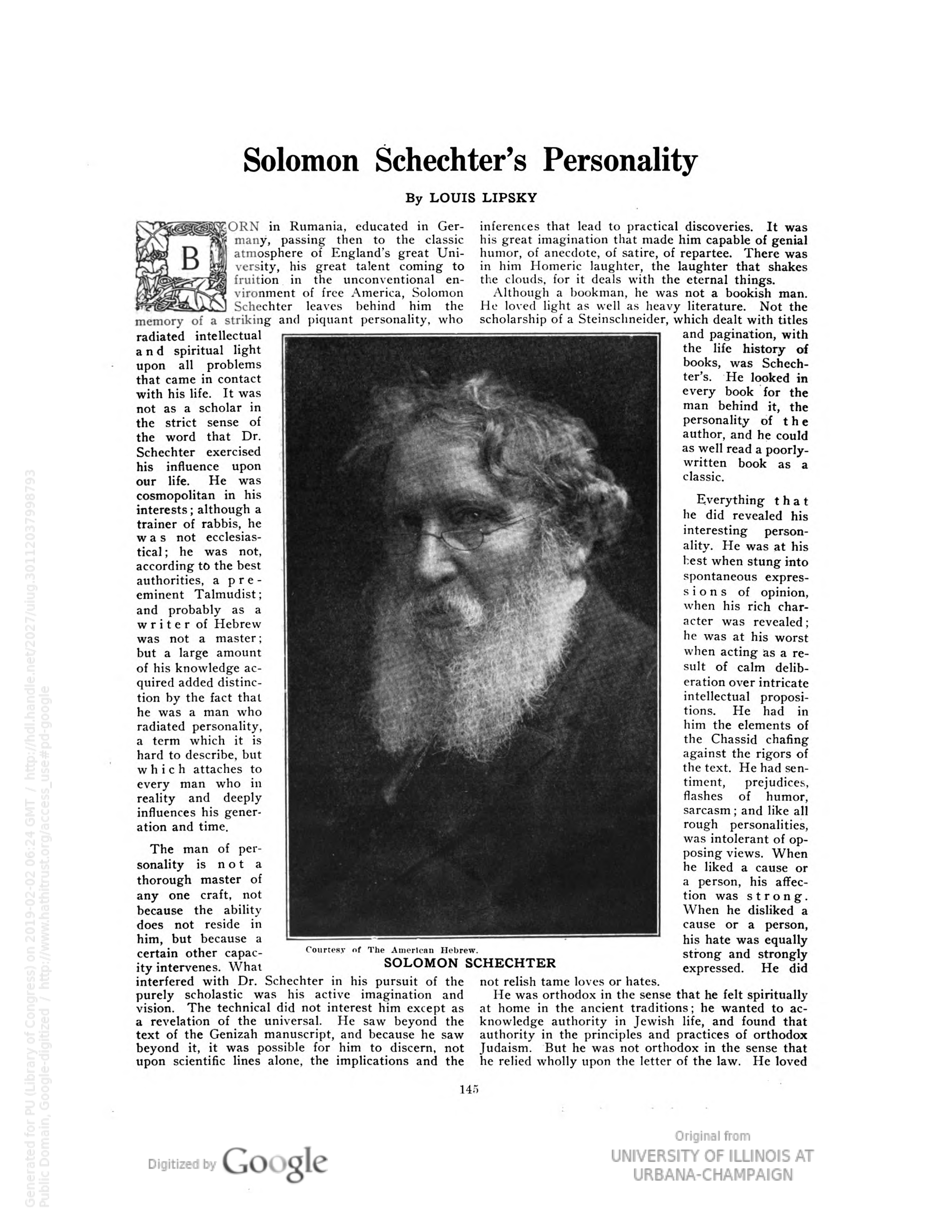
BORN in Rumania, educated in Germany, passing then to the classic atmosphere of England's great University, his great talent coming to fruition in the unconventional environment of free America, Solomon Schechter leaves behind him the memory of a striking and piquant personality, who radiated intellectual and spiritual light upon all problems that came in contact with his life. It was not as a scholar in the strict sense of the word that Dr. Schechter exercised his influence upon our life. He was cosmopolitan in his interests; although a trainer of rabbis, he was not ecclesiastical; he was not, according to the best authorities, a preeminent Talmudist; and probably as a writer of Hebrew was not a master; but a large amount of his knowledge acquired added distinction by the fact that he was a man who radiated personality, a term which it is hard to describe, but which attaches to every man who in reality and deeply influences his generation and time.
The man of personality is not a thorough master of any one craft, not because the ability does not reside in him, but because a certain other capacity intervenes. What interfered with Dr. Schechter in his pursuit of the purely scholastic was his active imagination and vision. The technical did not interest him except as a revelation of the universal. He saw beyond the text of the Genizah manuscript, and because he saw beyond it, it was possible for him to discern, not upon scientific lines alone, the implications and the
inferences that lead to practical discoveries. It was his great imagination that made him capable of genial humor, of anecdote, of satire, of repartee. There was in him Homeric laughter, the laughter that shakes the clouds, for it deals with the eternal things.
Although a bookman, he was not a bookish man. He loved light as well as heavy literature. Not the scholarship of a Steinschneider, which dealt with titles
and pagination, with the life history of books, was Schechter's. He looked in every book for the man behind it, the personality of the author, and he could as well read a poorly- written book as a classic.
Everything that he did revealed his interesting personality. He was at his best when stung into spontaneous expressions of opinion, when his rich character was revealed; he was at his worst when acting as a result of calm deliberation over intricate intellectual propositions. He had in him the elements of the Chassid chafing against the rigors of the text. He had sentiment, prejudices, flashes of humor, sarcasm; and like all rough personalities, was intolerant of opposing views. When he liked a cause or a person, his affection was strong. When he disliked a cause or a person, his hate was equally strong and strongly expressed. He did
not relish tame loves or hates. He was orthodox in the sense that he felt spiritually at home in the ancient traditions; he wanted to acknowledge authority in Jewish life, and found that authority in the principles and practices of orthodox Judaism. But he was not orthodox in the sense that he relied whollv unon the letter of the law. He loved