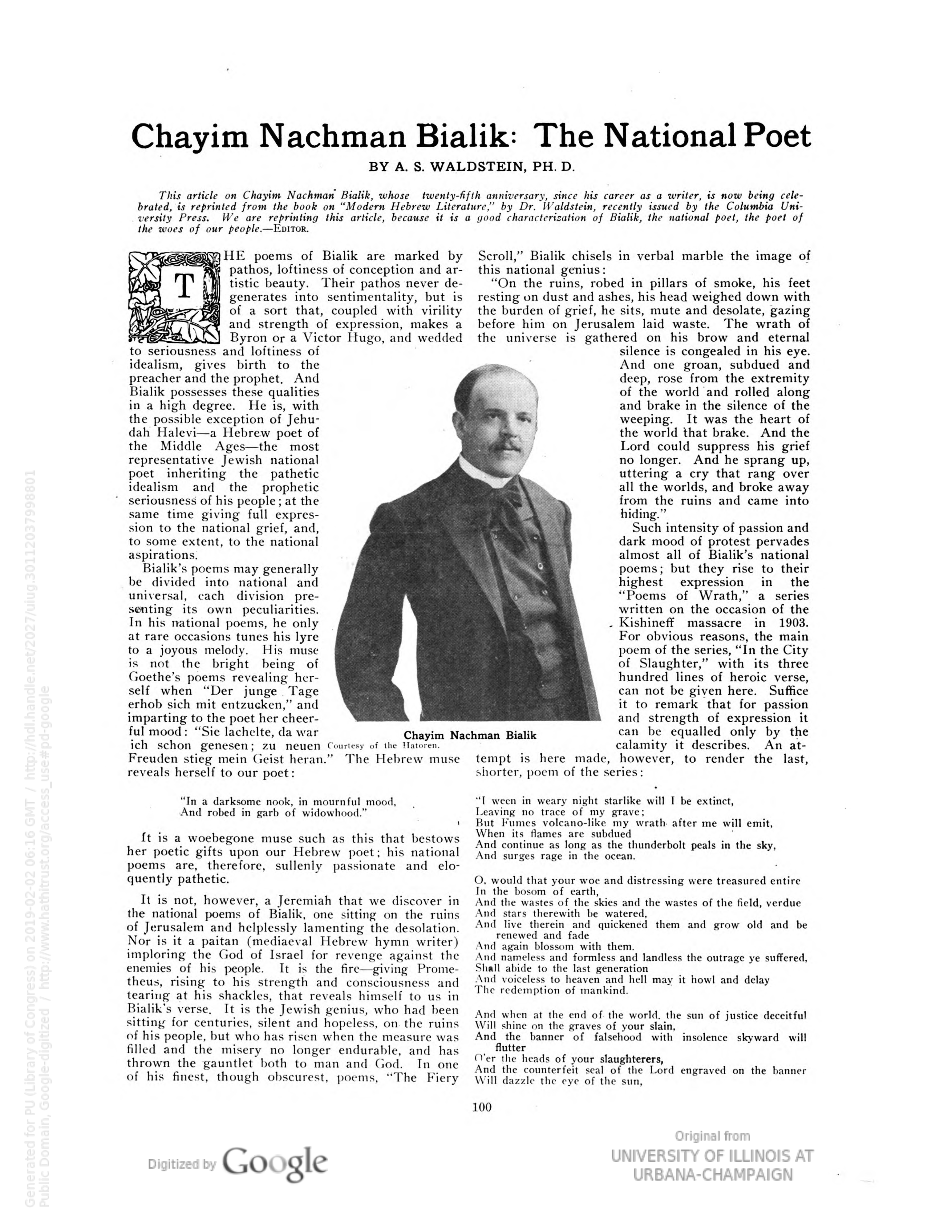
Chayim Nachman Bialik: The National Poet
This article on Chayim Nachman Bialik, whose twenty-fifth anniversary, since his career as a writer, is now being celebrated, is reprinted from the book on "Modern Hebrew Literature," by Dr. Waldstein, recently issued by the Columbia University Press. We are reprinting this article, because it is a good characterization of Bialik, the national poet, the poet of the woes of our people.—EDITOR.
THE poems of Bialik are marked by pathos, loftiness of conception and artistic beauty. Their pathos never degenerates into sentimentality, but is of a sort that, coupled with virility and strength of expression, makes a Byron or a Victor Hugo, and wedded
to seriousness and loftiness of idealism, gives birth to the preacher and the prophet. And Bialik possesses these qualities in a high degree. He is, with the possible exception of Jehudah Halevi—a Hebrew poet of the Middle Ages—the most representative Jewish national poet inheriting the pathetic idealism and the prophetic seriousness of his people; at the same time giving full expression to the national grief, and, to some extent, to the national aspirations.
Bialik's poems may generally be divided into national and universal, each division presenting its own peculiarities. In his national poems, he only at rare occasions tunes his lyre to a joyous melody. His muse is not the bright being of Goethe's poems revealing herself when "Der junge Tage erhob sich mit entzucken," and imparting to the poet her cheerful mood: "Sie lachelte, da war ich schon genesen; zu neuen Freuden stieg mein Geist heran." The Hebrew muse reveals herself to our poet:
"In a darksome nook, in mournful mood,And robed in garb of widowhood."
It is a woebegone muse such as this that bestows her poetic gifts upon our Hebrew poet; his national poems are, therefore, sullenly passionate and eloquently pathetic.
It is not, however, a Jeremiah that we discover in the national poems of Bialik, one sitting on the ruins of Jerusalem and helplessiy lamenting the desolation. Nor is it a paitan (mediaeval Hebrew hymn writer) imploring the God of Israel for revenge against the enemies of his people. It is the fire—giving Prometheus, rising to his strength and consciousness and tearinıg at his shackles, that reveals himself to us in Bialik's verse, It is the Jewish genius, who had been sitting for centuries, silent and hopeless, on the ruins of his people, but who has risen when the measure was filled and the misery no longer endurable, and has thrown the gauntlet both to man and God. In one of his finest, though obscurest, poems, “The Fiery
Scroll," Bialik chisels in verbal marble the image of this national genius:
"On the ruins, robed in pillars of smoke, his feet resting on dust and ashes, his head weighed down with the burden of grief, he sits, mute and desolate, gazing before him on Jerusalem laid waste. The wrath of the universe is gathered on his brow and eternal silence is concealed in his eye.
silence is congealed in his eye. And one groan, subdued and deep, rose from the extremity of the world and rolled along and brake in the silence of the weeping. It was the heart of the world that brake. And the Lord could suppress his grief no longer. And he sprang up, uttering a cry that rang over all the worlds, and broke away from the ruins and came into hiding."
Such ıntensity ol passıon and dark mood of protest pervades almost all of Bialik’s national poems; but they rise to their highest expression in the “Poems of Wrath,” a series written on the occasion of the Kishineff massacre in 1903. For obvious reasons, the main poem of the series, “In the City of Slaughter,” with its three hundred lines of heroic verse, can not be given here. Suffice it to remark that for passion and strength of expression it can be equalled only by the ‚alamity it describes. An atRE FREE. VERBPET B PD h ER F
tempt is here made, however, to render the last, shorter, poem of the series:
“I ween in weary night starlike will I be extinct, Leaving no trace of my grave; But Fumes volcano-like my wrath after me will emit, When its flames are subdued And continue as long as the thunderbolt peals in the sky, And surges rage in the ocean.
O, would that your woe and distressing were treasured entire In the bosom of earth, And the wastes of the skies and the wastes of the field, verdue And stars therewith be watered, And live therein and quickened them and grow old and be renewed and fade And again blossom with them. And nameless and formless and landless the outrage ye suffered, Shall abide to the last generation And voiceless to heaven and hell may it howl and delay The redemption of mankind.
And when at the end of the world, the sun of justice deceitful Will shine on the graves of your slain, And the banner of falsehood with insolence skyward will flutter O'er the heads of your slaughterers, And the counterfeit seal of the Lord engraved on the banner Will dazzle the eye of the sun,