Yigael: A Story of Merchaviah
ERCHAVIAH, the first Jewish settlement in the Valley of Jesreel, had to be gained by force. It was necessary not only to buy it from the Effendi, but also to drive away the Arabs, and to accustom the neighbors to the thought that it had passed for
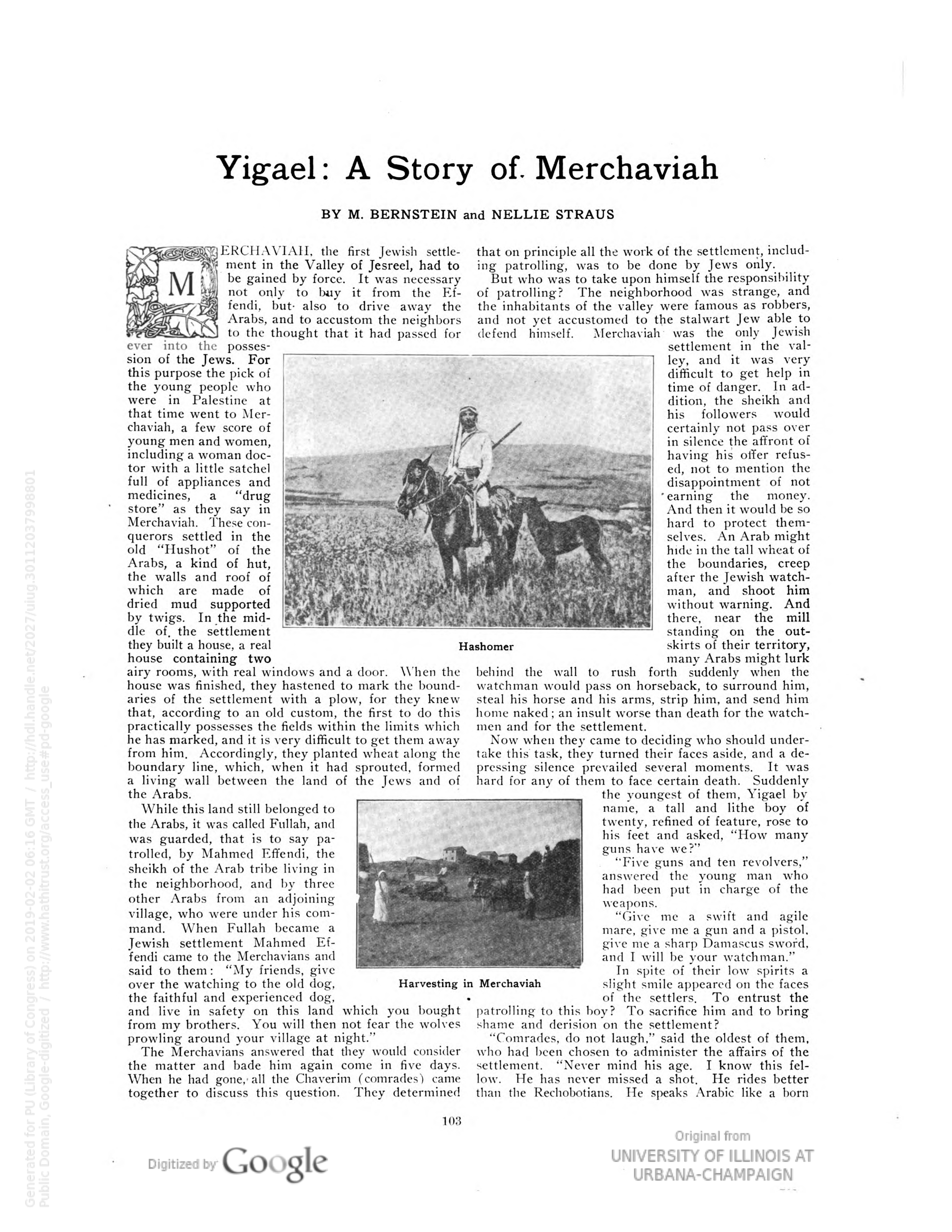
ever into the possession of the Jews. For this purpose the pick ol the young people who were in Palestine at that time went to Merchaviah, a few score of young men and women including a woman doctor with a little satchel full of appliances and mediciness, a “drug store” as they say in Merchaviah. T'hese conquerors settled in the old “Hushot” of the Arabs, a kind of hut, the walls and roof of which are made of dried mud supported by twigs. In the middle of, the settlement they built a house, a real! house containing two aurı rnnme. sth zäal x
airy rooms, with real windows and a door. When the house was finished, they hastened to mark the boundaries of the settlement with a plow, for they knew that, according to an old custom, the first to do this practically possesses the fields within the limits which he has marked, and it is very difficult to get them away from him. Accordingly, they planted wheat along the boundary line, which, when it had sprouted, formed a living wall between the land of the Jews and of the Arabs.
While this land still belonged to the Arabs, it was called Fullah, and was guarded, that is to say pa- trolled, by Mahmed Effendi, the sheikh of the Arab tribe living in the neighborhood, and by three other Arabs from an adjoining village, who were under his command. When Fullah became a Jewish settlement Mahmed Ef- fendi came to the Merchavians and said to them: “My friends, give over the watching to the old dog, the faithful and experienced dog, and live in safety on this land which you bought from my brothers. You will then not fear the wolves prowling around your village at night.”
The Merchavians answered that they would consider the matter and bade him again come in five days. When he had gone, all the Chaverim (comrades) came together to discuss this question. They determined
that on principle all the work of the settlement, including patrolling, was to be done by Jews only.
But who was to take upon himself the responsibility of patrolling? The neighborhood was strange, and the inhabitants of the valley were famous as robbers, and not yet accustomed to the stalwart Jew able to defend himself. Merchaviah was the only Jewish
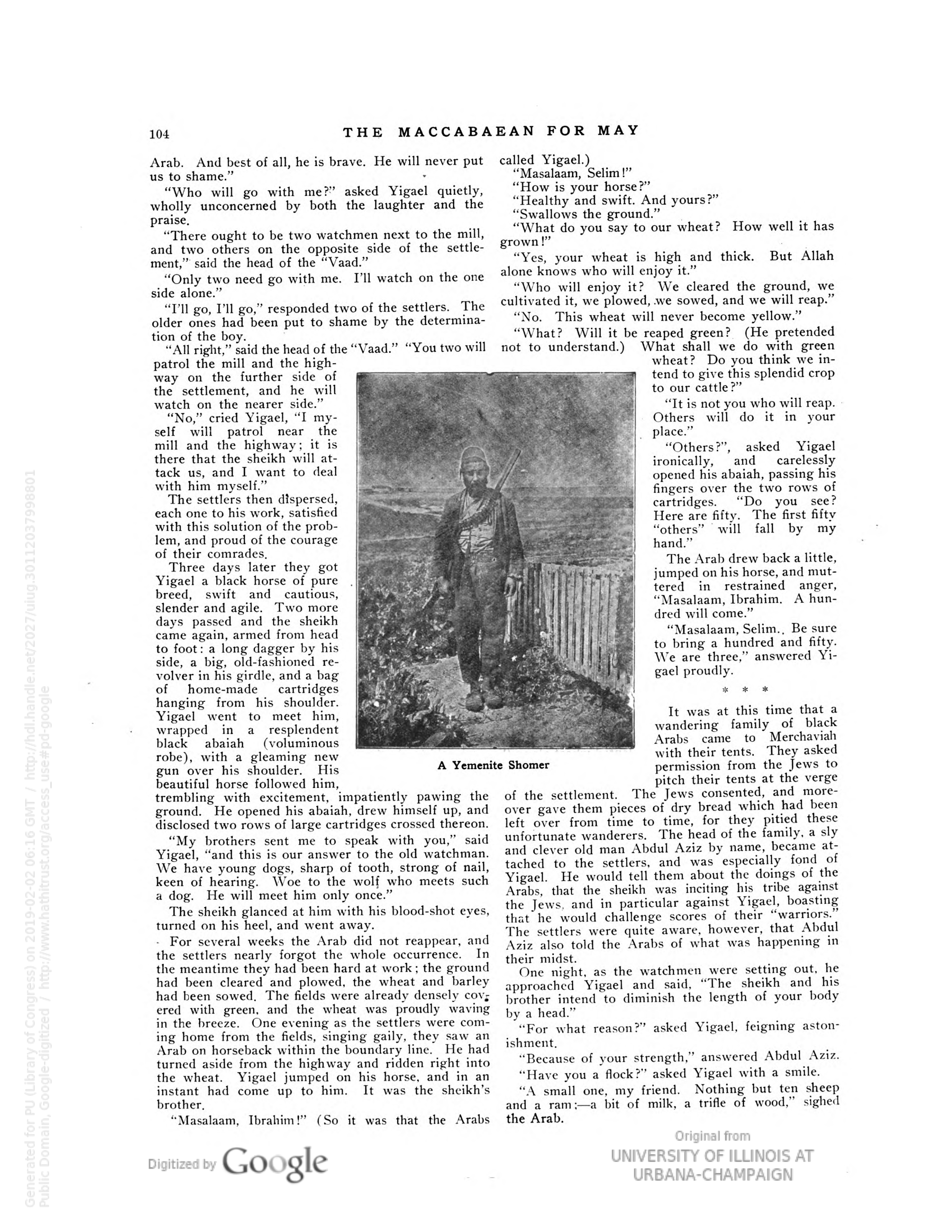
settlement in the valley, and it was very difficult to get help in time of danger. In addition, the sheikh and his followers would certainly not pass over in silence the affront of having his offer refused, not to mention the disappointment of not earning the money. And then it would be so hard to protect themselves. An Arab might hide in the tall wheat of the boundaries, creep after the Jewish watchman, and shoot him without warning. And there, near the mill standing on the outskirts of their territory, many Arabs might lurk
behind the wall to rush forth suddenly when the watchman would pass on horseback, to surround him, steal his horse and his arms, strip him, and send him home naked; an insult worse than death for the watchmen and for the settlement.
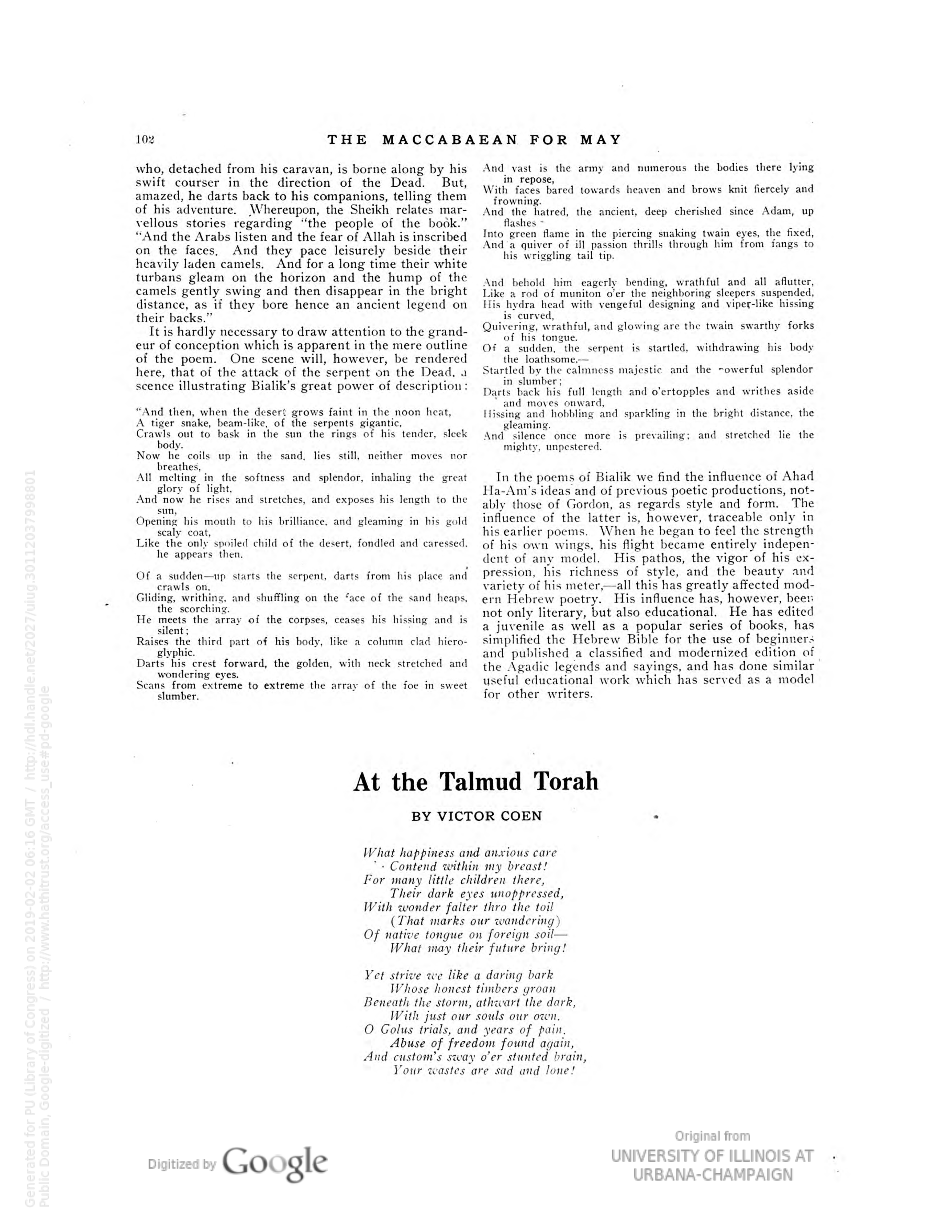
Now when they came to deciding who should undertake this task, they turned their faces aside, and a depressing silence prevailed several moments. It was hard for any of them to face certain death. Suddenly the youngest of them, Yigael by name, a tall and lithe boy of twenty, refined of feature, rose to his feet and asked, "How many guns have we?"
"Five guns and ten revolvers," answered the young man who had been put in charge of the weapons.
"Give me a swift and agile mare, give me a gun and a pistol, give me a sharp Damascus sword, and I will be your watchman."
Merchaviah In spite of their low spirits a slight smile appeared on the faces of the settlers. To entrust the patrolling to this boy? To sacrifice him and to bring shame and derision on the settlement?
"Comrades, do not laugh," said the oldest of them, who had been chosen to administer the affairs of the settlement. "Never mind his age. I know this fellow. He has never missed a shot. He rides better than the Rechobotians. He speaks Arabic like a born