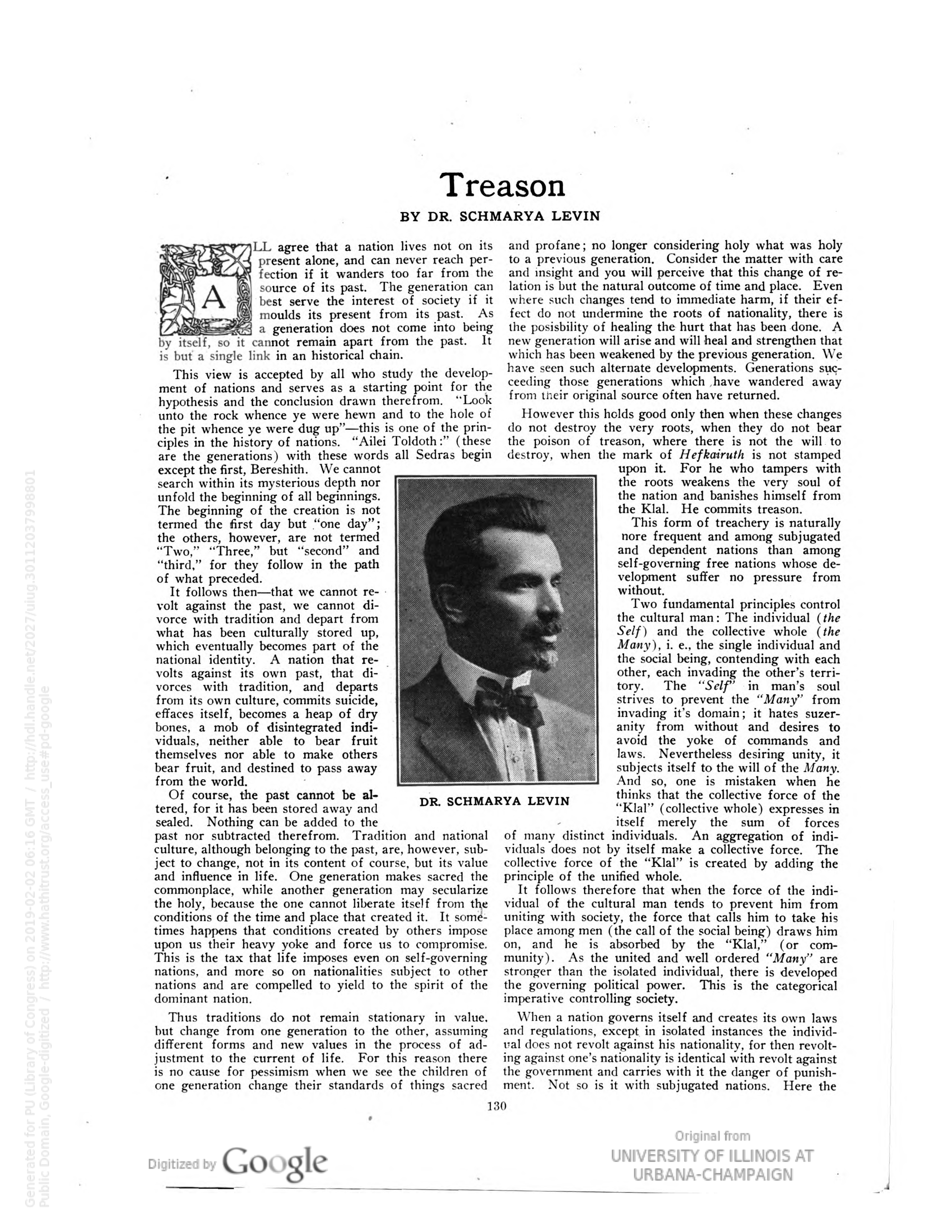
Treason
ALL agree that a nation lives not on its present alone, and can never reach perfection if it wanders too far from the source of its past. The generation can best serve the interest of society if it moulds its present from its past. As a generation does not come into being by itself, so it cannot remain apart from the past. It is but a single link in an historical chain.
This view is accepted by all who study the development of nations and serves as a starting point for the hypothesis and the conclusion drawn therefrom. "Look unto the rock whence ye were hewn and to the hole of the pit whence ye were dug up”—this is one of the principles in the history of nations. “Ailei Toldoth :” (these are the generations) with these words all Sedras begin except the first, Bereshith. We cannot search within its mysterious depth nor unfold the beginning of all beginnings. The beginning of the creation is not termed the first day but “one day”; the others, however, are not termed “Two,” “Three,” but “second” and “third,” for they follow in the path of what preceded.
It follows then—that we cannot revolt against the past, we cannot divorce with tradition and depart from what has been culturally stored up, which eventually becomes part of the national identity. A nation that revolts against its own past, that divorces with tradition, and departs from its own culture, commits suicide, effaces itself, becomes a heap of dry bones, a mob of disintegrated individuals, neither able to bear fruit themselves nor able to make others bear fruit, and destined to pass away from the world.
Of course, the past cannot be altered, for it has been stored away and DR. SCHM sealed. Nothing can be added to the past nor subtracted therefrom. Tradition and national culture, although belonging to the past, are, however, subject to change, not in its content of course, but its value and influence in life. One generation makes sacred the commonplace, while another generation may secularize the holy, because the one cannot liberate itself from the conditions of the time and place that created it. It sometimes happens that conditions created by others impose upon us their heavy yoke and force us to compromise. This is the tax that life imposes even on self-governing nations, and more so on nationalities subject to other nations and are compelled to yield to the spirit of the dominant nation.
Thus traditions do not remain stationary in value, but change from one generation to the other, assuming different forms and new values in the process of adjustment to the current of life. For this reason there is no cause for pessimism when we see the children of one generation change their standards of things sacred
and profane; no longer considering holy what was holy to a previous generation. Consider the matter with care and insight and you will perceive that this change of relation is but the natural outcome of time and place. Even where such changes tend to immediate harm, if their effect do not undermine the roots of nationality, there is the posisbility of healing the hurt that has been done. A new generation will arise and will heal and strengthen that which has been weakened by the previous generation. We have seen such alternate developments. Generations succeeding those generations which ‚have wandered away from their original source often have returned.
However this holds good only then when these changes do not destroy the very roots, when they do not bear the poison of treason, where there is not the will to destroy, when the mark of Hefkairuth is not stamped upon it. For he who tampers with the roots weakens the very soul of the nation and banishes himself from the Klal. He commits treason.
This form of treachery is naturally nore frequent and among subjugated and dependent nations than among self-governing free nations whose development suffer no pressure from without.
Two fundamental principles control the cultural man: The individual (the Self) and the collective whole (the Many), i. e., the single individual and the social being, contending with each other, each invading the other's territory. The "Self" in man's soul strives to prevent the "Many" from invading it's domain; it hates suzeranity from without and desires to avoid the yoke of commands and laws. Nevertheless desiring unity, it subjects itself to the will of the Many. And so, one is mistaken when he thinks that the collective force of the "Klal" (collective whole) expresses in itself merely the sum of forces of many distinct individuals. An aggregation of individuals does not by itself make a collective force. The collective force of the "Klal" is created by adding the principle of the unified whole.
It follows therefore that when the force of the individual of the cultural man tends to prevent him from uniting with society, the force that calls him to take his place among men (the call of the social being) draws him on, and he is absorbed by the “Klal,” (or community). As the united and well ordered “Many” are stronger than the isolated individual, there is developed the governing political power. This is the categorical imperative controlling society.
When a nation governs itself and creates its own laws and regulations, except in isolated instances the individual does not revolt against his nationality, for then revolting against one's nationality is identical with revolt against the government and carries with it the danger of punishment. Not so is it with subjugated nations. Here the