Yigael: A Story of Merchaviah
(Part Two)
BACK to the settlement at once," shouted the head of the Vaad. "Hurry! Run! or all will be lost." The Merchavians knew that the news of Selim's death would be signalled to all the neighboring villages, and that in an hour's time hundreds and thousands of Arabs would rush together to bury the dead body and to swear to avenge his blood. They hastened to the settlement to protect their homes and their lives.
They began their preparations without the loss of a second, for they expected a tremendous assault. They immediately brought all their valuables to the "Hospital," (the room adjoining the communal living-room); they woke the doctor, who had come back exhausted that very day from a nearby village where she had been tending a sick Arab, and set her and the other girls to work on preparing quarters for the wounded. The big table was brought in from the living-room, and placed in the center of the room after the long boards which formed its top had been turned; this was to be the operating table. When they had arranged the instruments, they distributed the bandages and plasters among the girls. Then they ran to the barn, where the weapons were kept. The best marksmen got the revolvers and Mausers, the others took whatever they could lay
u nn A £ Ze N EEE 8, their hands on; heavy iron cudgels, pitchforks, hatchets, and other farming implements. They dressed themselves in black so as not to be distinguishable in the darkness of the night. All the lights were blown out, and a general rush was made to the entrances of the settlement. These they barricaded with wagons which they had overturned, with logs, and with fragments of roofs, torn off from the nearest huts.
They decided to defend the whole settlement if possible, and if not, to concentrate their forces on "the house," which, as they declared, would be surrendered only when the last of them had died.
If we hold the house, the whole settlement is ours,” explained Meirke, the expert in Turkish law.
A messenger was sent to apprise the Kaimakam in Nazareth of the impending attack. Of course it was difficult and dangerous for any one to slip out of the settlement and through the Arab ranks, but Meirke insisted that this had to be done.
"Among us Turks, whoever arrives first at headquarters with his complaint is in the right," he said.
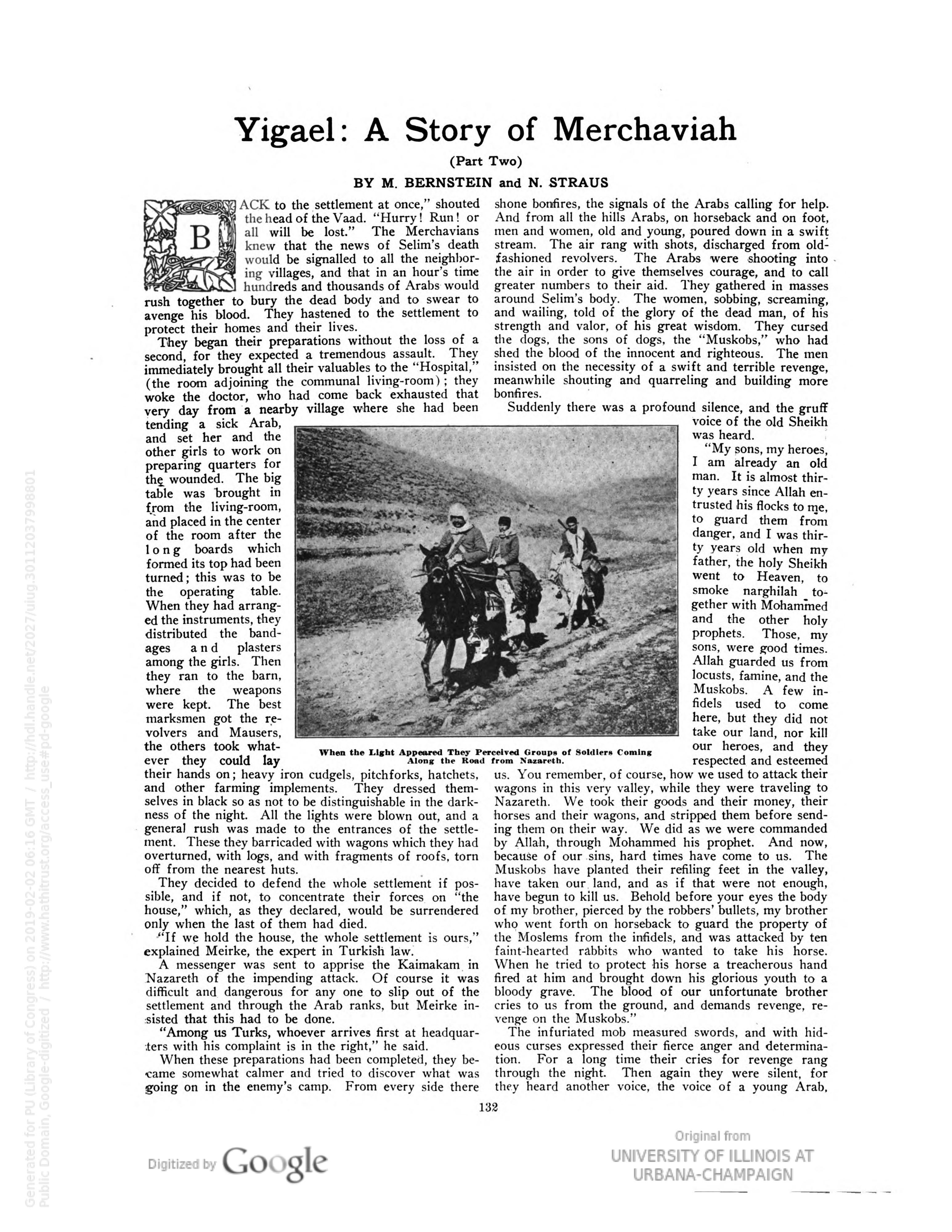
When these preparations had been completed, they became somewhat calmer and tried to discover what was going on in the enemy's camp. From every side there
shone bonfires, the signals of the Arabs calling for help. And from all the hills Arabs, on horseback and on foot, men and women, old and young, poured down in a swift stream. The air rang with shots, discharged from old-fashioned revolvers. The Arabs were shooting into the air in order to give themselves courage, and to call greater numbers to their aid. They gathered in masses around Selim's body. The women, sobbing, screaming, and wailing, told of the glory of the dead man, of his strength and valor, of his great wisdom. They cursed the dogs, the sons of dogs, the "Muskobs," who had shed the blood of the innocent and righteous. The men insisted on the necessity of a swift and terrible revenge, meanwhile shouting and quarreling and building more bonfires.
Suddenly there was a profound silence, and the gruff voice of the old Sheikh was heard.
"My sons, my heroes, I am already an old man. It is almost thirty years since Allah entrusted his flocks to me, to guard them from danger, and I was thirty years old when my father, the holy Sheikh went to Heaven, to smoke narghilah together with Mohammed and the other holy prophets. Those, my sons, were good times. Allah guarded us from locusts, famine, and the Muskobs. A few infidels used to come here, but they did not take our land, nor kill our heroes, and they respected and esteemed
us. You remember, of course, how we used to attack their wagons in this very valley, while they were traveling to Nazareth. We took their goods and their money, their horses and their wagons, and stripped them before sending them on their way. We did as we were commanded by Allah, through Mohammed his prophet. And now, because of our sins, hard times have come to us. The Muskobs have planted their refiling feet in the valley, have taken our land, and as if that were not enough, have begun to kill us. Behold before your eyes the body of my brother, pierced by the robbers’ bullets, my brother who went forth on horseback to guard the property of the Moslems from the infidels, and was attacked by ten faint-hearted rabbits who wanted to take his horse. When he tried to protect his horse a treacherous hand fired at him and brought down his glorious youth to a bloody grave. The blood of our unfortunate brother cries to us from the ground, and demands revenge, revenge on the Muskobs.”
The infuriated mob measured swords, and with hideous curses expressed their fierce anger and determination. For a long time their cries for revenge rang through the night. Then again they were silent, for they heard another voice, the voice of a young Arab,