Louis D. Brandeis
ERNEST POOLE, in his sketch of Mr. Brandeis almost grasps the initial factor of Mr. Brandeis' mental make-up. He says at the outset, Mr. Brandeis "is a Jew." But the term Jews is too generic. Mr. Brandeis is a Hebrew. Not in the sense in which writers use Hebrew as a more polite synonym for Jew, but in the more correct sense of applying an accurate description to its type. Once that is understood all the phases of Mr. Brandeis' career explain themselves, and bear a distinct, almost uniform relationship to each other, and his emergence as the Jewish leader at the end of a non-Jewish career is a natural phenomena.
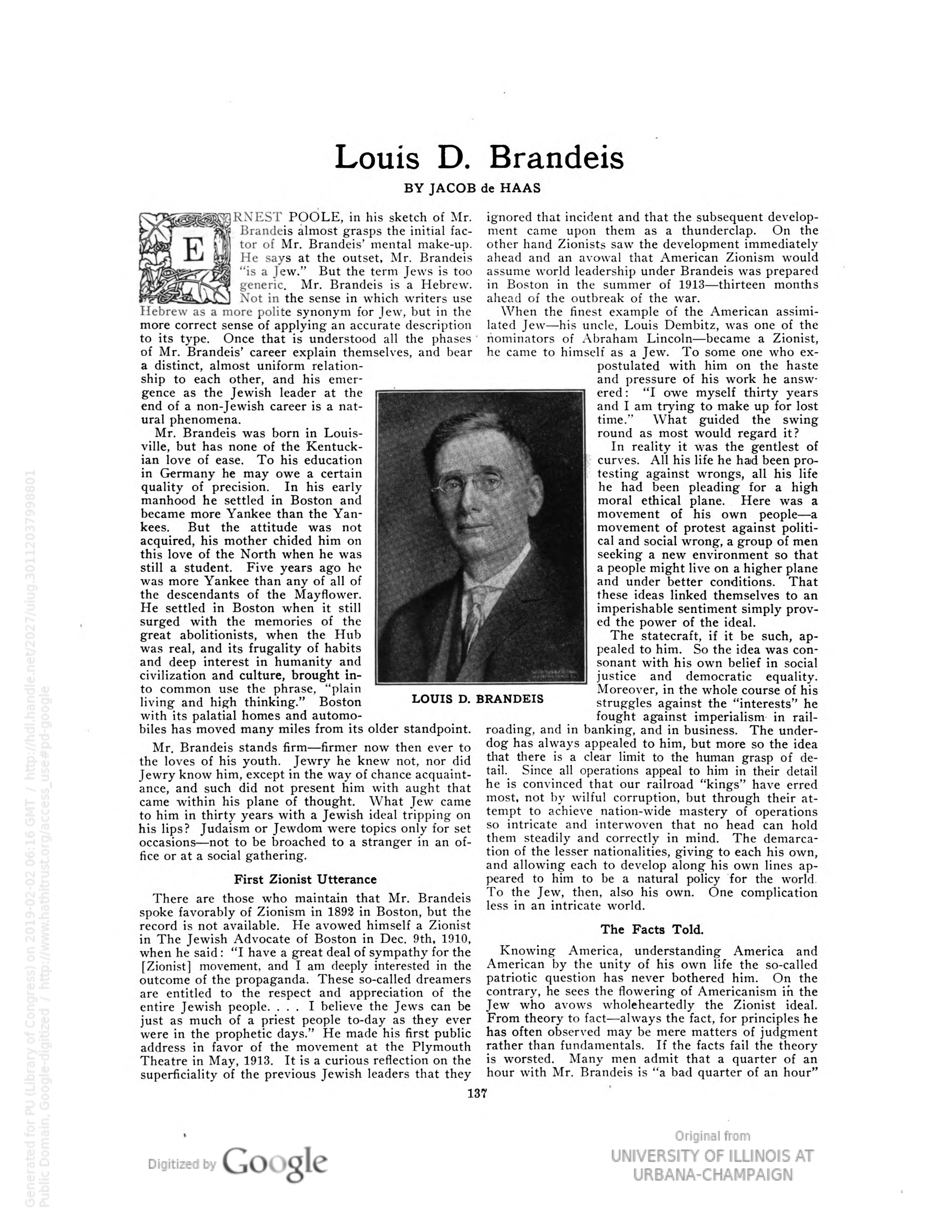
en TE a Mr. Brandeis was born in Louis- Bi ville, but has none of the Kentuck- ER ian love of ease. To his education SE in Germany he may owe a certain ne quality of precision. In his early x manhood he settled in Boston and became more Yankee than the Yan- } kees. But the attitude was not acquired, his mother chided him on this love of the North when he was still a student. Five years ago he was more Yankee than any of all of % the descendants of the Mayflower. He settled in Boston when it still j surged with the memories of the great abolitionists, when the Hub was real, and its frugality of habits and deep interest in humanity and civilization and culture, brought into common use the phrase, “plain living and high thinking.” Boston LOUIS D. with its palatial homes and automobiles has moved many miles from its older standpoint.
Mr. Brandeis stands firm—firmer now then ever to the loves of his youth. Jewry he knew not, nor did Jewry know him, except in the way of chance acquaintance, and such did not present him with aught that came within his plane of thought. What Jew came to him in thirty years with a Jewish ideal tripping on his lips? Judaism or Jewdom were topics only for set occasions—not to be broached to a stranger in an office or ata social gathering.
First Zionist Utterance
There are those who maintain that Mr. Brandeis spoke favorably of Zionism in 1892 in Boston, but the record is not available. He avowed himself a Zionist in The Jewish Advocate of Boston in Dec. 9th, 1910, when he said: “I have a great deal of sympathy for the [Zionist] movement, and I am deeply interested in the outcome of the propaganda. These so-called dreamers are entitled to the respect and appreciation of the entire Jewish people. ... I believe the Jews can be just as much of a priest people to-day as they ever were in the prophetic days.” He made his first public address in favor of the movement at the Plymouth Theatre in May, 1913. It is a curious reflection on the superficiality of the previous Jewish leaders that they
ignored that incident and that the subsequent development came upon them as a thunderclap. On the other hand Zionists saw the development immediately ahead and an avowal that American Zionism would assume world leadership under Brandeis was prepared in Boston in the summer of 1913—thirteen months ahead of the outbreak of the war.
When the finest example of the American assimilated Jew—his uncle, Louis Dembitz, was one of the nominators of Abraham Lincoln—became a Zionist, he came to himself as a Jew. To some one who expostulated with him on the haste and pressure of his work he answered: "I owe myself thirty years and I am trying to make up for lost time." What guided the swing round as most would regard it?
In reality it was the gentlest of curves. All his life he had been protesting against wrongs, all his life he had been pleading for a high moral ethical plane. Here was a movement of his own people—a movement of protest against political and social wrong, a group of men seeking a new environment so that a people might live on a higher plane and under better conditions. That these ideas linked themselves to an imperishable sentiment simply proved the power of the ideal.
The statecraft, if it be such, appealed to him. So the idea was consonant with his own belief in social justice and democratic equality. Moreover, in the whole course of his struggles against the "interests" he fought against imperialism in rail- roading, and in banking, and in business. The under- dog has always appealed to him, but more so the idea that there is a clear limit to the human grasp of detail. Since all operations appeal to him in their detail he is convinced that our railroad "kings" have erred not through willful corruption, but through their attempt to achieve nation-wide mastery of operations so intricate and interwoven that no head can hold them steadily and correctly in mind. The demarcation of the lesser nationalities, giving to each his own, and allowing each to develop along his own lines appeared to him to be a natural policy for the world. To the Jew, then, also his own. One complication less in an intricate world.
The Facts Told.
Knowing America, understanding America and American by the unity of his own life the so-called patriotic question has never bothered him. On the contrary, he sees the flowering of Americanism in the Jew who avows wholeheartedly the Zionist ideal. From theory to fact—always the fact, for principles he has often observed may be mere matters of judgment rather than fundamentals. If the facts fail the theory is worsted. Many men admit that a quarter of an hour with Mr. Brandeis is "a bad quarter of an hour"