After the War
HE European war has revolutionized the life and thought of the nations. Pacifists and militarists have taken the places formerly occupied by liberals and conservatives, by social reformers and "Stand-patters." Preparedness is now the issue upon which people divide. Yet I venture to say that there is one kind of preparedness upon which all can agree—preparedness for "after the war."
Particularly, we Jews must now prepare for constructive work in the land of our ancestors. Perhaps more than any other people, we have suffered from the outrages of the world catastrophe, in which we are altogether blameless. We will have much to rebuild. And as every people will strive to rehabilitate and beautify its
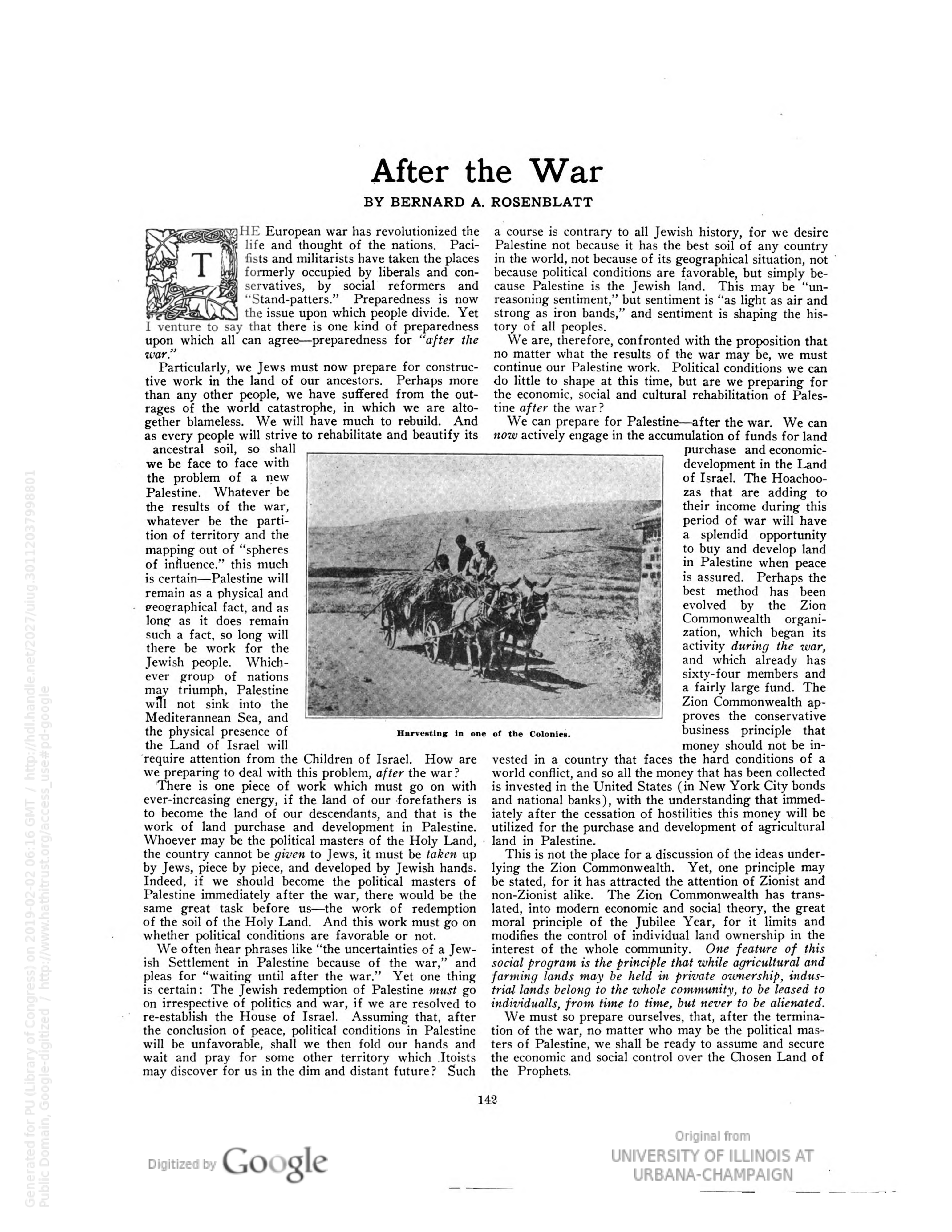
ancestral soil, so sha we be face to face with the problem of a new Palestine. Whatever be the results of the war, whatever be the partition of territory and the mapping out of “spheres of influence.” this much is certain—Palestine will remain as a physical and geographical fact, and as long as it does remain such a fact, so long will there be work for the Jewish people. Whichever group of nations may triumph, Palestine will not sink into the Mediterannean Sea, and the physical presence of the Land of Israel will require attention from tl we nrenarine to deal witt
ee et ae - a A ra ee re ee eh Be Den on 2 tern There is one piece of work which must go on with ever-increasing energy, if the land of our forefathers is to become the land of our descendants, and that is the work of land purchase and development in Palestine. Whoever may be the political masters of the Holy Land, the country cannot be given to Jews, it must be taken up by Jews, piece by piece, and developed by Jewish hands. Indeed, if we should become the political masters of Palestine immediately after the war, there would be the same great task before us—the work of redemption of the soil of the Holy Land. And this work must go on whether political conditions are favorable or not.
We often hear phrases like "the uncertainties of a Jewish Settlement in Palestine because of the war," and pleas for "waiting until after the war." Yet one thing is certain: The Jewish redemption of Palestine must go on irrespective of politics and war, if we are resolved to re-establish the House of Israel. Assuming that, after the conclusion of peace, political conditions in Palestine will be unfavorable, shall we then fold our hands and wait and pray for some other territory which Itoists may discover for us in the dim and distant future? Such
a course is contrary to all Jewish history, for we desire Palestine not because it has the best soil of any country in the world, not because of its geographical situation, not ' because political conditions are favorable, but simply because Palestine is the Jewish land. This may be “unreasoning sentiment,” but sentiment is “as light as air and strong as iron bands,” and sentiment is shaping the history of all peoples.
We are, therefore, confronted with the proposition that no matter what the results of the war may be, we must continue our Palestine work. Political conditions we can do little to shape at this time, but are we preparing for the economic, social and cultural rehabilitation of Palestine after the war?
We can prepare for Palestine—after the war. We can now actively engage in the accumulation of funds for land
purchase and economic- development in the Land of Israel. The Hoachoozas that are adding to their income during this period of war will have a splendid opportunity to buy and develop land in Palestine when peace is assured. Perhaps the best method has been evolved by the Zion Commonwealth organization, which began its activity during the war, and which already has sixty-four members and a fairly large fund. The Zion Commonwealth approves the conservative business principle that monev should not be in-
vested in a country that faces the hard conditions of a world conflict, and so all the money that has been collected is invested in the United States (in New York City bonds and national banks), with the understanding that immediately after the cessation of hostilities this money will be utilized for the purchase and development of agricultural land in Palestine.
This is not the place for a discussion of the ideas underlying the Zion Commonwealth. Yet, one principle may be stated, for it has attracted the attention of Zionist and non-Zionist alike. The Zion Commonwealth has translated, into modern economic and social theory, the great moral principle of the Jubilee Year, for it limits and modifies the control of individual land ownership in the interest of the whole community. One feature of this social program is the principle that while agricultural and farming lands may be held in private ownership, industrial lands belong to the whole community, to be leased to individualls, from time to time, but never to be alienated.