Zionism, Religion and Americanism
THE charge that Zionism is irreligious and un-American is made principally by two groups of people and, strange as it may be found, neither religious Jews nor religious Christians, on the one hand, nor yet the Americans of an older order or the ealier stock ever imply, however remotely, that Zionism is either irreligious or un-American. That Zionism is irreligious, it is left in the main for religionless Jews to assert. That Zionism is un-American is an indictment drawn up principally by Americans of very recent transportation and themselves of dubious, if not infirm loyalty.
The claim that Zionism is irreligious almost justifies the sneer of Carlyle that Jews are void of a sense of humor. The truth is that Zionism is alleged to be irreligious chiefly, if not solely, because it does not fit into certain preconceptions of Liberalism,—preconceptions which are, or of right ought to have become, obsolete, and in truth would have become obsolete had it not been for the inflexibly conservative character of much of Jewish pseudo-Liberalism.
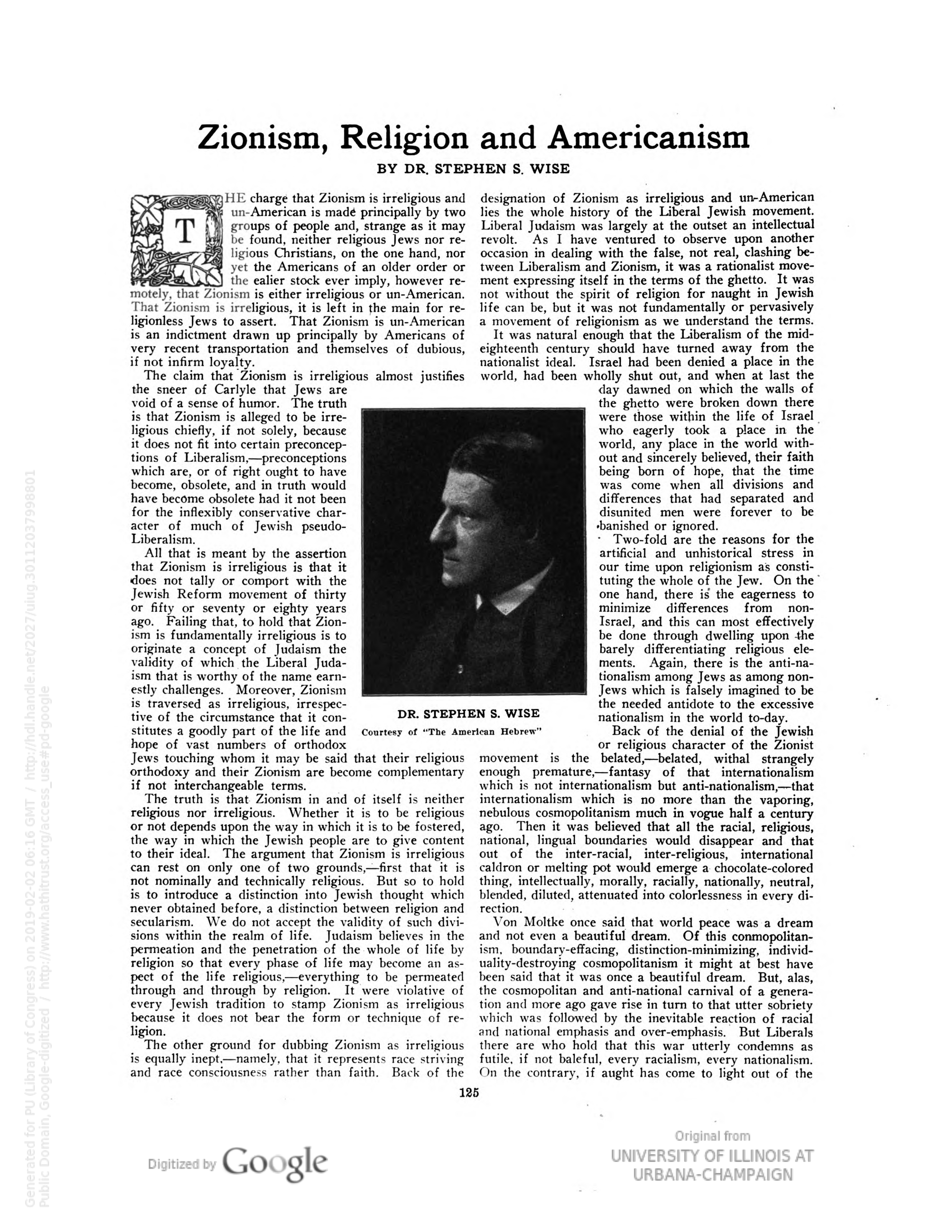
All that is meant by the assertion that Zionism is irreligious is that it does not tally or comport with the Jewish Reform movement of thirty or fifty or seventy or eighty years ago. Failing that, to hold that Zionism is fundamentally irreligious is to originate a concept of Judaism the validity of which the Liberal Judaism that is worthy of the name earnestly challenges. Moreover, Zionism is traversed as irreligious, irrespective of the circumstance that it con- DR. STEPH stitutes a goodly part of the life and Courtesy of “The Am hope of vast numbers of orthodox Jews touching whom it may be said that their religious orthodoxy and their Zionism are become complementary if not interchangeable terms.
u Be er - a re A ade, The truth is that Zionism in and of itself is neither religious nor irreligious. Whether it is to be religious or not depends upon the way in which it is to be fostered, the way in which the Jewish people are to give content to their ideal. The argument that Zionism is irreligious can rest on only one of two grounds,—first that it is not nominally and technically religious. But so to hold is to introduce a distinction into Jewish thought which never obtained before, a distinction between religion and secularism. We do not accept the validity of such divisions within the realm of life. Judaism believes in the permeation and the penetration of the whole of life by religion so that every phase of life may become an aspect of the life religious, —everything to be permeated through and through by religion. It were violative of every Jewish tradition to stamp Zionism as irreligious because it does not bear the form or technique of relieion.
The other ground for dubbing Zionism as irreligious is equally inept,—namely, that it represents race striving and race consciousness rather than faith. Back of the
designation of Zionism as irreligious and un-American lies the whole history of the Liberal Jewish movement. Liberal Judaism was largely at the outset an intellectual revolt. As I have ventured to observe upon another occasion in dealing with the false, not real, clashing between Liberalism and Zionism, it was a rationalist movement expressing itself in the terms of the ghetto. It was not without the spirit of religion for naught in Jewish life can be, but it was not fundamentally or pervasively a movement of religionism as we understand the terms.
It was natural enough that the Liberalism of the mid- eighteenth century should have turned away from the nationalist ideal. Israel had been denied a place in the world, had been wholly shut out, and when at last the day dawned on which the walls of the ghetto were broken down there were those within the life of Israel who eagerly took a place in the world, any place in the world without and sincerely believed, their faith being born of hope, that the time was come when all divisions and differences that had separated and disunited men were forever to be -banished or ienored.
u er ee - a Fa an * Twofold are the reasons for the artificial and unhistorical stress in our time upon religionism as constituting the whole of the Jew. On the one hand, there is the eagerness to minimize differences from non-Israel, and this can most effectively be done through dwelling upon the barely differentiating religious elements. Again, there is the anti-nationalism among Jews as among non-Jews which is falsely imagined to be the needed antidote to the excessive nationalism in the world to-dav.
Back of the denial of the Jewish or religious character of the Zionist belated, —fantasy of that internationalism nationalism but anti-nationalism,—that ich is no more than the vaporing, tanism much in vogue half a century believed that all the racial, religious, boundaries would disappear and that racial, inter-religious, international pot would emerge a chocolate-colored morally, racially, nationally, neutral, enuated into colorlessness in every di-
Von Moltke once said that world peace was a dream and not even a beautiful dream. Of this conmopolitanism, boundary-effacing, distinction-minimizing, individuality-destroying cosmopolitanism it might at best have been said that it was once a beautiful dream. But, alas, the cosmopolitan and anti-national carnival of a generation and more ago gave rise in turn to that utter sobriety which was followed by the inevitable reaction of racial and national emphasis and over-emphasis. But Liberals there are who hold that this war utterly condemns as futile, if not baleful, every racialism, every nationalism. On the contrarv. if aueht has come to Jieht out of the