Herzl, The Brilliant Jewish Leader
“GREAT men, taken up in any way, are profitable company,” says Carlyle, and Jewry had profitable company in Theodor Herzl, the twelfth anniversary of whose death was accepted as a world-wide day of recollection and mourning. And this acclaim from high and low, from men scattered throughout the world who knew no more of him than that he lived, and worked, and expressed to them something as tangible as life itself, renders unnecessary any new attest as to the worthiness of his life, the nobility of his aims, or a record of his high achievements.
gie Er a nn A nn A ee an To one who, as did the writer, knew him intimately, healthy and sick, virile and weak, cool and passionate, dreaming and acting, on the platform and in the domestic circle, talking to “schnorrers,” and conferring with potentates, time plays but the sorry part of dulling the memory in some detail. For I see him still, as you behold a cinema picture, in action; the wondrous lustre of his eyes still flashing its message of thanks for some little act, some detail carried out as he would have it done. And this Herzl, the hero of all the accumulating legends, was a man of endless developments, the incarnation of that adaptability and resource which has made Jewish life possible for two thousand vears.
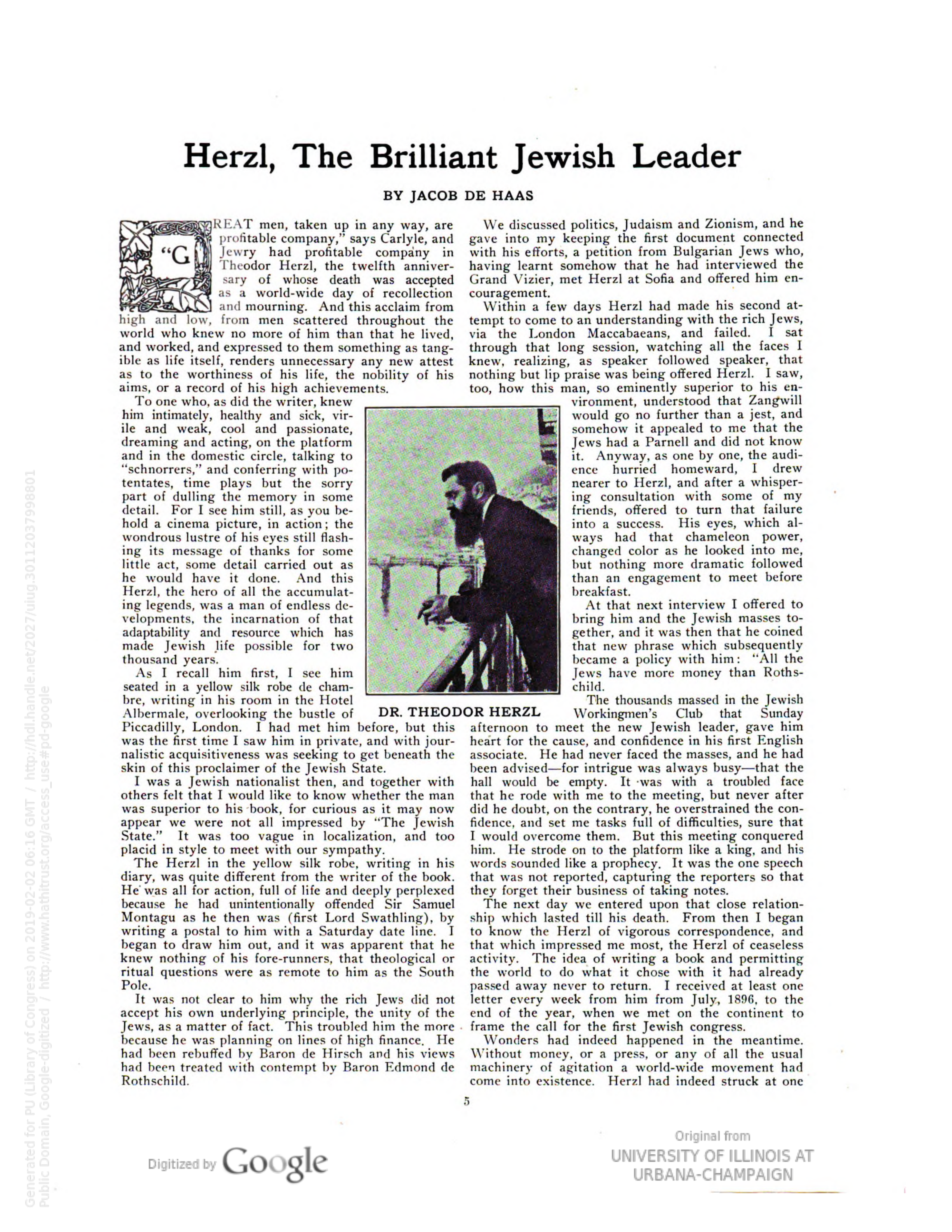
As I recall him first, I see him seated in a yellow silk robe de cham- bre, writing in his room in the Hotel Albermale, overlooking the bustle of Piccadilly, London. I had met him before, but this was the first time I saw him in private, and with journalistic acquisitiveness was seeking to get beneath the skin of this proclaimer of the Jewish State.
I was a Jewish nationalist then, and together with others felt that I would like to know whether the man was superior to his book, for curious as it may now appear we were not all impressed by "The Jewish State." It was too vague in localization, and too placid in style to meet with our sympathy.
At nn a he ni San din The Herzl in the yellow silk robe, writing in his diary, was quite different from the writer of the book. He’ was all for action, full of life and deeply perplexed because he had unintentionally offended Sir Samuel Montagu as he then was (first Lord Swathling), by writing a postal to him with a Saturday date line. I began to draw him out, and it was apparent that he knew nothing of his forerunners, that theological or ritual questions were as remote to him as the South Pole.
It was not clear to him why the rich Jews did not accept his own underlying principle, the unity of the Jews, as a matter of fact. This troubled him the more because he was planning on lines of high finance, He had been rebuffed by Baron de Hirsch and his views had been treated with contempt by Baron Edmond de Rathschild
We discussed politics, Judaism and Zionism, and he gave into my keeping the first document connected with his efforts, a petition from Bulgarian Jews who, having learnt somehow that he had interviewed the Grand Vizier, met Herzl at Sofia and offered him encouragement.
Within a few days Herzl had made his second attempt to come to an understanding with the rich Jews, via the London Maccabaeans, and failed. I sat through that long session, watching all the faces I knew, realizing, as speaker followed speaker, that nothing but lip praise was being offered Herzl. I saw, too, how this man, so eminently superior to his environment, understood that Zangwill would go no further than a jest, and somehow it appealed to me that the Jews had a Parnell and did not know it. Anyway, as one by one, I audience hurried homeward, I drew nearer to Herzl, and after a whispering consultation with some of my friends, offered to turn that failure into a success. His eyes, which always had that chameleon power, changed color as he looked into me, but nothing more dramatic followed than an engagement to meet before breakfast.
At that next interview I offered to bring him and the Jewish masses together, and it was then that he coined that new phrase which subsequently became a policy with him: "All the Jews have more money than Rothschild.
OR HERZL The thousands massed in the Jewish Workingmen's Club that Sunday afternoon to meet the new Jewish leader, gave him heart for the cause, and confidence in his first English associate. He had never faced the masses, and he had been advised for intrigue was always busy that the hall would be empty. It was with a troubled face that he rode with me to the meeting, but never after did he doubt, on the contrary, he overstrained the confidence, and set me tasks full of difficulties, sure that I would overcome them. But this meeting conquered him. He strode on to the platform like a king, and his words sounded like a prophecy. It was the one speech that was not reported, capturing the reporters so that they forget their business of taking notes.
u ae 1a Mn Da ur A et ee az m ee er — le ee na The next day we entered upon that close relationship which lasted till his death. From then I began to know the Herzl of vigorous correspondence, and that which impressed me most, the Herzl of ceaseless activity. The idea of writing a book and permitting the world to do what it chose with it had already passed away never to return. I] received at least one letter every week from him from July, 1896, to the end of the year, when we met on the continent to frame the call for the first Tewish conpress.
Wonders had indeed happened in the meantime. Without money, or a press, or any of all the usual machinery of agitation a world-wide movement had come into existence. Herzl had indeed struck at one