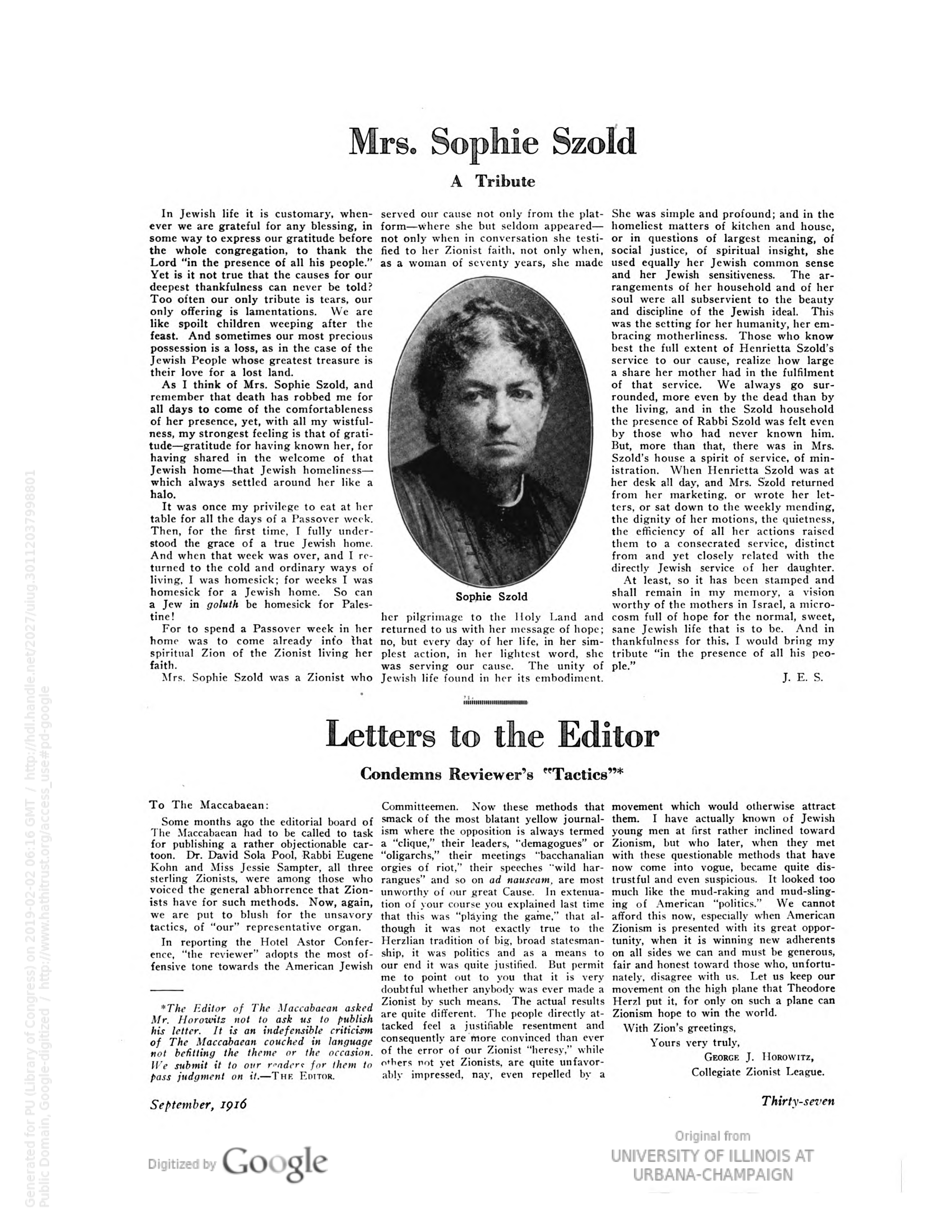
Mrs. Sophie Szold
A Tribute
In Jewish life it is customary, whenever we are grateful for any blessing, in some way to express our gratitude before the whole congregation, to thank the Lord "in the presence of all his people." Yet is it not true that the causes for our deepest thankfulness can never be told? Too often our only tribute is tears, our only offering is lamentations. We are like spoilt children weeping after the feast. And sometimes our most precious possession is a loss, as in the case of the Jewish People whose greatest treasure is their love for a lost land.
As I think of Mrs. Sophie Szold, and remember that death has robbed me for all days to come of the comfortableness of her presence, yet, with all my wistfulness, my strongest feeling is that of gratitude—gratitude for having known her, for having shared in the welcome of that Jewish home—that Jewish homeliness— which always settled around her like a halo.
It was once my privilege to eat at her table for allthe days of a Passover weck. Then, for the first time, I fully understood the grace of a true Jewish home. And when that week was over, and I rc- turned to the cold and ordinary ways of living, I was homesick; for weeks I was homesick for a Jewish home. So can a Jew in goluth be homesick for Palestine!
For to spend a Passover week in her home was to come already into that spiritual Zion of the Zionist living her faith.
Mrs. Sophie Szold was a Zionist who
served our cause not only from the platform—where she but seldom appeared—not only when in conversation she testified to her Zionist faith, not only when, as a woman of seventy years, she made
her pilgrimage to the Holy Land and returned to us with her message of hope; no, but every day of her life, in her simplest action, in her lightest word, she was serving our cause. The unity of Jewish life found in her its embodiment.
She was simple and profound; and in the homeliest matters of kitchen and house, or in questions of largest meaning, of social justice, of spiritual insight, she used equally her Jewish common sense and her Jewish sensitiveness. The arrangements of her household and of her soul were all subservient to the beauty and discipline of the Jewish ideal. This was the setting for her humanity, her embracing motherliness. Those who know best the full extent of Henrietta Szold’s service to our cause, realize how large a share her mother had in the fulfilment of that service. We always go surrounded, more even by the dead than by the living, and in the Szold household the presence of Rabbi Szold was felt even by those who had never known him. But, more than that, there was in Mrs. Szold’s house a spirit of service, of ministration. When Henrietta Szold was at her desk all day, and Mrs. Szold returned from her marketing, or wrote her letters, or sat down to the weekly mending, the dignity of her motions, the quietness, the efficiency of all her actions raiscd them to a consecrated service, distinct from and yet closely related with the directlv Tewish service of her dauprhter.
At least, so it has been stamped and shall remain in my memory, a vision worthy of the mothers in Israel, a microcosm full of hope for the normal, sweet, sane Jewish life that is to be. And in thankfulness for this, I would bring my tribute "in the presence of all his people."
Letters to the Editor
Condemns Reviewer's "Tactics"*
Some months ago the editorial board of The Maccabaean had to be called to task for publishing a rather objectionable cartoon. Dr. David Sola Pool, Rabbi Eugene Kohn and Miss Jessie Sampter, all three sterling Zionists, were among those who voiced the general abhorrence that Zionists have for such methods. Now, again, we are put to blush for the unsavory tactics, of “our” representative organ.
In reporting the Hotel Astor Conference, "the reviewer" adopts the most offensive tone towards the American Jewish
Committeemen. Now these methods that smack of the most blatant yellow journalism where the opposition is always termed a “clique,” their leaders, “demagogues” or “oligarchs,” their meetings "bacchanalian orgies of riot,” their speeches "wild har- rangues” and so on ad nauseam, are most unworthy of our great Cause. In extenuation of your course you explained last time that this was “pläying the game,” that although it was not exactly true to the Herzlian tradition of big, broad statesmanship, it was politics and as a means to our end it was quite justified. But permit me to point out to you that it is very doubtful whether anybody was ever made a Zionist by such means. The actual results are quite different. The people directly attacked feel a justifiable resentment and consequently are more convinced than ever of the error of our Zionist “heresy,” while others not yet Zionists, are quite unfavor- ablv impressed. nav. even repelled bv a
movement which would otherwise attract them. I have actually known of Jewish young men at first rather inclined toward Zionism, but who later, when they met with these questionable methods that have now come into vogue, became quite distrustful and even suspicious. It looked too much like the mud-raking and mud-slinging of American “politics.” We cannot afford this now, especially when American Zionism is presented with its great opportunity, when it is winning new adherents on all sides we can and must be generous, fair and honest toward those who, unfortunately, disagree with us. Let us keep our movement on the high plane that Theodore Herzl put it, for only on such a plane can Zionism hope to win the world.
With Zion's greetings,
Yours very truly,
GEORGE J. HOROWITZ, Collegiate Zionist League.