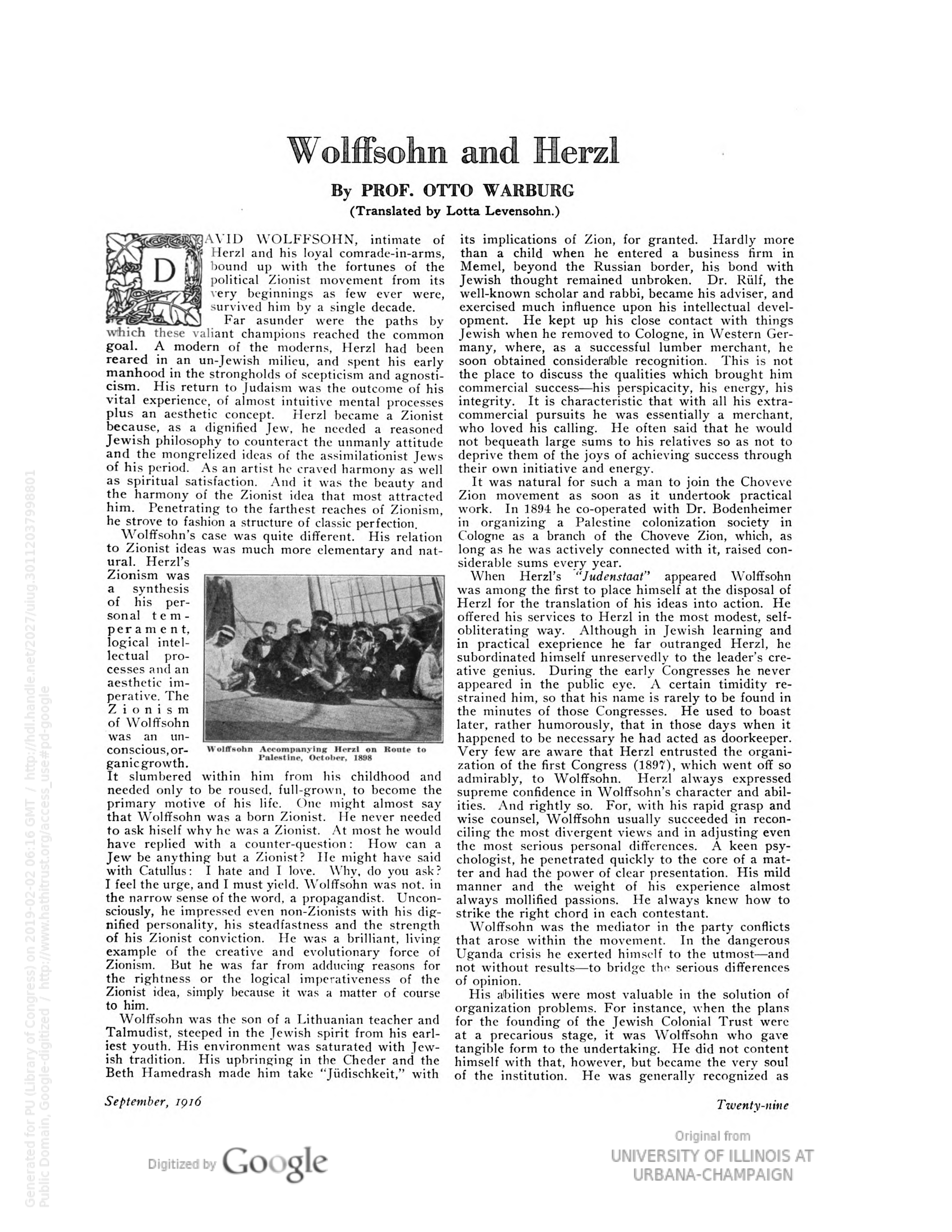
Wolffsohn and Herzl By PROF. OTTO WARBURG (Translated by Lotta Levensohn.) DAVID WOLFFSOHN, intimate of Herzl and his loyal comrade-in-arms, bound up with the fortunes of the political Zionist movement from its very beginnings as few ever were, survived him by a single decade. Far asunder were the paths by which these valiant champions reached the common goal. A modern of the moderns, Herzl had been reared in an un-Jewish milieu, and spent his early manhood in the strongholds of scepticism and agnosticism. His return to Judaism was the outcome of his vital experience, of almost intuitive mental processes plus an aesthetic concept. Herzl became a Zionist because, as a dignified Jew, he needed a reasoned Jewish philosophy to counteract the unmanly attitude and the mongrelized ideas of the assimilationist Jews of his period. As an artist he craved harmony as well as spiritual satisfaction. And it was the beauty and the harmony of the Zionist idea that most attracted him. Penetrating to the farthest reaches of Zionism, he strove to fashion a structure of classic perfection. Wolffsohn’s case was quite different. His relation to Zionist ideas was much more elementary and natural. Herzl’s Zionism was a synthesis of his personal temperament, logical intellectual processes and an aesthetic imperative. The Zionism of Wolffsohn was an unconscious, organic growth. Wolffsohn Accompanying Herzl on Route to Palestine, October, 1898 It slumbered within him from his childhood and needed only to be roused, full-grown, to become the primary motive of his life. One might almost say that Wolffsohn was a born Zionist. He never needed to ask hiself why he was a Zionist. At most he would have replied with a counter-question: How can a Jew be anything but a Zionist? He might have said with Catullus: I hate and I love. Why, do you ask? I feel the urge, and I must yield. Wolffsohn was not. in the narrow sense of the word, a propagandist. Unconsciously, he impressed even non-Zionists with his dignified personality, his steadfastness and the strength of his Zionist conviction. He was a brilliant, living example of the creative and evolutionary force of Zionism. But he was far from adducing reasons for the rightness or the logical imperativeness of the Zionist idea, simply because it was a matter of course to him. Wolffsohn was the son of a Lithuanian teacher and Talmudist, steeped in the Jewish spirit from his earliest youth. His environment was saturated with Jewish tradition. His upbringing in the Cheder and the Beth Hamedrash made him take “Jüdischkeit,” with its implications of Zion, for granted. Hardly more than a child when he entered a business firm in Memel, beyond the Russian border, his bond with Jewish thought remained unbroken. Dr. Rülf, the well-known scholar and rabbi, became his adviser, and exercised much influence upon his intellectual development. He kept up his close contact with things Jewish when he removed to Cologne, in Western Germany, where, as a successful lumber merchant, he soon obtained considerable recognition. This is not the place to discuss the qualities which brought him commercial success—his perspicacity, his energy, his integrity. It is characteristic that with all his extra-commercial pursuits he was essentially a merchant, who loved his calling. He often said that he would not bequeath large sums to his relatives so as not to deprive them of the joys of achieving success through their own initiative and energy. It was natural for such a man to join the Choveve Zion movement as soon as it undertook practical work. In 1894 he co-operated with Dr. Bodenheimer in organizing a Palestine colonization society in Cologne as a branch of the Choveve Zion, which, as long as he was actively connected with it, raised considerable sums every year. When Herzl’s “Judenstaat” appeared Wolffsohn was among the first to place himself at the disposal of Herzl for the translation of his ideas into action. He offered his services to Herzl in the most modest, self-obliterating way. Although in Jewish learning and in practical exeprience he far outranged Herzl, he subordinated himself unreservedly to the leader’s creative genius. During the early Congresses he never appeared in the public eye. A certain timidity restrained him, so that his name is rarely to be found in the minutes of those Congresses. He used to boast later, rather humorously, that in those days when it happened to be necessary he had acted as doorkeeper. Very few are aware that Herzl entrusted the organization of the first Congress (1897), which went off so admirably, to Wolffsohn. Herzl always expressed supreme confidence in Wolffsohn’s character and abilities. And rightly so. For, with his rapid grasp and wise counsel, Wolffsohn usually succeeded in reconciling the most divergent views and in adjusting even the most serious personal differences. A keen psychologist, he penetrated quickly to the core of a matter and had the power of clear presentation. His mild manner and the weight of his experience almost always mollified passions. He always knew how to strike the right chord in each contestant. Wolffsohn was the mediator in the party conflicts that arose within the movement. In the dangerous Uganda crisis he exerted himself to the utmost—and not without results—to bridge the serious differences of opinion. His abilities were most valuable in the solution of organization problems. For instance, when the plans for the founding of the Jewish Colonial Trust were at a precarious stage, it was Wolffsohn who gave tangible form to the undertaking. He did not content himself with that, however, but became the very soul of the institution. He was generally recognized as September, 1916 Twenty-nine