A Tribute to David Wolffsohn
HE was the most efficient of us all. Owing to his immense intelligence he grasped at once the substance of everything that was put before him. Apart from that he was exceedingly kind-hearted. His natural goodness gave him no rest whenever he heard of the suffering of others. And he was brave. He gave himself wholly to the Jewish people, and never spared himself.
When, in Scheveningen, in the summer of 1904. he learned of the death of Herzl he utterly broke down. He came to me and wept like a child. He could not be pacihied. He wept over his dear friend and over the great man the Jewish people had lost. A few days later, when we entered the house of the great deceased,
his strength failed him. He found it physically impossible to go up the stairs of the house where he lived through so many great and noble moments. At that moment he changed. What followed I might call “the ten years of sufferings of David Wolffsohn.” He was never again as happy as in the time of Herzl. Indeed not from ambition, rather as a duty deposed on him, he took over Herzl’s heritage.
Our old defects were again revealed. We were no longer united. Zangwill, the great writer, left the Zionist movement, and in his own camp Wolffsohn did not find the support to which his efficiency and his whole-hearted
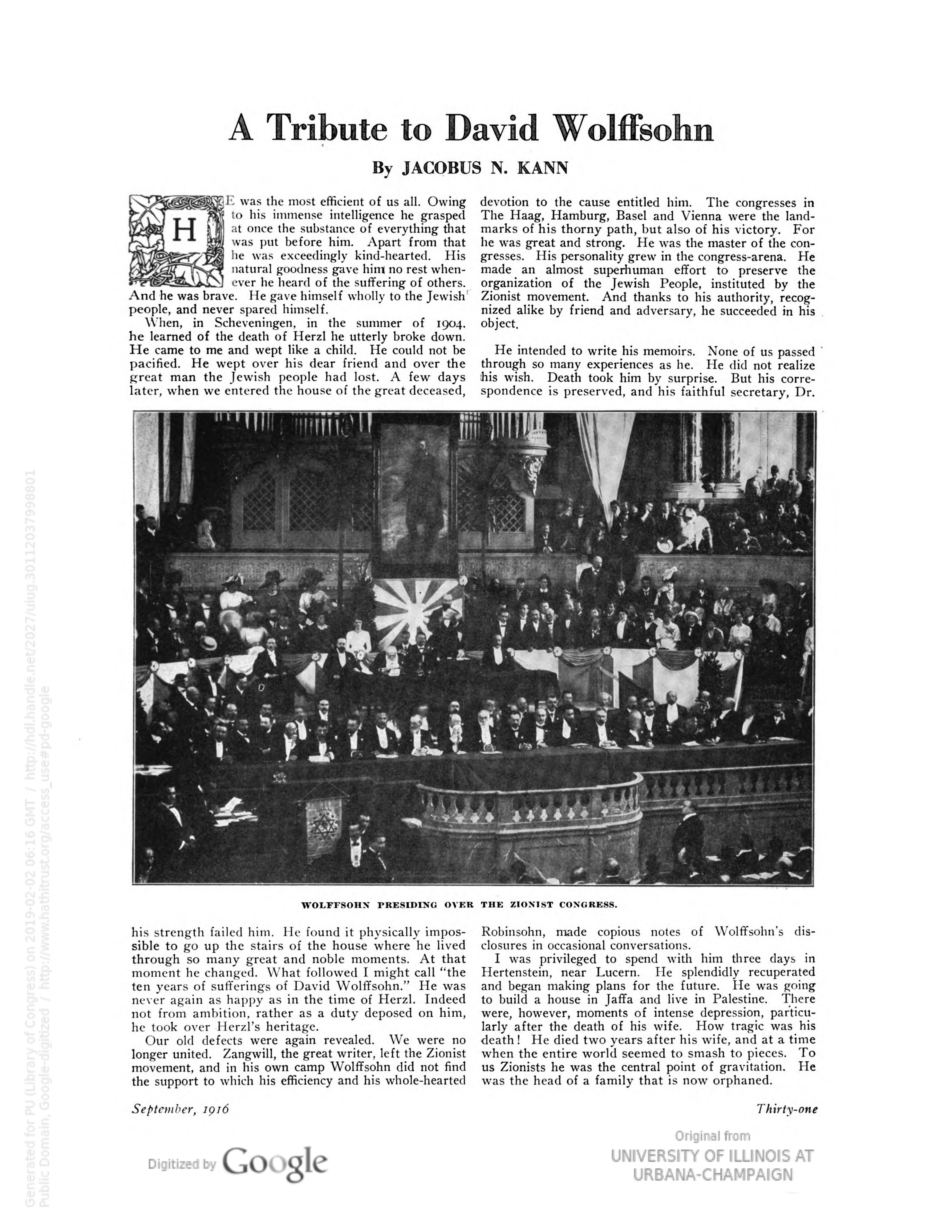
devotion to the cause entitled him. The congresses in The Haag, Hamburg, Basel and Vienna were the landmarks of his thorny path, but also of his victory. For he was great and strong. He was the master of the congresses. His personality grew in the congress-arena. He made an almost superhuman effort to preserve the organization of the Jewish People, instituted by the Zionist movement. And thanks to his authority, recognized alike by friend and adversary, he succeeded in his object.
He intended to write his memoirs. None of us passed through so many experiences as he. He did not realize this wish. Death took him by surprise. But his correspondence is preserved, and his faithful secretary, Dr.
Robinsohn, made copious notes of Wolffsohn’s disclosures in oecasional conversations.
I was privileged to spend with him three days in Hertenstein, near Lucern. He splendidly recuperated and began making plans for the future. He was going to build a house in Jaffa and live in Palestine. There were, however, moments of intense depression, particularly after the death of his wife. How tragic was his death! He died two years after his wife, and at a time when the entire world seemed to smash to pieces. To us Zionists he was the central point of gravitation. He was the head of a family that is now orphaned.