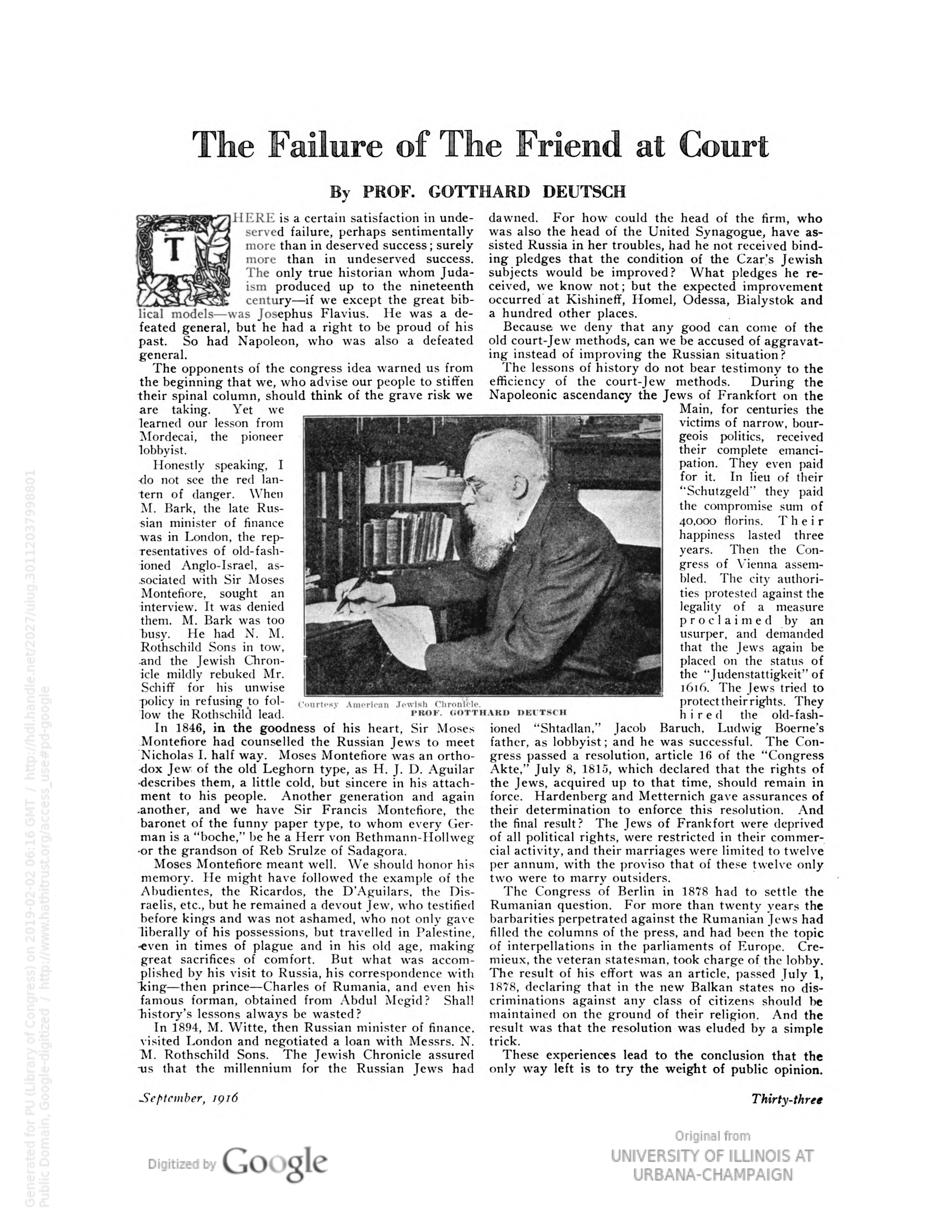
The Failure of The Friend at Court
THERE is a certain satisfaction in undeserved failure, perhaps sentimentally more than in deserved success; surely more than in undeserved success. The only true historian whom Judaism produced up to the nineteenth century—if we except the great biblical models—was Josephus Flavius. He was a defeated general, but he had a right to be proud of his past. So had Napoleon, who was also a defeated general.
The opponents of the congress idea warned us from the beginning that we, who advise our people to stiffen their spinal column, should think of the grave risk we are taking. Yet we learned our lesson from Mordecai, the pioneer lobbyist.
Honestly speaking, I «do not see the red lantern of danger. \Vhen M. Bark, the late Russian minister of finance was in London, the representatives of old-fashioned Anglo-Israel, as- ‚sociated with Sir Moses Montefiore, sought an interview. It was denied them. M. Bark was too busy. He had N. M. Rothschild Sons in tow, and the Jewish Chronicle mildiy rebuked Mr. Schiff for his unwise policy in refusing to follow the Rothschild lead.
In 1846, in the goodness of his heart, Sir Moses Montefiore had counselled the Russian Jews to meet Nicholas I. half way. Moses Montefiore was an orthodox Jew of the old Leghorn type, as H. J. D. Aguilar describes them, a little cold, but sincere in his attachment to his people. Another generation and again another, and we have Sir Francis Montefiore, the baronet of the funny paper type, to whom every German is a "boche," be he a Herr von Bethmann-Hollwegor the grandson of Reb Srulze of Sadagora.
u er SE N ea Fe hand er nn De DE ee et = Fr ae Moses Montefiore meant well. We should honor his memory. He might have followed the example of the Abudientes, the Ricardos, the D’Aguilars, the Dis- raelis, etc., but he remained a devout Jew, who testified before kings and was not ashamed, who not only gave liberally of his possessions, but travelled in Palestine, ven in times of plague and in his old age, making great sacrifices of comfort. But what was accomplished by his visit to Russia, his correspondence with king—then prince— Charles of Rumania, and even his famous forman, obtained from Abdul Megid? Shall history’s lessons always be wasted?
In 1894, M. Witte, then Russian minister of finance, visited London and negotiated a loan with Messrs. N. M. Rothschild Sons. The Jewish Chronicle assured us that the millennium for the Russian Jews had
dawned. For how could the head of the firm, who was also the head of the United Synagogue, have assisted Russia in her troubles, had he not received binding pledges that the condition of the Czar's Jewish subjects would be improved? What pledges he received, we know not; but the expected improvement occurred at Kishineff, Homel, Odessa, Bialystok and a hundred other places.
Because we deny that any good can come of the old court-Jew methods, can we be accused of aggravating instead of improving the Russian situation?
The lessons of history do not bear testimony to the efficiency of the court-Jew methods. During the Napoleonic ascendancy the Jews of Frankfort on the
Main, for centuries the victims of narrow, bourgeois politics, received their complete emancipation. They even paid for it. In lieu of their “Schutzgeld” they paid the compromise sum of 40,000 florins. Their happiness lasted three years. Then the Congress of Vienna assembled. The city authorities protested against the legality of a measure proclaimed by an usurper, and demanded that the Jews again be placed on the status of the “ Judenstattigkeit’’ of 1616. The Jews tried to protecttheirrights. They hired the old-fash-
ioned “Shtadlan,” Jacob Baruch, Ludwig Boerne’s father, as lobbyist; and he was successful. The Congress passed a resolution, article 16 of the “Congress Akte,” July 8, 1815, which declared that the rights of the Jews, acquired up to that time, should remain in force. Hardenberg and Metternich gave assurances of their determination to enforce this resolution. And the final result? The Jews of Frankfort were deprived of all political rights, were restricted in their commercial activity, and their marriages were limited to twelve per annum, with the proviso that of these twelve only two were to marrv outsiders.
The Congress of Berlin in 1878 had to settle the Rumanian question. For more than twenty years the barbarities perpetrated against the Rumanian Jews had filled the columns of the press, and had been the topic of interpellations in the parliaments of Europe. Cremieux, the veteran statesman, took charge of the lobby. The result of his effort was an article, passed July 1, 1878, declaring that in the new Balkan states no dis- eriminations against any class of citizens should be maintained on the ground of their religion. And the result was that the resolution was eluded by a simple trick.