Over the Grave of a Poet
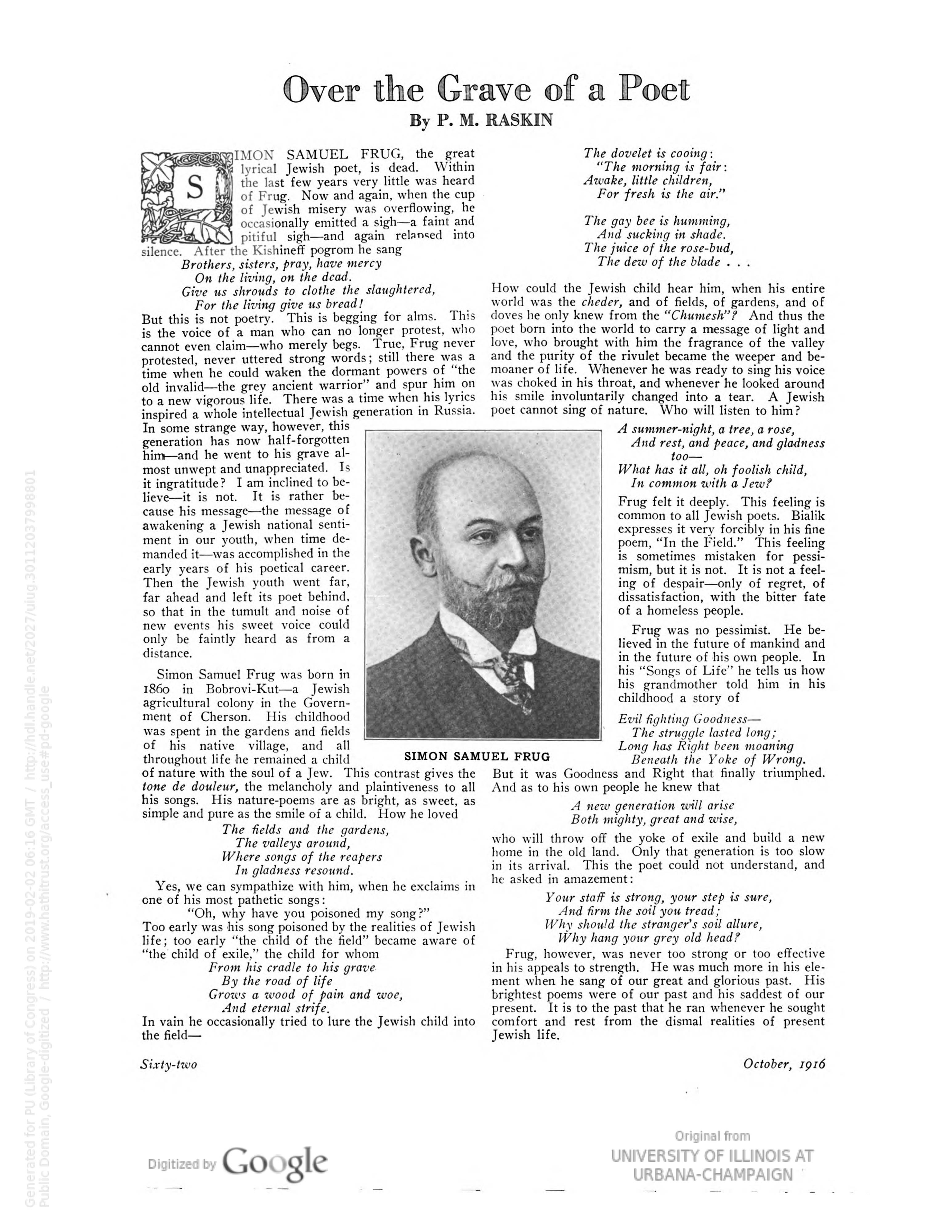
SIMON SAMUEL FRUG, the great lyrical Jewish poet, is dead. Within the last few years very little was heard of Frug. Now and again, when the cup of Jewish misery was overflowing, he occasionally emitted a sigh—a faint and pitiful sigh—and again relansed into silence. After the Kishineff pogrom he sang
Brothers, sisters, pray, have mercyOn the living, on the dead.Give us shrouds to clothe the slaughtered,For the living give us bread!
But this is not poetry. This is begging for alms. This is the voice of a man who can no longer protest, who cannot even claim—who merely begs. True, Frug never protested, never uttered strong words; still there was a time when he could waken the dormant powers of “the old invalid—the grey ancient warrior” and spur him on inspired vigorous life. There was a time when his lyrics to a new vigorous intellectual Jewish generation in Russia. In some strange way, however, this generation has now half-forgotten him—and he went unappreciated almost unwept and unappreciated. It is ingratitude? I am inclined to believe—it is not. It is rather because his message—the message of awakening a Jewish national sentiment in our youth, when time demanded it—was accomplished in the early years of his poetical career. Then the Jewish youth went far, far ahead and left its poet behind, so new events his sweet voice could only be faintly heard as from a distance.
Simon Samuel Frug was born in 1860 in Bobrovi-Kut —a Jewish agricultural colony in the Government of Cherson. His childhood was spent in the gardens and fields of his native village, and all throughout life he remained a child of nature with the soul of a Jew. This contrast gives the tone de douleur, the melancholy and plaintiveness to all his songs. His nature-poems are as bright, as sweet, as simple and pure as the smile of a child. How he loved
The fields and the gardens,The valleys around,Where songs of the reapersIn gladness resound.
Yes, we can sympathize with him, when he exclaims in one of his most pathetic songs: “Oh, why have you poisoned my song?” Too early was his song poisoned by the realities of Jewish life; too early “the child of the field” became aware of “the child of exile,” the child for whom From his cradle to his grave. By the road of life. Grows a wood of pain and woe,And eternal strife. In vain he occasionally tried to lure the Jewish child into the field—
The dovelet is cooing:“The morning is fair:Awake, little children,For fresh is the air.”
The gay bee is humming, And sucking in shade. The juice of the rose-bud, The dew of the blade . . .
How could the Jewish child hear him, when his entire world was the cheder, and of fields, of gardens, and of doves he only knew from the “Chumesh”? And thus the poet born into the world to carry a message of light and love, who brought with him the fragrance of the valley and the purity of the rivulet became the weeper and bemoaner of life. Whenever he was ready to sing his voice was choked in his throat, and whenever he looked around his smile involuntarily changed into a tear. A Jewish poet cannot sing of nature. Who will listen to him?
A summer-night, a tree, a rose,And rest, and peace, and gladnesstoo—What has it all, oh foolish child,In common with a Jew?
Frug felt it deeply. This feeling is common to all Jewish poets. Bialik expresses it very forcibly in his fine poem, “In the Field.” This feeling is sometimes mistaken for pessimism, but it is not. It is not a feeling of despair—only of regret, of dissatisfaction, with the bitter fate of a homeless people.
Frug was no pessimist. He believed in the future of mankind and in the future of his own people. In his “Songs of Life” he tells us how his grandmother told him in his childhood a story of
Evil fighting Goodness—The struggle lasted long;Long has Right been moaningBeneath the Yoke of Wrong.
But it was Goodness and Right that finally triumphed. And as to his own people he knew that
A new generation will arise Both mighty, great and wise,
who will throw off the yoke of exile and build a new home in the old land. Only that generation is too slow in its arrival. This the poet could not understand, and he asked in amazement:
Your staff is strong, your step is sure,And firm the soil you tread;Why should the stranger’s soil allure,Why hang your grey old head?
Frug, however, was never too strong or too effective in his appeals to strength. He was much more in his element when he sang of our great and glorious past. His brightest poems were of our past and his saddest of our present. It is to the past that he ran whenever he sought comfort and rest from the dismal realities of present Jewish life.