The Agricultural School In Palestine
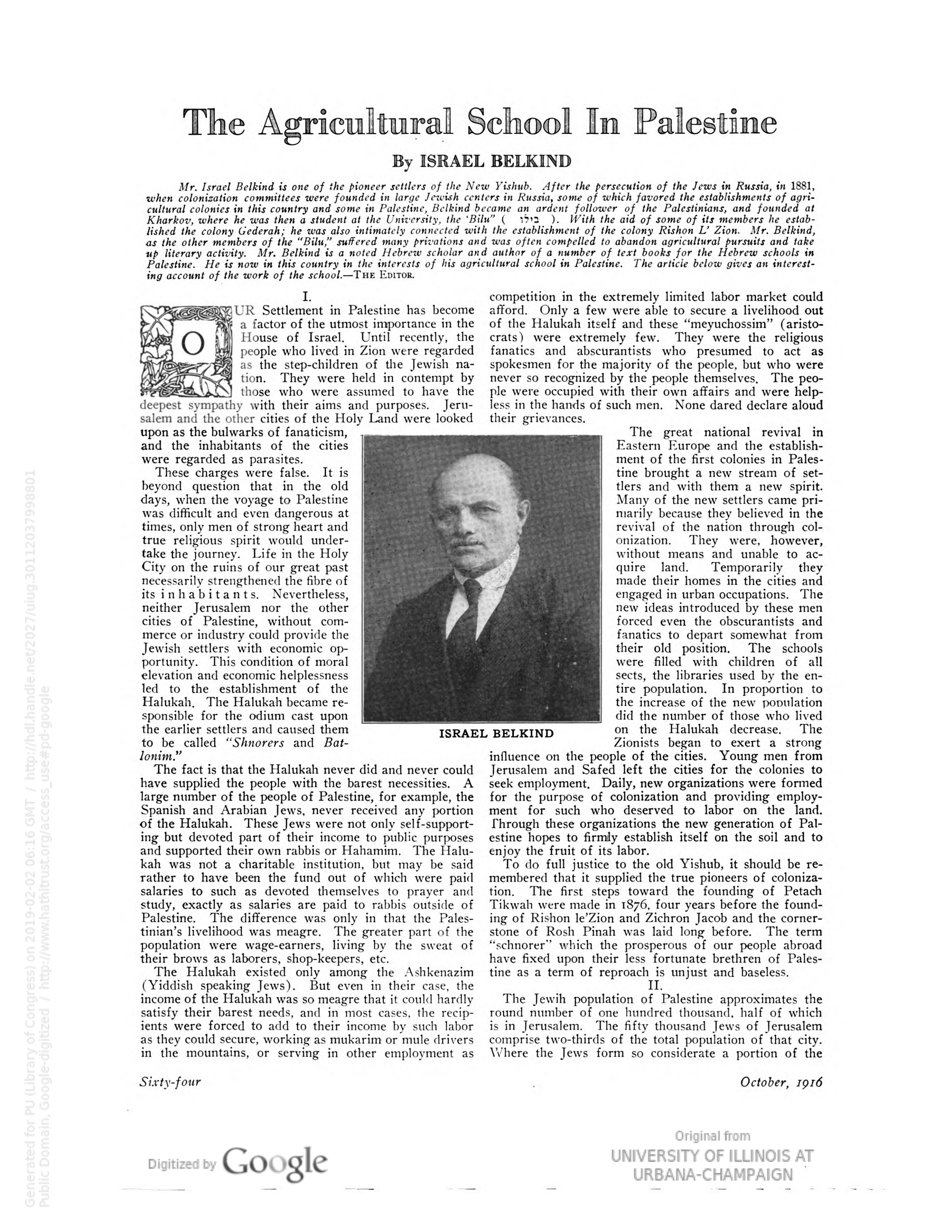
Mr. Israel Belkind is one of the pioneer settlers of the New Yishub. After the persecution of the Jews in Russia, in 1881, when colonization committees were founded in large Jewish centers in Russia, some of which favored the establishments of agricultural colonies in this country and some in Palestine, Belkind became an ardent follower of the Palestinians, and founded at Kharkov, where he was then a student at the University, the 'Bilu” ( 92 ). With the aid of some of its members he established the colony Gederah; he was also intimately connected with the establishment of the colony Rishon L’ Zion. Mr. Belkind, as the other members of the “Bilu,” suffered many privations and was often compelled to abandon agricultural pursuits and take up literary activity. Mr. Belkind is a noted Hebrew scholar and author of a number of text books for the Hebrew schools in Palestine. He is now in this country in the interests of his agricultural school in Palestine. The articie below gives an interesting account of the work of the school. —THE EDITor.
I. UR Settlement in Palestine has become a factor of the utmost importance in the House of Israel. Until recently, the people who lived in Zion were regarded as the step-children of the Jewish nation. They were held in contempt by those who were assumed to have the deepest sympathy with their aims and purposes. Jerusalem and the other cities of the Holy Land were looked upon as the bulwarks of fanaticism, and the inhabitants of the cities were regarded as parasites.
These charges were false. It is beyond question that in the old days, when the voyage to Palestine was difficult and even dangerous at times, only men of strong heart and true religious spirit would undertake the journey. Life in the Holy City on the ruins of our great past necessarily strengthened the fibre of its inhabitants. Nevertheless, neither Jerusalem nor the other cities of Palestine, without commerce or industry could provide the Jewish settlers with economic opportunity. This condition of moral elevation and economic helplessness led to the establishment of the Halukah. The Halukah became responsible for the odium cast upon the earlier settlers and caused them to be called “Shnorers and Batlonim.”
The fact is that the Halukah never did and never could have supplied the people with the barest necessities. A large number of the people of Palestine, for example, the Spanish and Arabian Jews, never received any portion of the Halukah. These Jews were not only self-support-ing but devoted part of their income to public purposes and supported their own rabbis or Hahamim. The Halukah was not a charitable institution, but may be said rather to have been the fund out of which were paid salaries to such as devoted themselves to prayer and study, exactly as salaries are paid to rabbis outside of Palestine. The difference was only in that the Pales-tinian's livelihood was meagre. The greater part of the population were wage-earners, living by the sweat of their brows as laborers, shopkeepers, etc.
The Halukah existed only among the Ashkenazim (Yiddish speaking Jews). But even in their case, the income of the Halukah was so meagre that it could hardly satisfy their barest needs, and in most cases, the recipients were forced to add to their income by such labor as they could secure, working as mukarim or mule drivers in the mountains, or serving in other employment as
competition in the extremely limited labor market could afford. Only a few were able to secure a livelihood out of the Halukah itself and these “meyuchossim” (aristocrats) were extremely few. They were the religious fanatics and abscurantists who presumed to act as spokesmen for the majority of the people, but who were never so recognized by the people themselves. The people were occupied with their own affairs and were helpless in the hands of such men. None dared declare aloud their erievances.
The great national revival in Eastern Europe and the establishment of the first colonies in Palestine brought a new stream of settlers and with them a new spirit. Many of the new settlers came primarily because they believed in the revival of the nation through colonization. They were, however, without means and unable to acquire land. Temporarily they made their homes in the cities and engaged in urban occupations. The new ideas introduced by these men forced even the obscurantists and fanatics to depart somewhat from their old position. The schools were filled with children of all sects, the libraries used by the entire population. In proportion to the increase of the new population did the number of those who lived on the Halukah decrease. The Zionists began to exert a strong influence on the people of the cities. Young men from Jerusalem and Safed left the cities for the colonies to seek employment. Daily, new organizations were formed for the purpose of colonization and providing employment for such who deserved to labor on the land. Through these organizations the new generation of Palestine hopes to firmly establish itself on the soil and to enjoy the fruit of its labor.
To do full justice to the old Yishub, it should be remembered that it supplied the true pioneers of colonization. The first steps toward the founding of Petach Tikwah were made in 1876, four years before the founding of Rishon le'Zion and Zichron Jacob and the cornerstone of Rosh Pinah was laid long before. The term "schnorer" which the prosperous of our people abroad have fixed upon their less fortunate brethren of Palestine as a term of reproach is unjust and baseless.
II.
The Jewish population of Palestine approximates the round number of one hundred thousand, half of which is in Jerusalem. The fifty thousand Jews of Jerusalem comprise two-thirds of the total population of that city. Where the Jews form so considerate a portion of the