Ahad Ha-Am—The Man and His Doctrines
THE nineteenth century will go down in history as one of the most significant centuries in the development of Judaism. Fresh from the ghettos, physical and cultural, in which they had been for years confined, the Jews, at the beginning of the nineteenth century, stood blinking in the dazzling light of culture into which they had been introduced by the efforts of men like Mendelssohn and the Russian Maskilim. They had stepped into the light out of sheer darkness, and remained, for a time, completely dazed. In some instances, they withdrew again into their shell and refused to have anything to do with the light. In other instances, they left their shell entirely, and threw themselves directly into the face of the light. Mediaval darkness or total assimilation—which was it to be?
This question, propounded by the eighteenth century, it was the task of the nineteenth to attempt, at least, to answer. And the Jew of the nineteenth century made, we can proudly assert, a valiant attempt to answer it. Samson Raphael Hirsch, the brilliant founder of the neo-orthodox school, Zacharias Frankel, the head of the newly-created conservative historical school, so-called, and Abraham Geiger, the inaugurator of the modern Jewish Reform movement—these three men, among many others, offered solutions of a widely divergent nature to the perlexing problem. But as the century advanced, it became evident that none of the three had framed an effectual answer. Hirsch, in his zeal, had allowed the religious aspect to overshadow all the other phases of Judaism—national, cultural, and social; Frankel's method was, at best, only a compromise; while Geiger and his followers sowed the seeds, innocently enough, it must be said in extenuation, of that contemporary Reform Judaism which is in large part reform and in small part Judaism. Judaism could be preserved only by asserting among the other nations of the world its own peculiar individuality as a national entity marked by lofty religious and moral development.
And this is what modern Zionism attempted to do. Taking root simultaneously in the minds of such radically opposite Jewish thinkers as the ultra-orthodox rabbi, Hirsch Kalischer of Thorn, the socialist Moses Hess, and the medical practitioner who had for many years been totally estranged from the rest of his co-religionists, Leo Pinsker, the idea of a central home for the dispersed Jews of the world soon struck out in all directions, particularly among the poorly- situated Jews of Eastern Europe. The “Lovers of Zion” attempted to put this idea into practical shape by the planting of numerous agricultural colonies in the Holy Land. Theodore Herzl and Max Nordau
looked forward hopefully toward the construction of a politically independent Jewish state. But all these pioneers in the field of Zionism had made one grave mistake—they had attempted to rejuvenate the body of Judaism while neglecting its soul.
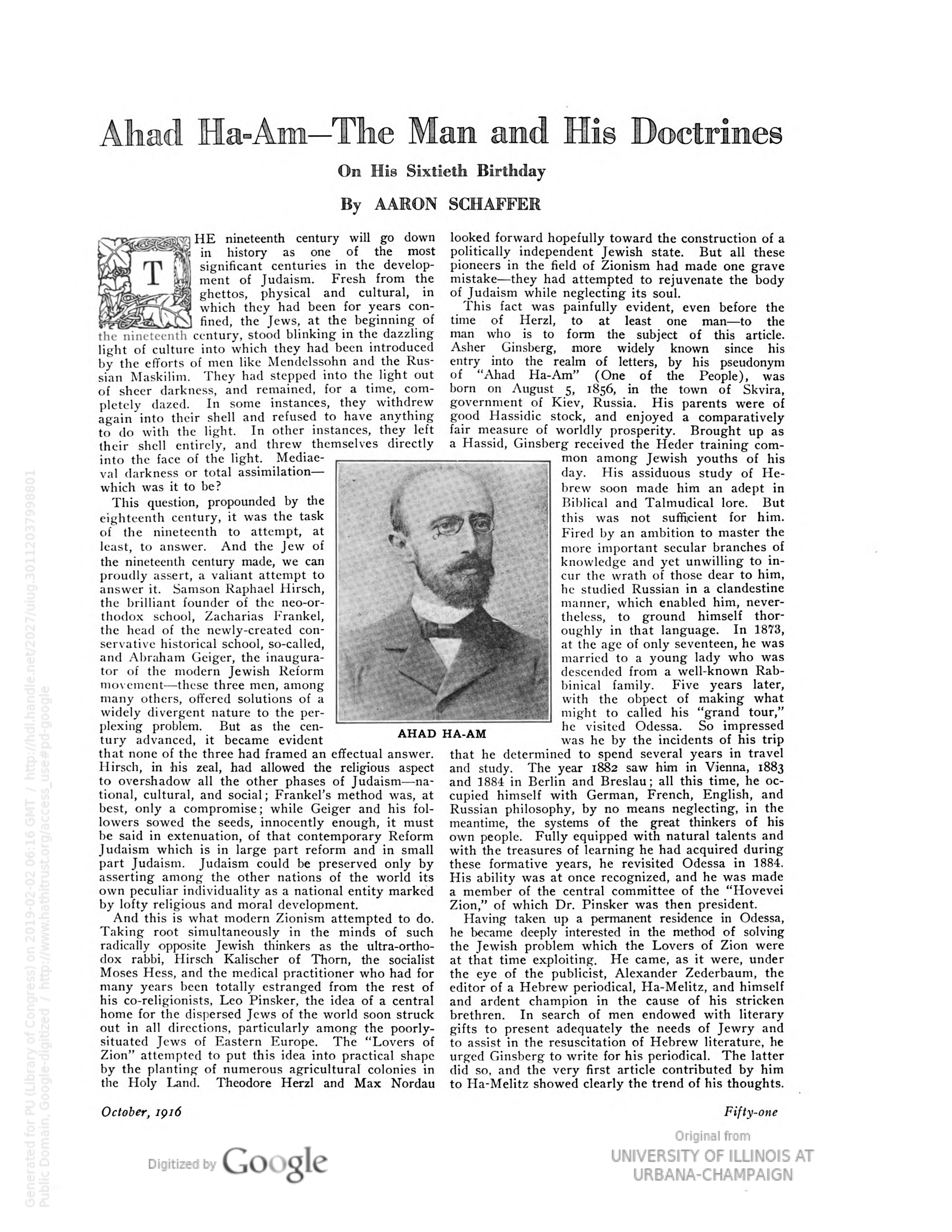
This fact was painfully evident, even before the ime of Herzl, to at least one man—to the nan who is to form the subject of this article. Asher Ginsberg, more widely known since his ntry into the realm of letters, by his pseudonym f “Ahad Ha-Am” (One of the People), was orn on August 5, 1856, in the town of Skvira, government of Kiev, Russia. His parents were of good Hassidic stock, and enjoyed a comparatively air measure of worldly prosperity. Brought up as Hassid, Ginsberg received the Heder training com-
mon among Jewish youths of his day. His assiduous study of Hebrew soon made him an adept in Biblical and Talmudical lore. But this was not sufficient for him. Fired by an ambition to master the more important secular branches of knowledge and yet unwilling to incur the wrath of those dear to him, he studied Russian in a clandestine manner, which enabled him, nevertheless, to ground himself thoroughly in that language. In 1873, at the age of only seventeen, he was married to a young lady who was descended from a well-known Rabbinical family. Five years later, with the object of making what might be called his "grand tour," he visited Odessa. So impressed was he by the incidents of his trip
that he determined to spend several years in travel and study. The year 1882 saw him in Vienna, 1883 and 1884 in Berlin and Breslau; all this time, he occupied himself with German, French, English, and Russian philosophy, by no means neglecting, in the meantime, the systems of the great thinkers of his own people. Fully equipped with natural talents and with the treasures of learning he had acquired during these formative years, he revisited Odessa in 1884. His ability was at once recognized, and he was made a member of the central committee of the "Hovevei Zion," of which Dr. Pinsker was then president.
Having taken up a permanent residence in Odessa, he became deeply interested in the method of solving the Jewish problem which the Lovers of Zion were at that time exploiting. He came, as it were, under the eye of the publicist, Alexander Zederbaum, the editor of a Hebrew periodical, Ha-Melitz, and himself an ardent champion in the cause of his stricken brethren. In search of men endowed with literary gifts to present adequately the needs of Jewry and to assist in the resuscitation of Hebrew literature, he urged Ginsberg to write for his periodical. The latter did so, and the very first article contributed by him to Ha-Melitz showed clearly the trend of his thoughts.