The White Lily
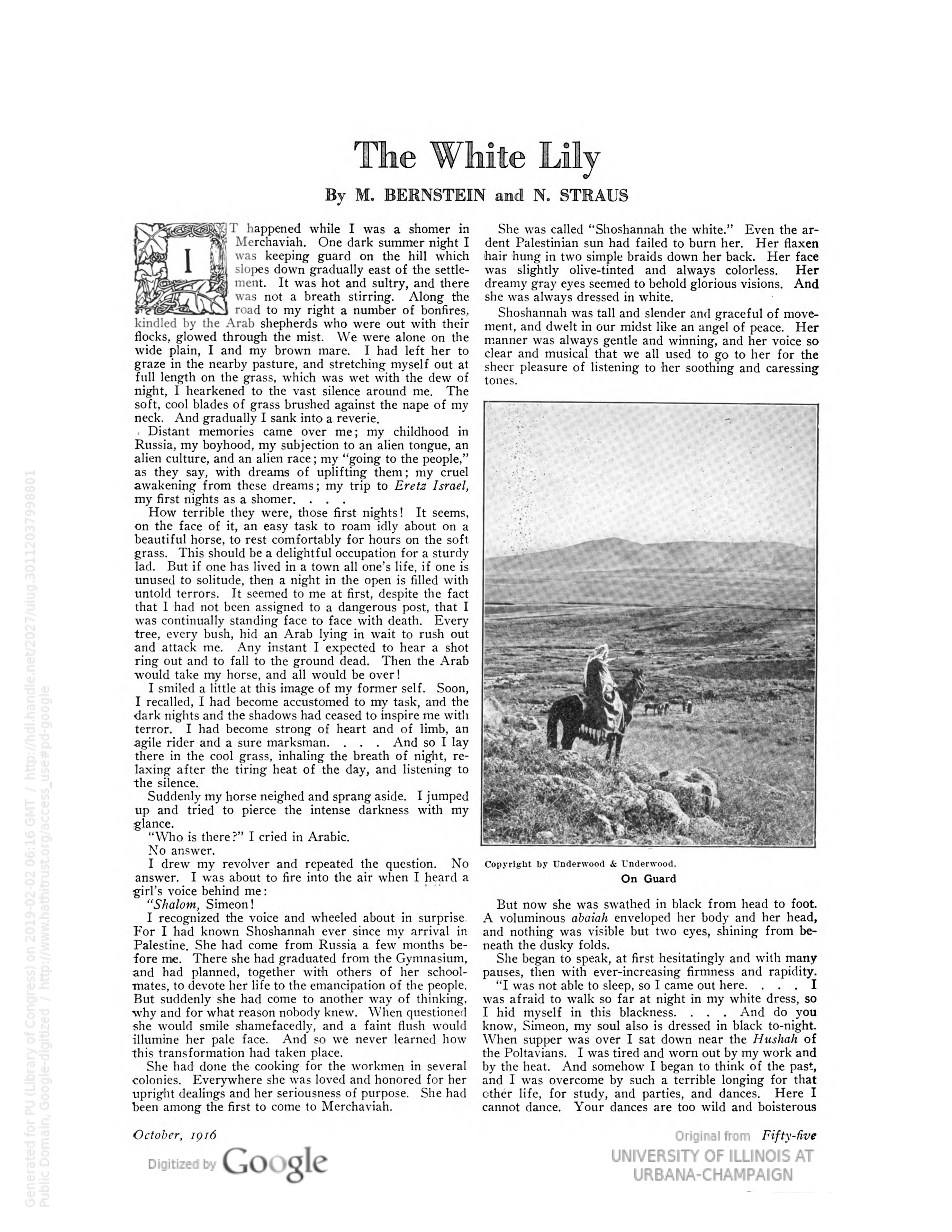
IT happened while I was a shomer in Merchaviah. One dark summer night I was keeping guard on the hill which slopes down gradually east of the settlement. It was hot and sultry, and there was not a breath stirring. Along the road to my right a number of bonfires, kindled by the Arab shepherds who were out with their flocks, glowed through the mist. We were alone on the wide plain, I and my brown mare. I had left her to graze in the nearby pasture, and stretching myself out at full length on the grass, which was wet with the dew of night, I hearkened to the vast silence around me. The soft, cool blades of grass brushed against the nape of my neck. And gradually I sank into a reverie,
Distant memories came over me; my childhood in Russia, my boyhood, my subjection to an alien tongue, an alien culture, and an alien race; my "going to the people," as they say, with dreams of uplifting them; my cruel awakening from these dreams; my trip to Eretz Israel, my first nights as a shomer.
How terrible they were, those first nights! It seems, on the face of it, an easy task to roam idly about on a beautiful horse, to rest comfortably for hours on the soft grass. This should be a delightful occupation for a sturdy lad. But if one has lived in a town all one's life, if one is unused to solitude, then a night in the open is filled with untold terrors. It seemed to me at first, despite the fact that I had not been assigned to a dangerous post, that I was continually standing face to face with death. Every tree, every bush, hid an Arab lying in wait to rush out and attack me. Any instant I expected to hear a shot ring out and to fall to the ground dead. Then the Arab would take my horse, and all would be over!
I smiled a little at this image of my former self. Soon, I recalled, I had become accustomed to my task, and the dark nights and the shadows had ceased to inspire me with terror. I had become strong of heart and of limb, an agile rider and a sure marksman. And so I lay there in the cool grass, inhaling the breath of night, relaxing after the tiring heat of the day, and listening to the silence.
Suddenly my horse neighed and sprang aside. I jumped up and tried to pierce the intense darkness with my glance.
"Who is there?" I cried in Arabic.No answer.I drew my revolver and repeated the question. No
answer. I was about to fire into the air when I heard a girl's voice behind me:
“"Shalom, Simeon! I recognized the voice and wheeled about in surprise. For I had known Shoshannah ever since my arrival in Palestine, She had come from Russia a few months before me. There she had graduated from the Gymnasium, and had planned, together with others of her schoolmates, to devote her life to the emancipation of the people. But suddenly she had come to another way of thinking, why and for what reason nobody knew. When questionerl she would smile shamefacedly, and a faint flush would illumine her pale face. And so we never learned how this transformation had taken place.
She had done the cooking for the workmen in several colonies. Everywhere she was loved and honored for her upright dealings and her seriousness of purpose. She had been among the first to come to Merchaviah.
She was called "Shoshannah the white." Even the ardent Palestinian sun had failed to burn her. Her flaxen hair hung in two simple braids down her back. Her face was slightly olive-tinted and always colorless. Her dreamy gray eyes seemed to behold glorious visions. And she was always dressed in white.
Shoshannah was tall and slender and graceful of movement, and dwelt in our midst like an angel of peace. Her manner was always gentle and winning, and her voice so clear and musical that we all used to go to her for the sheer pleasure of listening to her soothing and caressing tones.
But now she was swathed in black from head to foot. A voluminous abaiah enveloped her body and her head, and nothing was visible but two eyes, shining from beneath the dusky folds.
She began to speak, at first hesitatingly and with many pauses, then with ever-increasing firmness and rapidity. “I was not able to sleep, so I came out here. . . . I was afraid to walk so far at night in my white dress, so I hid myself in this blackness. . . . And do you know, Simeon, my soul also is dressed in black to-night. When supper was over I sat down near the Hushah of the Poltavians. I was tired and worn out by my work and by the heat. And somehow I began to think of the past, and I was overcome by such a terrible longing for that other life, for study, and parties, and dances. Here I cannot dance. Your dances are too wild and boisterous