"Zionism and the Jewish Future"
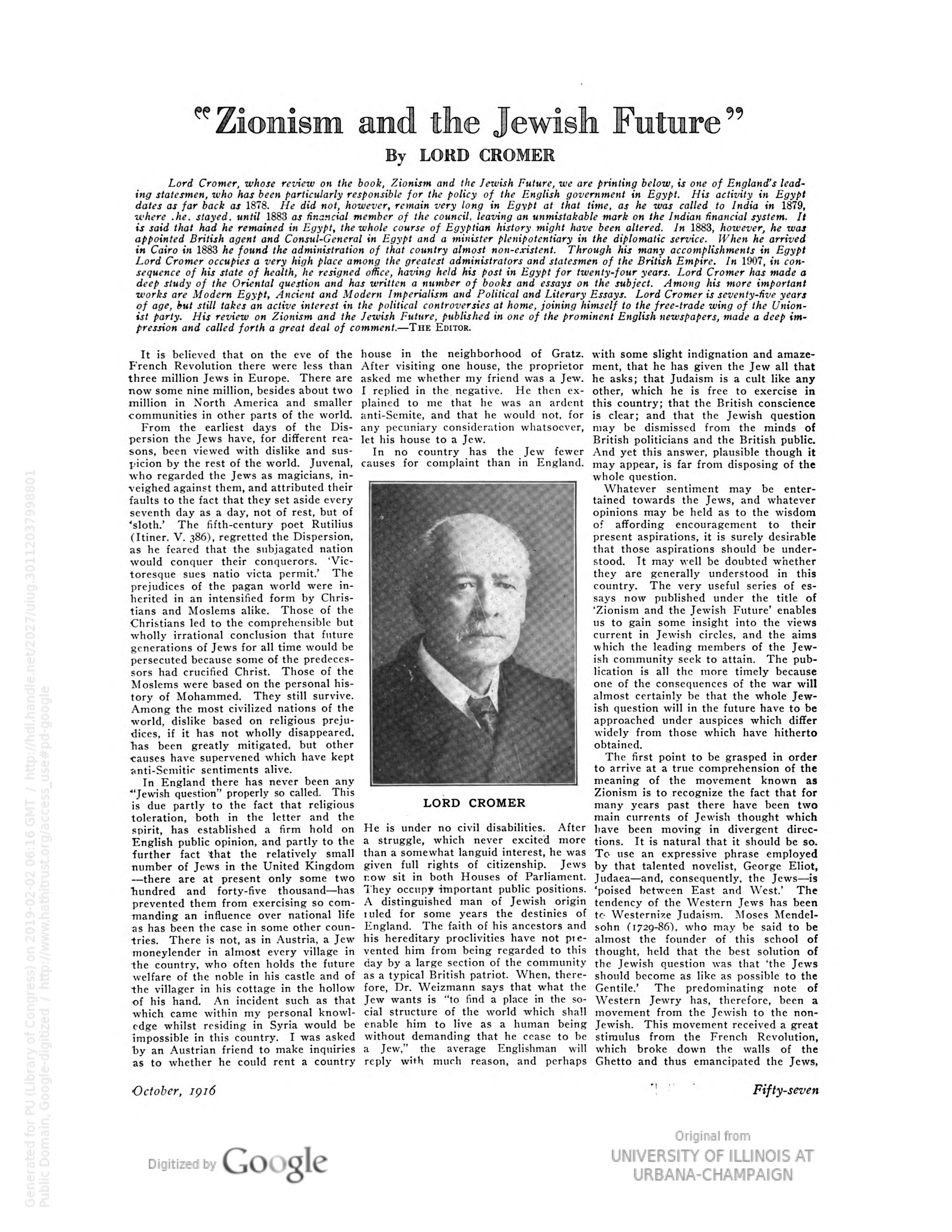
Lord Cromer, whose review on the book, Zionism and the Jewish Future, we are printing below, is one of England’s leading statesmen, who has been particularly responsible for the policy of the English government in Egypt. His activity in Egypt dates as far back as 1878. He did not, however, remain very long in Egypt at that time, as he was called to India in 1879, where he stayed until 1883 as financial member of the council, leaving an unmistakable mark on the Indian financial system. It is said that had he remained in Egypt, the whole course of Egyptian history might have been altered. In 1883, however, he was appointed British agent and Consul-General in Egypt and a minister plenipotentiary in the diplomatic service. When he arrived in Cairo in 1883 he found the administration of that country almost non-existent. Through his many accomplishments in Egypt Lord Cromer occupies a very high place among the greatest administrators and statesmen of the British Empire. In 1907, in consequence of his state of health, he resigned office, having held his post in Egypt for twenty-four years. Lord Cromer has made a deep study of the Oriental question and has written a number of books and essays on the subject. Among his more important works are Modern Egypt, Ancient and Modern Imperialism and Political and Literary Essays. Lord Cromer is seventy-five years of age, but still takes an active interest in the political controversies at home, joining himself to the free-trade wing of the Unionist party. His review on Zionism and the Jewish Future, published in one of the prominent English newspapers, made a deep impression and called forth a great deal of comment. —THE EDITOR.
It is believed that on the eve of the French Revolution there were less than three million Jews in Europe. There are now some nine million, besides about two million in North America and smaller communities in other varts of the world.
From the earliest days of the Dispersion the Jews have, for different reasons, been viewed with dislike and sus- ricion by the rest of the world. Juvenal, who regarded the Jews as magicians, inveighed against them, and attributed their faults to the fact that they set aside every seventh day as a day, not of rest, but of “sloth.. The fifth-century poet Rutilius (Itiner. V. 386), regretted the Dispersion, as he feared that the subjagated nation would conquer their conquerors. ‘Vic- toresque sues natio victa permit.. The prejudices of the pagan world were inherited in an intensified form by Christians and Moslems alike. Those of the Christians led to the comprehensible but wholly irrational conclusion that future generations of Jews for all time would be persecuted because some of the predecessors had crucified Christ. Those of the Moslems were based on the personal history of Mohammed. They still survive. Among the most civilized nations of the world, dislike based on religious prejudices, if it has not wholly disappeared. has been greatly mitigated, but other causes have supervened which have kept anti-Semitie sentiments alive.
In England there has never been any “Jewish question” properly so called. This is due partly to the fact that religious toleration, both in the letter and the spirit, has established a firm hold on English public opinion, and partly to the further fact that the relatively small number of Jews in the United Kingdom -—there are at present only some two hundred and forty-five thousand—has prevented them from exercising so commanding an influence over national life as has been the case in some other countries. There is not, as in Austria, a Jew moneylender in almost every village in the country, who often holds the future welfare of the noble in his castle and of the villager in his cottage in the hollow of his hand. An incident such as that which came within my personal knowledge whilst residing in Syria would be impossible in this country. I was asked by an Austrian friend to make inquiries as to whether he could rent a country
house in the neighborhood of Gratz. After visiting one house, the proprietor asked me whether my friend was a Jew. I replied in the negative. He then explained to me that he was an ardent anti-Semite, and that he would not, for any pecuniary consideration whatsoever, let his house to a Jew.
In no country has the Jew fewer causes for complaint than in England.
He is under no civil disabilities. After a struggle, which never excited more than a somewhat languid interest, he was given full rights of citizenship. Jews now sit in both Houses of Parliament. They occupy important public positions. A distinguished man of Jewish origin ruled for some years the destinies of England. The faith of his ancestors and his hereditary proclivities have not prevented him from being regarded to this day by a large section of the community as a typical British patriot. When, therefore, Dr. Weizmann says that what the Jew wants is “to find a place in the social structure of the world which shall enable him to live as a human being without demanding that he cease to be a Jew” the average Englishman will reply with much reason, and perhaps
with some slight indignation and amazement, that he has given the Jew all that he asks; that Judaism is a cult like any other, which he is free to exercise in this country; that the British conscience is clear; and that the Jewish question may be dismissed from the minds of British politicians and the British public. And yet this answer, plausible though it may appear, is far from disposing of the whole auestion.
Whatever sentiment may be entertained towards the Jews, and whatever opinions may be held as to the wisdom of affording encouragement to their present aspirations, it is surely desirable that those aspirations should be understood. It may well be doubted whether they are generally understood in this country. The very useful series of essays now published under the title of 'Zionism and the Jewish Future' enables us to gain some insight into the views current in Jewish circles, and the aims which the leading members of the Jewish community seek to attain. The publication is all the more timely because one of the consequences of the war will almost certainly be that the whole Jewish question will in the future have to be approached under auspices which differ widely from those which have hitherto obtained.
The first point to be grasped in order to arrive at a true comprehension of the meaning of the movement known as Zionism is to recognize the fact that for many years past there have been two main currents of Jewish thought which have been moving in divergent directions. It is natural that it should be so. To use an expressive phrase employed by that talented novelist, George Eliot, Judaea —and, consequently, the Jews—is 'poised between East and West.' The tendency of the Western Jews has been to Westernize Judaism. Moses Mendelsohn (1729-86), who may be said to be almost the founder of this school of thought, held that the best solution of the Jewish question was that 'the Jews should become as like as possible to the Gentile.' The predominating note of Western Jewry has, therefore, been a movement from the Jewish to the non-Jewish. This movement received a great stimulus from the French Revolution, which broke down the walls of the Ghetto and thus emancipated the Jews,