From Seattle to Safed
The Story of the Transfer Department
Among the war achievements of the Zionist organization the transfer department established by the Provisional Zionist Committee will distinctly rank as an accomplishment and perhaps because it is an accomplishment those who habitually find fault with every Zionist effort may find fault with it.
When in October, 1914, it became apparent that the development of the war would involve tens of thousands of Jews in misery and the first steps were taken to organize a general relief committee, there was presented to the Provisional Zionist Committee the following suggestions: The adequate relief of the Jews in Russia and Galicia would cost about $15,000,000 a year—even $30,000,000 was spoken of—but according to the general information available about $13,000,00 a year was being forwarded by Jews in this country to Jews in Europe. If safe methods were found for the transmission of monies to the war zones, it could be assumed that those supplying these $13,000,000 would at least supply that amount for their relatives and in all probability they could be induced to send much more. If this monev were transmitted, a great deal of relief money would still
be necessary, but if this transmission was not arranged for, then the stoppage of normal supplies would seriously aggravate the evil conditions that the war would produce.
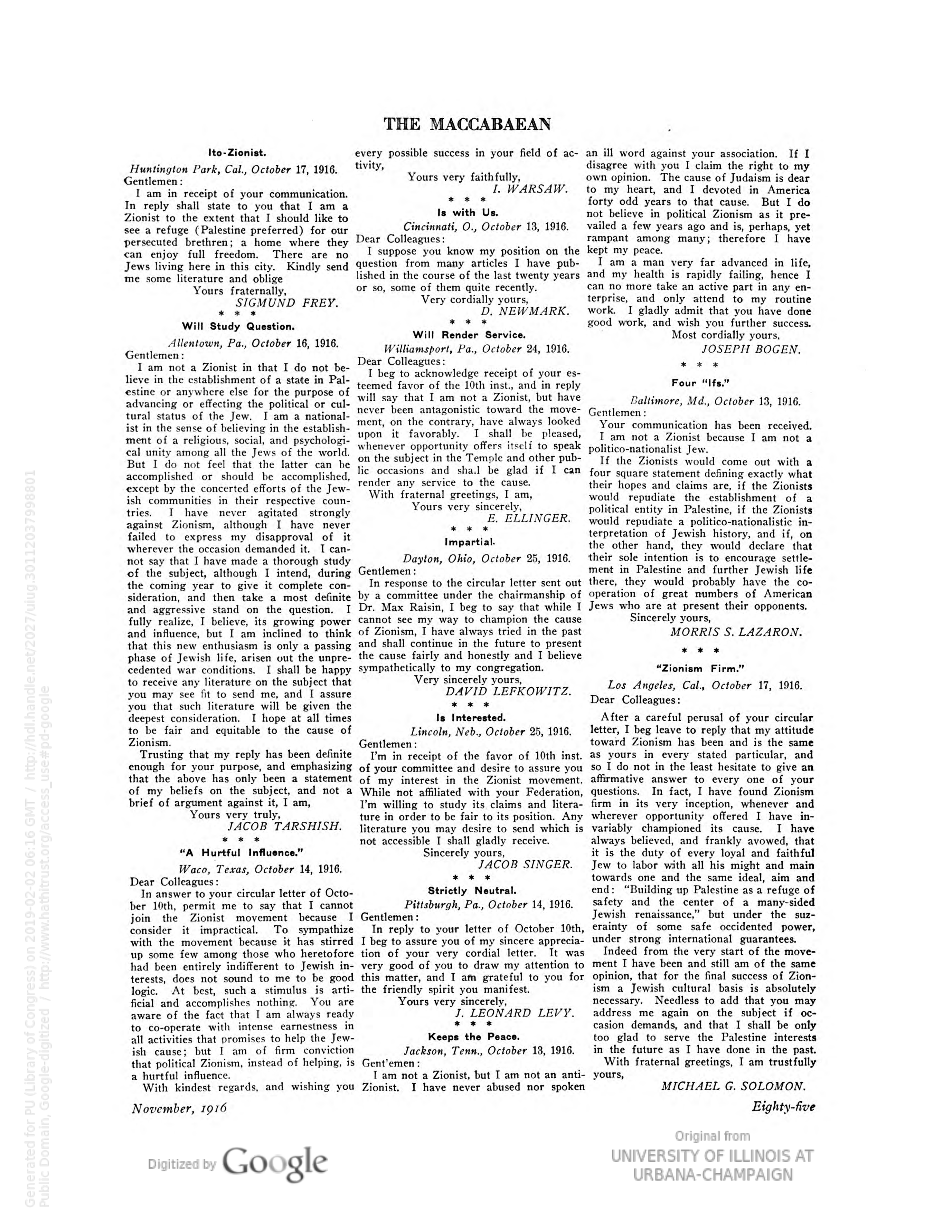
The members of the Provisional Zionist Committee saw the point and submitted it to the organization conference of the American Jewish Relief Committee. The suggestion was brushed aside, insistence merely obtaining consent to mention this kind of work in the general appeal. There the matter rested for a few weeks. Then the Provisional Zionist Committee found itself face to face with an intimate problem. Money was needed for Palestine.e The PZC had to send money to Palestine. There were other individuals clamoring to send money to Palestine. The PZC thereupon opened the Transfer Department. Subsequently other agencies undertook a certain amount of this work for Europe. Then again they dropped it for Europe. The PZC took it up for Europe as well. Now the PZC acts as transfer agent with the approval of the United States Government for all creeds, races and nationalities in this country to all manners of peoples in the war zones. The Palestinian account was opened Oct. 26, 1914, the European on June 2, 1915.
The Transfer Department has never solicited business because it had no desire to interfere with banks that make a business of foreign exchange. Also it has avoided the possibility of coming into competition with other organizations. Nevertheless, it has been a remarkably successful undertaking. The more so as it has not courted publicity, the more so in that the transfer department does not call in all the newspaper men when it re-
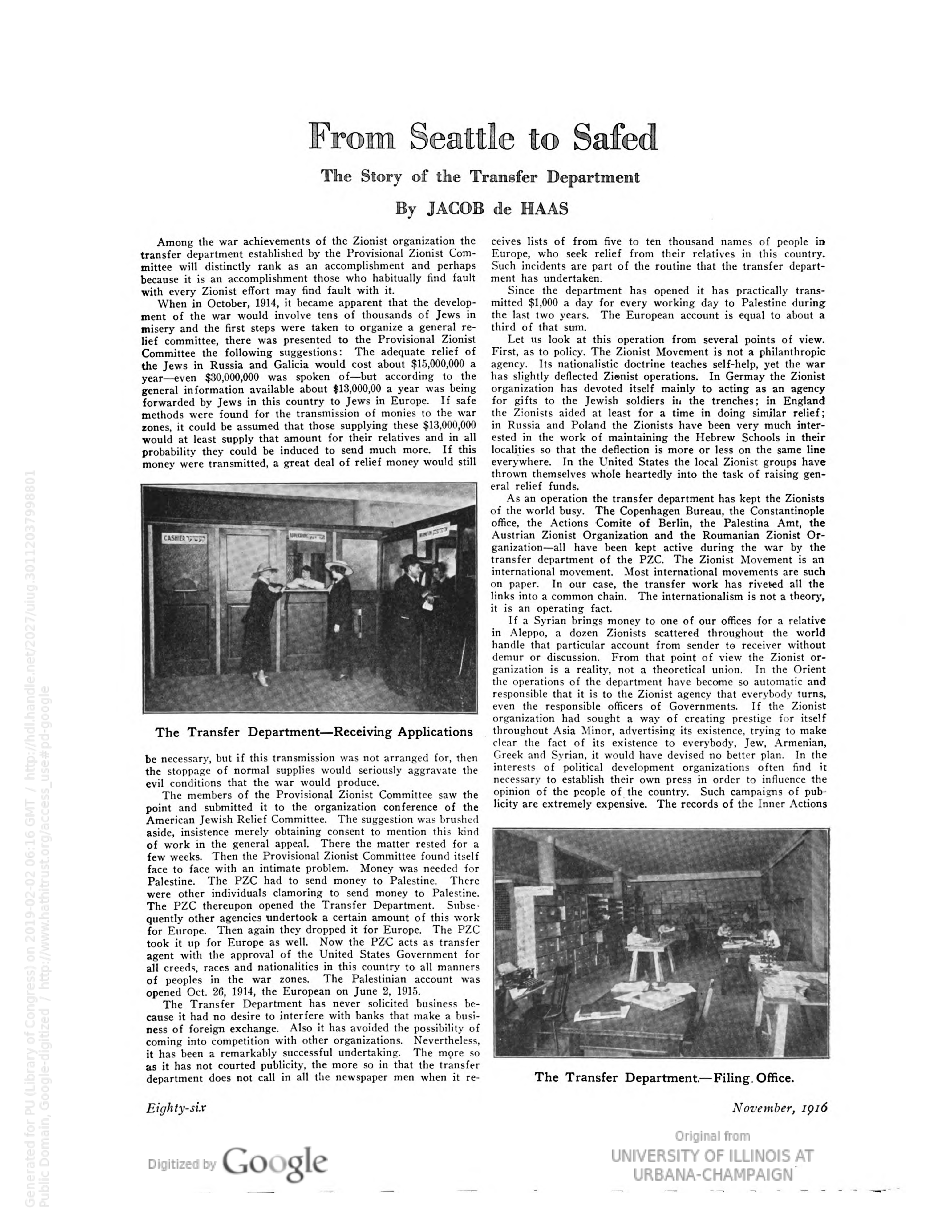
ceives lists of from five to ten thousand names of people in Europe, who seek relief from their relatives in this country. Such incidents are part of the routine that the transfer department has undertaken.
Since the department has opened it has practically transmitted $1,000 a day for every working day to Palestine during the last two years. The European account is equal to about a third of that sum.
Let us look at this operation from several points of view. First, as to policy. The Zionist Movement is not a philanthropic agency. Its nationalistic doctrine teaches self-help, yet the war has slightly deflected Zionist operations. In Germay the Zionist organization has devoted itself mainly to acting as an agency for gifts to the Jewish soldiers in the trenches; in England the Zionists aided at least for a time in doing similar relief; in Russia and Poland the Zionists have been very much interested in the work of maintaining the Hebrew Schools in their localities so that the deflection is more or less on the same line everywhere. In the United States the local Zionist groups have thrown themselves whole heartedly into the task of raising general relief funds.
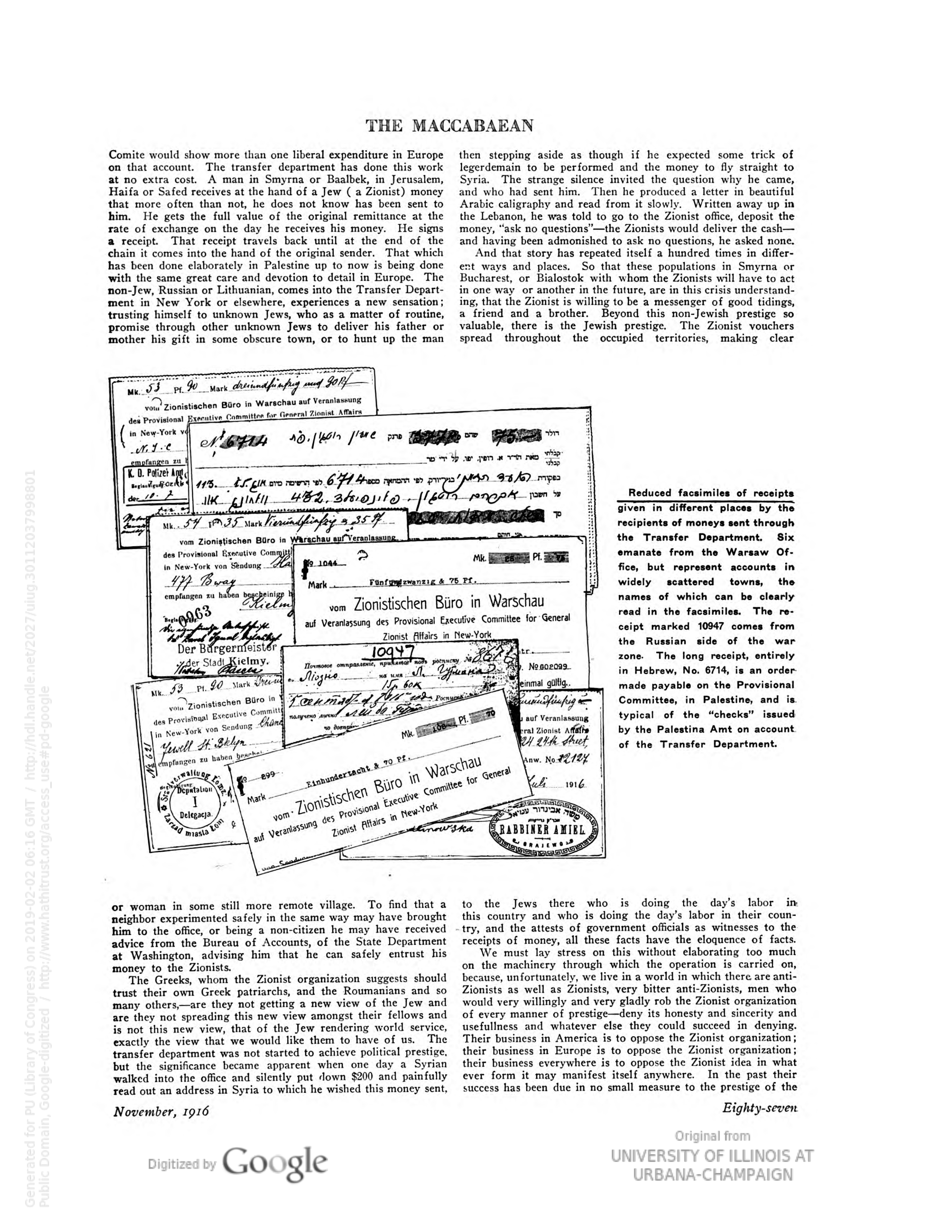
As an operation the transfer department has kept the Zionists of the world busy. The Copenhagen Bureau, the Constantinople office, the Actions Comite of Berlin, the Palestina Amt, the Austrian Zionist Organization and the Roumanian Zionist Organization —all have been kept active during the war by the transfer department of the PZC. The Zionist Movement is an international movement. Most international movements are such on paper. In our case, the transfer work has riveted all the links into a common chain. The internationalism is not a theory, it is an operating fact.
bt En A A de hen ch dehnt - end nn in nn If a Syrian brings money to one of our oflices for a relative in Aleppo, a dozen Zionists scattered throughout the world handle that particular account from sender te receiver without demur or discussion. From that point of view the Zionist organization is a reality, not a theoretical union. In the Orient the operations of the department have become so automatic and responsible that it is to the Zionist agency that everybody turns, even the responsible oflicers of Governments. If the Zionist organization had sought a way of creating prestige for itself throughout Asia Minor, advertising its existence, trying to make clear the fact of its existence to everybody, Jew, Armenian, Greek and Syrian, it would have devised no better plan. In the interests of political development organizations often find it necessary to establish their own press in order to influence the opinion of the people of the country. Such campaigns of publicity are extremelv expensive. The records of the Inner Actions