Mr. Justice Brandeis To His Sixtieth Birthday
THERE are quite a number of well-meaning people who resent the appreciations of Mr. Justice Brandeis' services to the Jewish cause, evoked since his elevation to the Supreme Court, and especially do they resent the attribution of leadership which the Zionists accord him. Mr. Brandeis gave to America the best that was in him, serving unselfishly, efficiently, building up a reputation which extends to all corners of the United States, where his name signifies unusual ability coupled with exceptional disinterestedness. But to the Jews he gave nothing of his talents, until, within four or five years of reaching his sixtieth birthday, he turned his attention to the Jewish problem. Why should leaders who have spent their lives with the Jewish people be set aside in favor of this man?
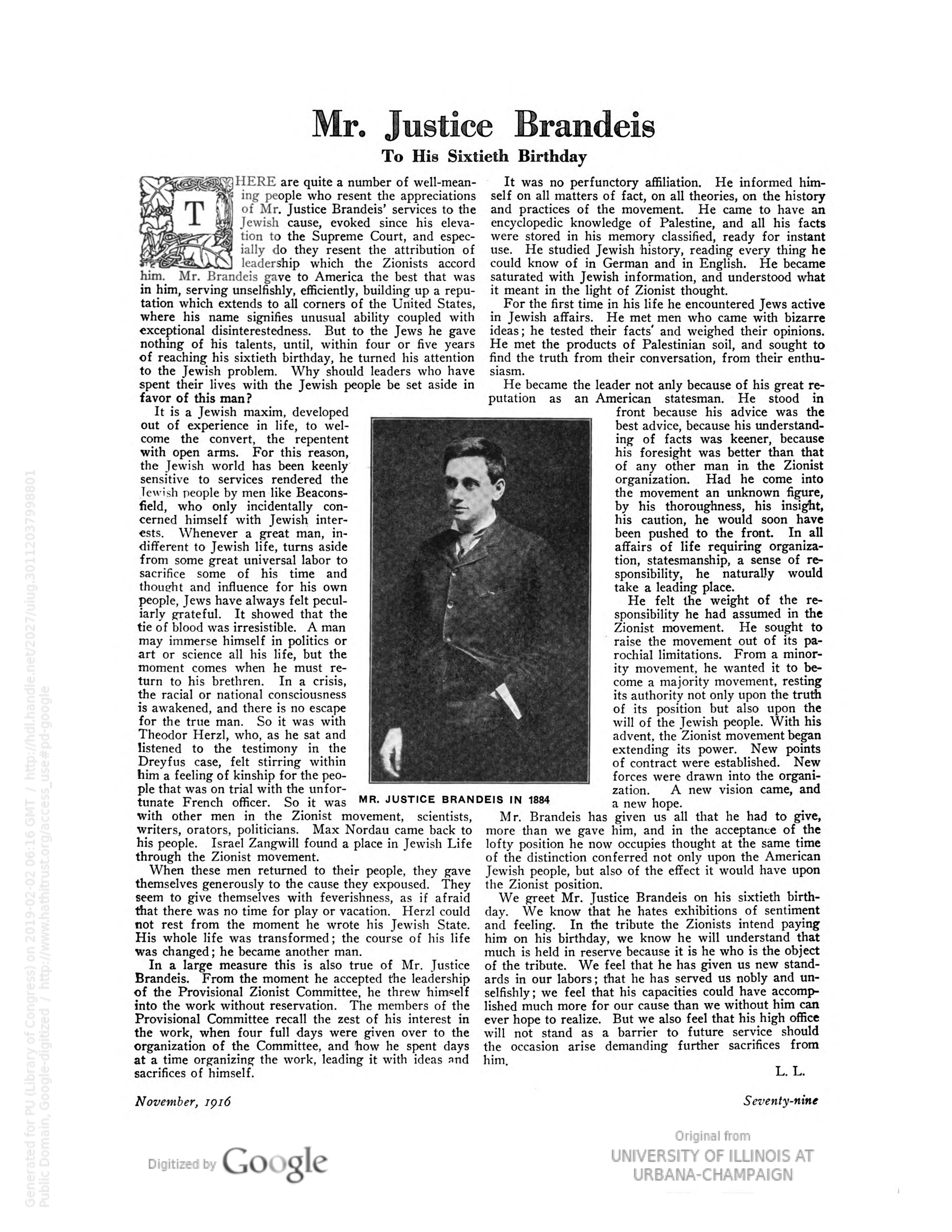
It is a Jewish maxim, developed out of experience in life, to welcome the convert, the repentent with open arms. For this reason, the Jewish world has been keenly sensitive to services rendered the Jewish people by men like Beaconsfield, who only incidentally concerned himself with Jewish interests. Whenever a great man, indifferent to Jewish life, turns aside from some great universal labor to sacrifice some of his time and thought and influence for his own people, Jews have always felt pecul- iarly grateful. It showed that the tie of blood was irresistible. A man may immerse himself in politics or art or science all his life, but the moment comes when he must return to his brethren. In a crisis, the racial or national consciousness is awakened, and there is no escape for the true man. So it was with Theodor Herzl, who, as he sat and listened to the testimony in the Dreyfus case, felt stirring within him a feeling of kinship for the people that was on trial with the unfortunate French officer. So it was MR. JUSTICE BRAN with other men in the Zionist movement, scientists, writers, orators, politicians. Max Nordau came back to his people. Israel Zangwill found a place in Jewish Life through the Zionist movement.
When these men returned to their people, they gave themselves generously to the cause they expoused. They seem to give themselves with feverishness, as if afraid that there was no time for play or vacation. Herzl could not rest from the moment he wrote his Jewish State. His whole life was transformed; the course of his life was changed; he became another man.
In a large measure this is also true of Mr. Justice Brandeis. From the moment he accepted the leadership of the Provisional Zionist Committee, he threw himself into the work without reservation. The members of the Provisional Committee recall the zest of his interest in the work, when four full days were given over to the organization of the Committee, and how he spent days at a time organizing the work, leading it with ideas and sacrifices of himself.
It was no perfunctory affiliation. He informed himself on all matters of fact, on all theories, on the history and practices of the movement. He came to have an encyclopedic knowledge of Palestine, and all his facts were stored in his memory classified, ready for instant use. He studied Jewish history, reading every thing he could know of in German and in English. He became saturated with Jewish information, and understood what it meant in the light of Zionist thought.
For the first time in his life he encountered Jews active in Jewish affairs. He met men who came with bizarre ideas; he tested their facts' and weighed their opinions. He met the products of Palestinian soil, and sought to find the truth from their conversation, from their enthusiasm.
He became the leader not only because of his great reputation as an American statesman. He stood in
front because his advice was the best advice, because his understanding of facts was keener, because his foresight was better than that of any other man in the Zionist organization. Had he come into the movement an unknown figure, by his thoroughness, his insight, his caution, he would soon have been pushed to the front. In all affairs of life requiring organization, statesmanship, a sense of responsibility, he naturally would take a leadine place.
He felt the weight of the responsibility he had assumed in the Zionist movement. He sought to raise the movement out of its parochial limitations. From a minority movement, he wanted it to become a majority movement, resting its authority not only upon the truth of its position but also upon the will of the Jewish people. With his advent, the Zionist movement began extending its power. New points of contract were established. New forces were drawn into the organization. A new vision came, and a new hope.
Mr. Brandeis has given us all that he had to give, more than we gave him, and in the acceptance of the lofty position he now occupies thought at the same time of the distinction conferred not only upon the American Jewish people, but also of the effect it would have upon the Zionist position.
We greet Mr. Justice Brandeis on his sixtieth birthday. We know that he hates exhibitions of sentiment and feeling. In the tribute the Zionists intend paying him on his birthday, we know he will understand that much is held in reserve because it is he who is the object of the tribute. We feel that he has given us new standards in our labors; that he has served us nobly and unselfishly; we feel that his capacities could have accomplished much more for our cause than we without him can ever hope to realize. But we also feel that his high office will not stand as a barrier to future service should the occasion arise demanding further sacrifices from him.