A PICTORIAL REVIEW OF THE JEWISH NATIONAL FUND
The Origin of the National Fund
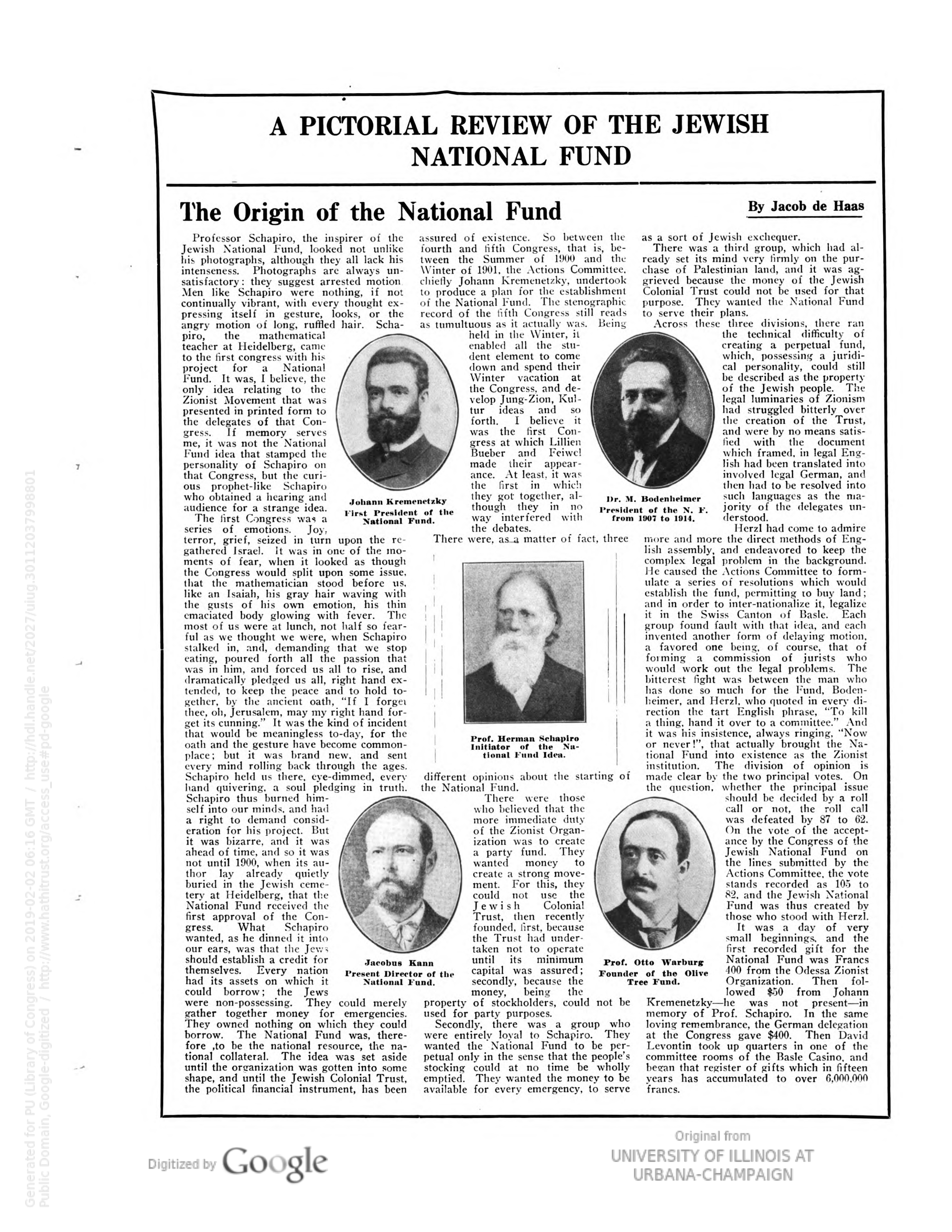
Professor Schapiro, the inspirer of the Jewish National Fund, looked not unlike his photographs, although they all lack his intenseness. Photographs are always unsatisfactory: they suggest arrested motion. Men like Schapiro were nothing, if not continually vibrant, with every thought expressing itself in gesture, looks, or the angry motion of long, ruffled hair. Schapiro, the mathematical teacher at Heidelberg, came to the first congress with his project for a National Fund. It was, I believe, the only idea relating to the Zionist Movement that was presented in printed form to the delegates of that Congress. If memory serves me, it was not the National Fund idea that stamped the personality of Schapiro on that Congress, but the curious prophet-like Schapiro who obtained a hearing and audience for a strange idea. The first Congress was a series of emotions. Joy; terror, grief, seized in turn upon the re-gathered Israel. It was in one of the moments of fear, when it looked as though the Congress would split upon some issue, that the mathematician stood before us, like an Isaiah, his gray hair waving with the gusts of his own emotion, his thin emaciated body glowing with fever. The most of us were at lunch, not half so fearful as we thought we were, when Schapiro stalked in, and, demanding that we stop eating, poured forth all the passion that was in him, and forced us all to rise, and dramatically pledged us all, right hand extended, to keep the peace and to hold together, by the ancient oath, “If I forget thee, oh, Jerusalem, may my right hand forget its cunning.” It was the kind of incident that would be meaningless to-day, for the oath and the gesture have become commonplace; but it was brand new, and sent every mind rolling back through the ages. Schapiro held us there, eye-dimmed, every hand quivering, a soul pledging in truth. Schapiro thus burned himself into our minds, and had a right to demand consideration for his project. But it was bizarre, and it was ahead of time, and so it was not until 1900, when its author lay already quietly buried in the Jewish cemetery at Heidelberg, that the National Fund received the first approval of the Congress. What Schapiro wanted, as he dinned it into our ears, was that the Jews should establish a credit for themselves. Every nation had its assets on which it could borrow; the Jews were non-possessing. They could merely gather together money for emergencies. They owned nothing on which they could borrow. The National Fund was, therefore ,to be the national resource, the national collateral. The idea was set aside until the organization was gotten into some shape, and until the Jewish Colonial Trust, the political financial instrument, has been
assured of existence. So between the fourth and fifth Congress, that is, between the Summer of 1900 and the Winter of 1901, the Actions Committee, chiefly Johann Kremenetzky, undertook to produce a plan for the establishment of the National Fund. The stenographic record of the fifth Congress still reads as tumultuous as it actually was. Being held in the Winter, it enabled all the student element to come down and spend their Winter vacation at the Congress, and develop Jung-Zion, Kultur ideas and so forth. I believe it was the first Congress at which Lillien Bueber and Feiwel made their appearance. At least, it was the first in which they got together, although they in no way interfered with the debates.
as a sort of Jewish exchequer. There was a third group, which had already set its mind very firmly on the purchase of Palestinian land, and it was aggrieved because the money of the Jewish Colonial Trust could not be used for that purpose. They wanted the National Fund to serve their plans. Across these three divisions, there ran the technical difficulty of creating a perpetual fund, which, possessing a juridical personality, could still be described as the property of the Jewish people. The legal luminaries of Zionism had struggled bitterly over the creation of the Trust, and were by no means satisfied with the document which framed, in legal English, had been translated into involved legal German, and then had to be resolved into such languages as the majority of the delegates understood. Herzl had come to admire more and more the direct methods of English assembly, and endeavored to keep the complex legal problem in the background. He caused the Actions Committee to formulate a series of resolutions which would establish the fund, permitting to buy land; and in order to internationalize it, legalize it in the Swiss Canton of Basle. Each group found fault with that idea, and each invented another form of delaying motion, a favored one being, of course, that of forming a commission of jurists who would work out the legal problems. The bitterest fight was between the man who has done so much for the Fund, Bodenheimer, and Herzl, who quoted in every direction the tart English phrase, "To kill a thing, hand it over to a committee." And it was his insistence, always ringing, "Now or never!", that actually brought the National Fund into existence as the Zionist institution. The division of opinion is made clear by the two principal votes. On the question, whether the principal issue should be decided by a roll call or not, the roll call was defeated by 37 to 62. On the vote of the acceptance by the Congress of the Jewish National Fund on the lines submitted by the Actions Committee, the vote stands recorded as 105 to 82, and the Jewish National Fund was thus created by those who stood with Herzl. It was a day of very small beginnings, and the first recorded gift for the National Fund was Francs 400 from the Odessa Zionist Organization. Then followed $50 from Johann Kremenetzky —he was not present—in memory of Prof. Schapiro. In the same loving remembrance, the German delegation at the Congress gave $400. Then David Levontin took up quarters in one of the committee rooms of the Basle Casino, and began that register of gifts which in fifteen years has accumulated to over 6,000,000 francs.
ferent opinions about the starting of National Fund. There were those who believed that the more immediate duty of the Zionist Organization was to create a party fund. They wanted money to create a strong movement. For this, they could not use the Jewish Colonial Trust, then recently founded, first, because the Trust had undertaken not to operate until its minimum capital was assured; secondly, because the money, being the property of stockholders, could not be used for party purposes. Secondly, there was a group who were entirely loyal to Schapiro. They wanted the National Fund to be perpetual only in the sense that the people's stocking could at no time be wholly emptied. They wanted the money to be available for every emergency, to serve
should be decided by a roll call or not, the roll call was defeated by 87 to 62. On the vote of the acceptance by the Congress of the Jewish National Fund on the lines submitted by the Actions Committee, the vote stands recorded as 105 to 82, and the Jewish National Fund was thus created by those who stood with Herzl. It was a day of very small beginnings, and the first recorded gift for the National Fund was Francs 400 from the Odessa Zionist Organization. Then followed $50 from Johann he was not present—in of. Schapiro. In the same rance, the German delegation ss gave $400. Then David up quarters in one of the ns of the Basle Casino, and ster of gifts which in fifteen umulated to over 6,000,000