In the Beginning—the Idea
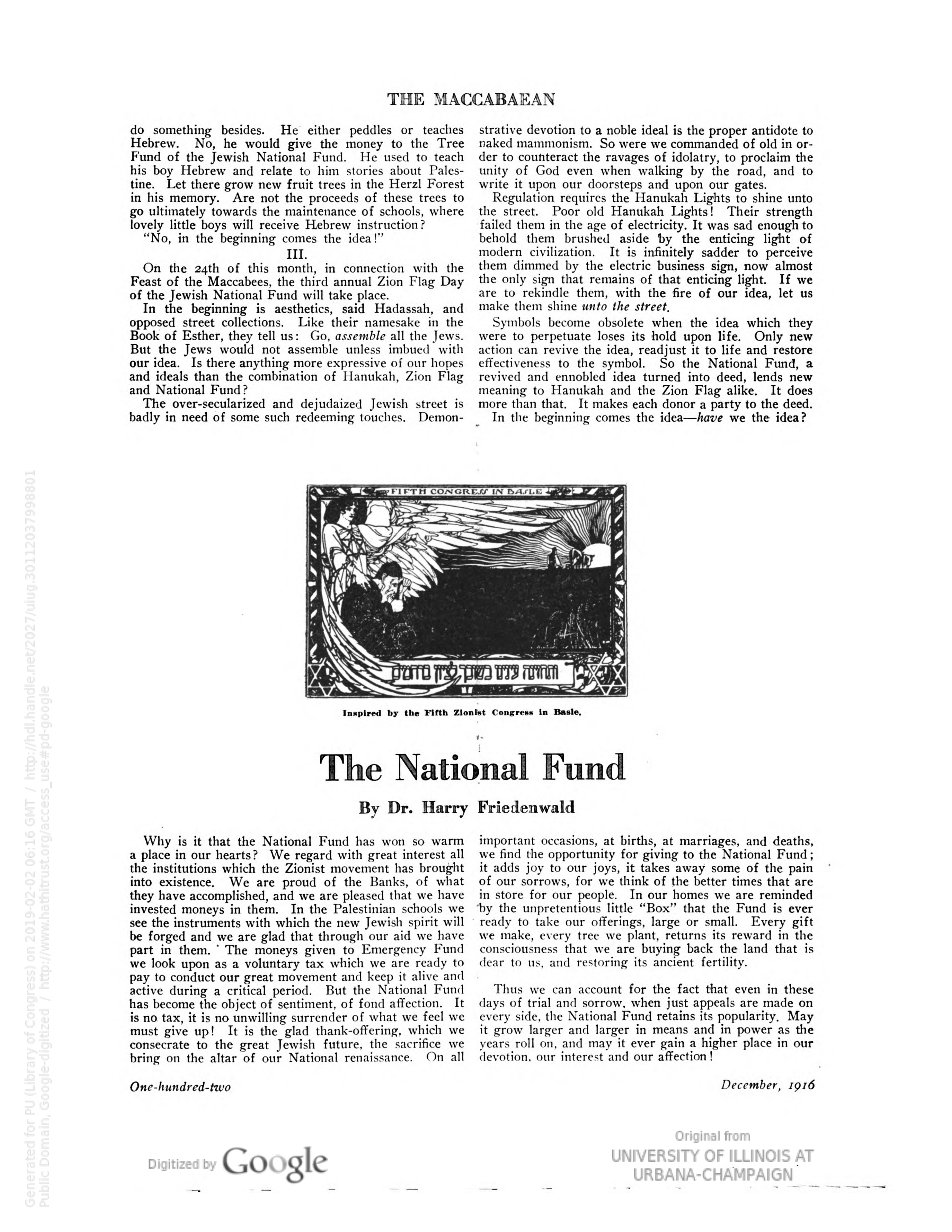
THESE words were uttered by the immortal leader in his opening address to the fifth Zionist Congress. The same Congress, inspired by a great idea, called into being, with but slender means, a fund calculated to guide the destinies of a reborn nation: the Jewish National Fund.
The idea of a Homeland for the Jews, as incorporated in the Basle Program, was then five years old. But a Homeland is not necessarily an abode for social justice. Is not the danger of private land ownership and land monopoly, with all their inherent evils, lurking there already? Does not he, the weary landless wanderer, know the wrongfulness of land lust and land grabbing? And shall not he, the misjudged of all the earth, provide for justice in his own Homeland? He certainly shall. The National Fund shall acquire land in Palestine as the inalienable property of the Jewish People, leaseable to anyone who is willing to till, sow and plant. "For mine is the land," saith the Lord.
Since then the idea developed. The bare land is of no avail to the settler who has neither implements nor money. Why should not the nation provide the creators of its wealth also with implements, live stock, even with a little house, all or any, as the case may require, on reasonable terms? Of course it should, and the Co-operative Colonization Fund and Workmen's Dwelling Fund were called into being as branches of the Jewish National Fund.
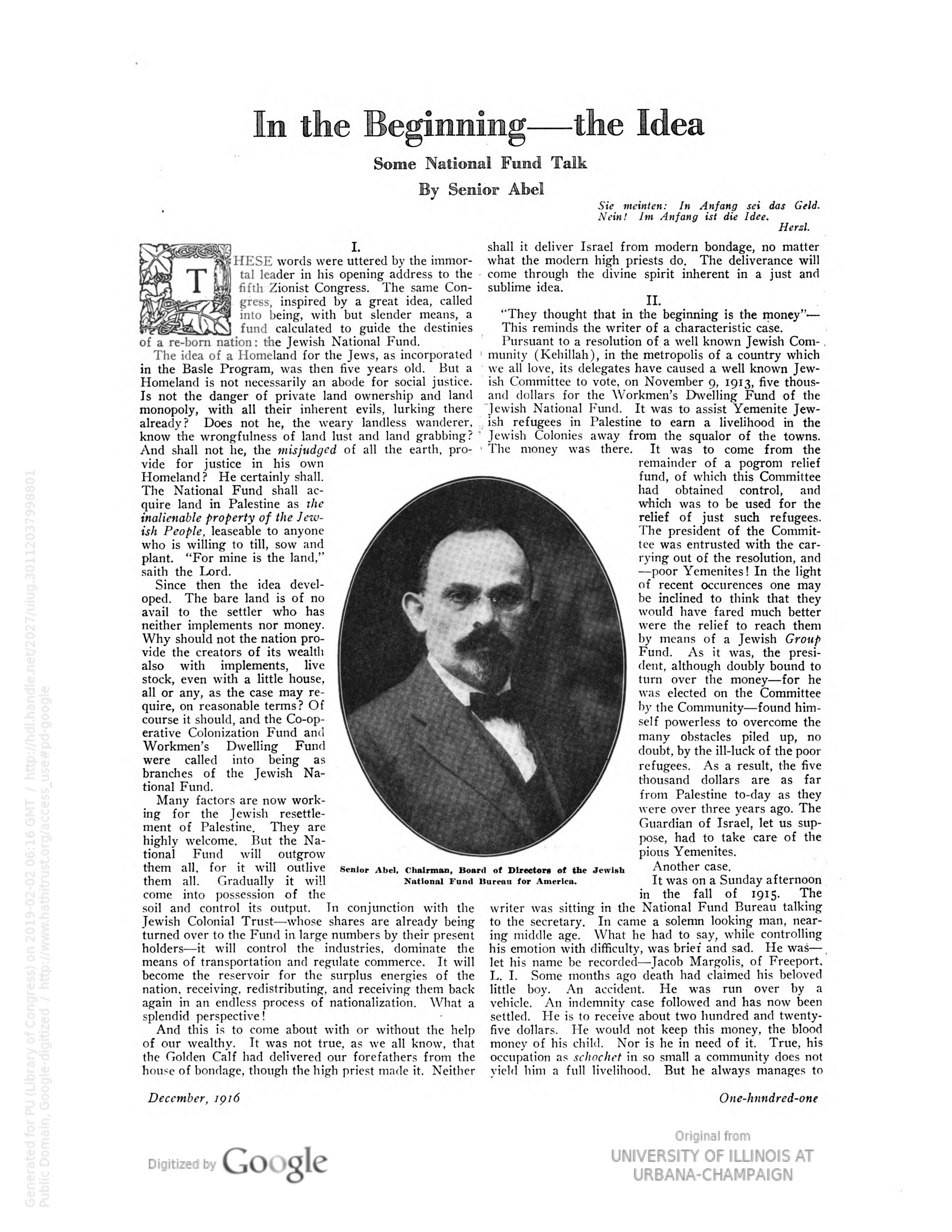
Many factors are now working for the Jewish resettlement of Palestine. They are highly welcome. But the National Fund will outgrow them all, for it will outlive senior Abel, Chairman, Boa them all. Gradually it will National Fund come into possession of the soil and control its output. Im conjunction with the Jewish Colonial Trust—whose shares are already being turned over to the Fund in large numbers by their present holders—it will control the industries, dominate the means of transportation and regulate commerce. It will become the reservoir for the surplus energies of the nation, receiving, redistributing, and receiving them back again in an endless process of nationalization. What a splendid perspective! .
And this is to come about with or without the help of our wealthy. It was not true, as we all know, that the Golden Calf had delivered our forefathers from the house of bondage, though the high priest made it. Neither
Sie meinten: In Anfang sei das Geld. Nein! Im Anfang ist die Idee. Herzl
II. "They thought that in the beginning is the money"—This reminds the writer of a characteristic case. Pursuant to a resolution of a well known Jewish Community (Kehillah), in the metropolis of a country which we all love, its delegates have caused a well known Jewish Committee to vote, on November 9, 1913, five thousand dollars for the Workmen's Dwelling Fund of the Jewish National Fund. It was to assist Yemenite Jewish refugees in Palestine to earn a livelihood in the Jewish Colonies away from the squalor of the towns. The money was there. It was to come from the remainder of a pogrom relief fund, of which this Committee had obtained control, and which was to be used for the relief of just such refugees. The president of the Committee was entrusted with the carrying out of the resolution, and—poor Yemenites! In the light of recent occurrences one may be inclined to think that they would have fared much better were the relief to reach them by means of a Jewish Group Fund. As it was, the president, although doubly bound to turn over the money—for he was elected on the Committee by the Community—found himself powerless to overcome the many obstacles piled up, no doubt, by the ill-luck of the poor refugees. As a result, the five thousand dollars are as far from Palestine to-day as they were over three years ago. The Guardian of Israel, let us suppose, had to take care of the pious Yemenites.
Another case. It was on a Sunday afternoon in the fall of 1915. The National Fund Bureau talking ıe a solemn looking man, near- ıe had to say, while controlling y, was brief and sad. He was— — Jacob Margolis, of Freeport, death had claimed his beloved t. He was run over by a ase followed and has now been about two hundred and twenty- not keep this money, the blood r is he in need of it. True, his so small a community does not od. But he always manages to