The Anniversary of the National Fund
THE Jewish National Fund celebrates its fifteenth anniversary at a time when the greater portion of the Jewish people is living through the greatest catastrophe which has ever befallen any nation, when destruction and devastation are bringing havoc to the economic and spiritual life of our people, and when one part of the same people is warring against the other. The ranks of the firmly established Zionist organization are thinning and the best forces of the Zionist camp are torn from their own national creative service to saturate with their blood the battle fields of stranger nations, or struggling heroically on the ruins of our people to ameliorate the sufferings of the impoverished, dejected and ravished of our brethren.
A time like the present is not most propitious to give expression to the great achievements of the most beloved of all our institutions, the Jewish National Fund. But with devotion we can at this moment unite in silent prayer and hearty thanksgiving and for a brief but thorough consideration of the import of our mighty institution.
Of what significance is the National Fund to us, what has it given to us since its creation, and what is it possible to yield us in the future? These are questions which confront us and which should always stand before us; but particularly at this time when we are at the conclusion of a momentous period of its existence.
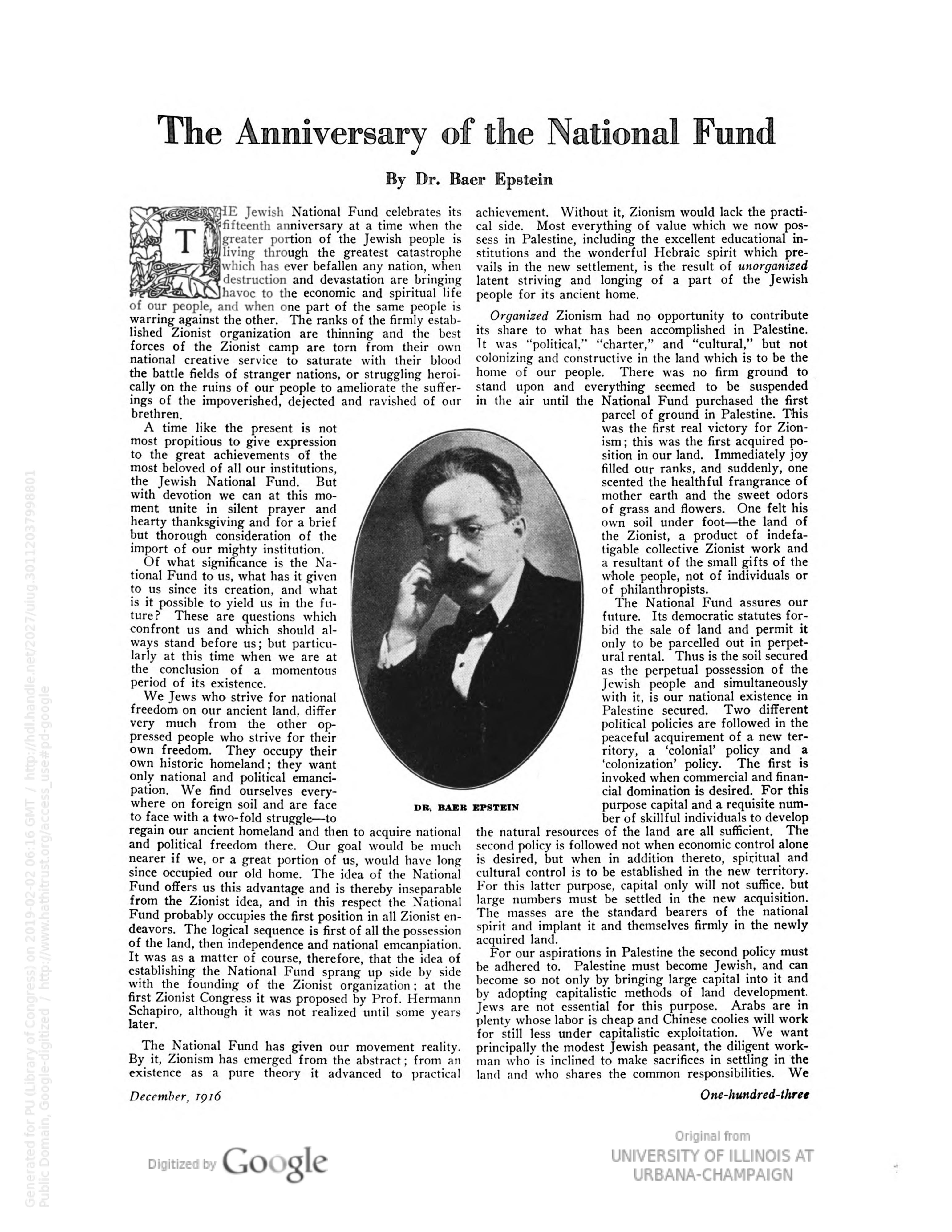
We Jews who strive for national freedom on our ancient land, differ very much from the other oppressed people who strive for their own freedom. They occupy their own historic homeland; they want only national and political emancipation. We find ourselves everywhere on foreign soil and are face DR, BAEI to face with a twofold struggle—to regain our ancient homeland and then to acquire national and political freedom there. Our goal would be much nearer if we, or a great portion of us, would have long since occupied our old home. The idea of the National Fund offers us this advantage and is thereby inseparable from the Zionist idea, and in this respect the National Fund probably occupies the first position in all Zionist endeavors. The logical sequence is first of all the possession of the land, then independence and national emcanpiation. It was as a matter of course, therefore, that the idea of establishing the National Fund sprang up side by side with the founding of the Zionist organization; at the first Zionist Congress it was proposed by Prof. Hermann Schapiro, although it was not realized until some years later.
The National Fund has given our movement reality. By it, Zionism has emerged from the abstract; from an existence as a pure theory it advanced to practical
achievement. Without it, Zionism would lack the practical side. Most everything of value which we now possess in Palestine, including the excellent educational institutions and the wonderful Hebraic spirit which prevails in the new settlement, is the result of unorganised latent striving and longing of a part of the Jewish people for its ancient home.
Organized Zionism had no opportunity to contribute its share to what has been accomplished in Palestine. It was "political," "charter," and "cultural," but not colonizing and constructive in the land which is to be the home of our people. There was no firm ground to stand upon and everything seemed to be suspended in the air until the National Fund purchased the first parcel of ground in Palestine. This was the first real victory for Zionism; this was the first acquired position in our land. Immediately joy filled our ranks, and suddenly, one scented the healthful frangrance of mother earth and the sweet odors of grass and flowers. One felt his own soil under foot —the land of the Zionist, a product of indefatigable collective Zionist work and a resultant of the small gifts of the whole people, not of individuals or of philanthropists.
The National Fund assures our future. Its democratic statutes forbid the sale of land and permit it only to be parcelled out in perpet- ural rental. Thus is the soil secured as the perpetual possession of the Jewish people and simultaneously with it, is our national existence in Palestine secured. Two different political policies are followed in the peaceful acquirement of a new territory, a 'colonial' policy and a 'colonization' policy. The first is invoked when commercial and financial domination is desired. For this purpose capital and a requisite number of skillful individuals to develop
the natural resources of the land are all sufficient. The second policy is followed not when economic control alone is desired, but when in addition thereto, spiritual and cultural control is to be established in the new territory. For this latter purpose, capital only will not suffice, but large numbers must be settled in the new acquisition. The masses are the standard bearers of the national spirit and implant it and themselves firmly in the newly acquired land.
For our aspirations in Palestine the second policy must be adhered to. Palestine must become Jewish, and can become so not only by bringing large capital into it and by adopting capitalistic methods of land development. Jews are not essential for this purpose. Arabs are in plenty whose labor is cheap and Chinese coolies will work for still less under capitalistic exploitation. We want principally the modest Jewish peasant, the diligent workman who is inclined to make sacrifices in settling in the land and who shares the common responsibilities. We