An Historical Event
The Victory of the Jewish Democracy in the American Jewish Congress
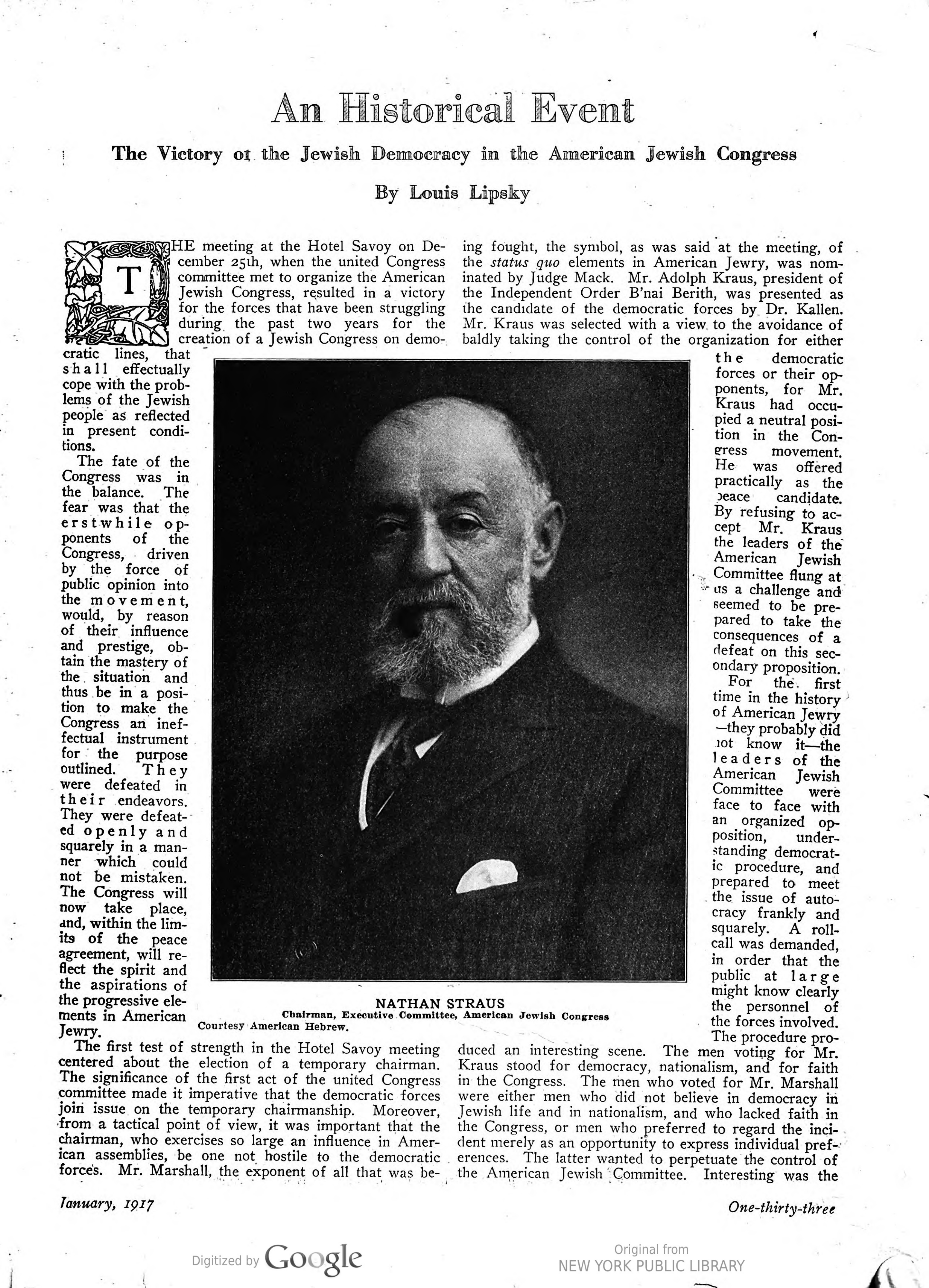
THE meeting at the Hotel Savoy on December 25th, when the united Congress committee met to organize the American Jewish Congress, resulted in a victory for the forces that have been struggling during the past two years for the creation of a Jewish Congress on democratic lines, that shall effectually cope with the problems of the Jewish people as reflected in present conditions.
The fate of the Congress was in the balance. The fear was that the erstwhile opponents of 6 Congress, > driven by the force of public opinion into the movement, would, by reason of their influence and prestige, obtain the mastery of the situation and thus be in a position to make the Congress an ineffectual instrument for’ the purpose outlined. They were defeated in their endeavors, They were defeated openly and squarely in a manner which 4 not be mistaken. The Congress will now take place, and, within the limits of the peace agreement, will reflect the spirit and the aspirations of the progressive elements in American Jewry.
The first test of strength in the Hotel Savoy meeting centered about the election of a temporary chairman. The significance of the first act of the united Congress committee made it imperative that the democratic forces join issue on the temporary chairmanship. Moreover, from a tactical point of view, it was important that the chairman, who exercises so large an influence in American assemblies, be one not hostile to the democratic forces. Mr. Marshall, the exponent of all that was be-
ing fought, the symbol, as was said at the meeting, of the status quo elements in American Jewry, was nominated by Judge Mack. Mr. Adolph Kraus, president of the Independent Order B'nai Berith, was presented as the candidate of the democratic forces by Dr. Kallen. Mr. Kraus was selected with a view to the avoidance of baldly taking the control of the organization for either
the democratic forces or their opponents, for Mr. Kraus had occupied a neutral position in the Congress movement. He was offered practically as the peace candidate. By refusing to accept Mr. Kraus the leaders of the American Jewish Committee flung at us a challenge and seemed to be prepared to take the consequences of a defeat on this secondary proposition.
For the first time in the history of American Jewry—they probably did not know it—the leaders of the American Jewish Committee were face with an organized opposition, understanding democratic procedure, and prepared to meet the issue of autocracy frankly and squarely. A roll-call was demanded, in order that the public at large might know clearly the personnel of the forces involved.
The procedure pro- en voting for Mr.
duced an interesting scene. The men voting for Mr. Kraus stood for democracy, nationalism, and for faith in the Congress. The men who voted for Mr. Marshall were either men who did not believe in democracy in Jewish life and in nationalism, and who lacked faith in the Congress, or men who preferred to regard the incident merely as an opportunity to express individual preferences. The latter wanted to perpetuate the control of the American Jewish Committee. Interesting was the