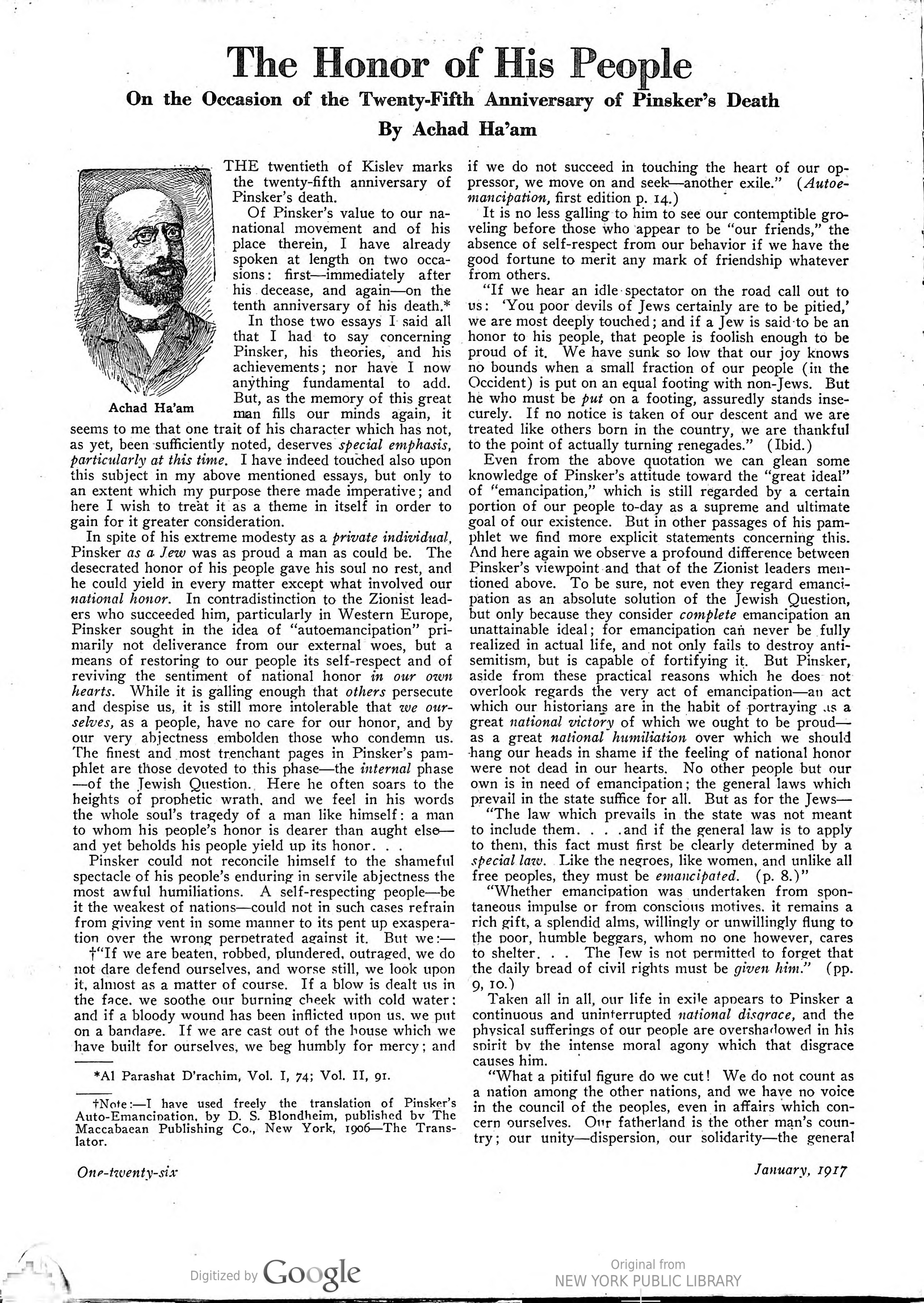
The Honor of His People On the Occasion of the Twenty-Fifth Anniversary of Pinsker's Death By Achad Ha'am
THE twentieth of Kislev marks the twenty-fifth anniversary of Pinsker's death.
Of Pinsker's value to our national movement and of his place therein, I have already spoken at length on two occasions: first—immediately after his decease, and again—on the tenth anniversary of his death.*
In those two essays I said all that I had to say concerning Pinsker, his theories, and his achievements; nor have I now anything fundamental to add. But, as the memory of this great man fills our minds again, it
seems to me that one trait of his character which has not, as yet, been sufficiently noted, deserves special emphasis, particularly at this time. I have indeed touched also upon this subject in my above mentioned essays, but only to an extent which my purpose there made imperative; and here I wish to treat it as a theme in itself in order to gain for it greater consideration.
In spite of his extreme modesty as a private individual, Pinsker as a Jew was as proud a man as could be. The desecrated honor of his people gave his soul no rest, and he could yield in every matter except what involved our national honor. In contradistinction to the Zionist leaders who succeeded him, particularly in Western Europe, Pinsker sought in the idea of "autoemancipation" primarily not deliverance from our external woes, but a means of restoring to our people its self-respect and of reviving the sentiment of national honor in our own hearts. While it is galling enough that others persecute and despise us, it is still more intolerable that we ourselves, as a people, have no care for our honor, and by our very abjectness embolden those who condemn us. The finest and most trenchant pages in Pinsker's pamphlet are those devoted to this phase—the internal phase—of the Jewish Question. Here he often soars to the heights of prophetic wrath, and we feel in his words the whole soul's tragedy of a man like himself: a man to whom his people's honor is dearer than aught else—and yet beholds his people yield up its honor. . .
Pinsker could not reconcile himself to the shameful spectacle of his people's enduring in servile abjectness the most awful humiliations. A self-respecting people—be it the weakest of nations—could not in such cases refrain from giving vent in some manner to its pent up exasperation over the wrong perpetrated against it. But we:—
†"If we are beaten, robbed, blundered, outraged, we do not dare defend ourselves, and worse still, we look upon it, almost as a matter of course. If a blow is dealt us in the face, we soothe our burning cheek with cold water; and if a bloody wound has been inflicted upon us, we put on a bandage. If we are cast out of the house which we have built for ourselves, we beg humbly for mercy; and
*Al Parashat D'rachim, Vol. I, 74; Vol. II, 91.
- The Maccabaean Publishing Co., New York, 1906—The Translator.
if we do not succeed in touching the heart of our oppressor, we move on and seek—another exile." (Autoemancipation, first edition p. 14.)
It is no less galling to him to see our contemptible groveling before those who appear to be "our friends," the absence of self-respect from our behavior if we have the good fortune to merit any mark of friendship whatever from others.
"If we hear an idle spectator on the road call out to us: 'You poor devils of Jews certainly are to be pitied,' we are most deeply touched; and if a Jew is said to be an honor to his people, that people is foolish enough to be proud of it. We have sunk so low that our joy knows no bounds when a small fraction of our people (in the Occident) is put on an equal footing with non-Jews. But he who must be put on a footing, assuredly stands insecurely. If no notice is taken of our descent and we are treated like others born in the country, we are thankful to the point of actually turning renegades." (Ibid.)
Even from the above quotation we can glean some knowledge of Pinsker's attitude toward the "great ideal" of "emancipation," which is still regarded by a certain portion of our people to-day as a supreme and ultimate goal of our existence. But in other passages of his pamphlet we find more explicit statements concerning this. And here again we observe a profound difference between Pinsker's viewpoint and that of the Zionist leaders mentioned above. To be sure, not even they regard emancipation as an absolute solution of the Jewish Question, but only because they consider complete emancipation an unattainable ideal; for emancipation can never be fully realized in actual life, and not only fails to destroy anti-semitism, but is capable of fortifying it. But Pinsker, aside from these practical reasons which he does not overlook regards the very act of emancipation which our historians are in the habit of portraying as a great national victory of which we ought to be proud as a great national humiliation over which we should hang our heads in shame if the feeling of national honor were not dead in our hearts. No other people but our own is in need of emancipation; the general laws which prevail in the state suffice for all. But as for the Jews
"The law which prevails in the state was not meant to include them. . . . and if the general law is to apply to them, this fact must first be clearly determined by a special law. Like the negroes, like women, and unlike all free peoples, they must be emancipated." (p. 8.)
"Whether emancipation was undertaken from spontaneous impulse or from conscious motives, it remains a rich gift, a splendid alms, willingly or unwillingly flung to the poor, humble beggars, whom no one however, cares to shelter. . . . The Jew is not permitted to forget that the daily bread of civil rights must be given him." (pp. 9, 10.)
Taken all in all, our life in exile appears to Pinsker a continuous and uninterrupted national disgrace, and the physical sufferings of our people are overshadowed in his spirit by the intense moral agony which that disgrace causes him.
"What a pitiful figure do we cut! We do not count as a nation among the other nations, and we have no voice in the council of the peoples, even in affairs which concern ourselves. Our fatherland is the other man's country; our unity —dispersion, our solidarity—the general