What Has Pinsker Given Us?
ODERN Jewish cultural history consists of three epochs: the epoch of compromise, the epoch of national negation, and the epoch of national affirmation. Mendelsohn was the father of the first epoch; Pinsker of the third.
The philosophy of the first epoch attempted a compromise between Judaism and general culture in that it founded the conception of Judaism on a religious basis and denied its national element. The. enlightened minds at the end of the eighteenth century regarded religion as an unimportant factor in life; hence the Jewish religion, too, must cease to dominate Jewish life and control the individual or group. They granted that there is a Jewish religion, but at the same time they considered the teachings of Frederick the Great: “Jeder kann nach seiner Facon selig werden” (everyone can find salvation according to his own fashion)—a cardinal principle and guide in life. Thus the predomi- nance of the Jewish religion deteri- orated, as a matter of course. Men- delsohn’s disciples did not hear this from their master explicitly but they implied this signification. The master wanted merely to compromise but the disciples went much further—they reduced Judaism so that there was nothing left of it to compromise. Heinrich Heine ex-pressed’ the opinion of Mendel- sohn’s disciples when he proclaimed: “Judaism is only a misfortune.”
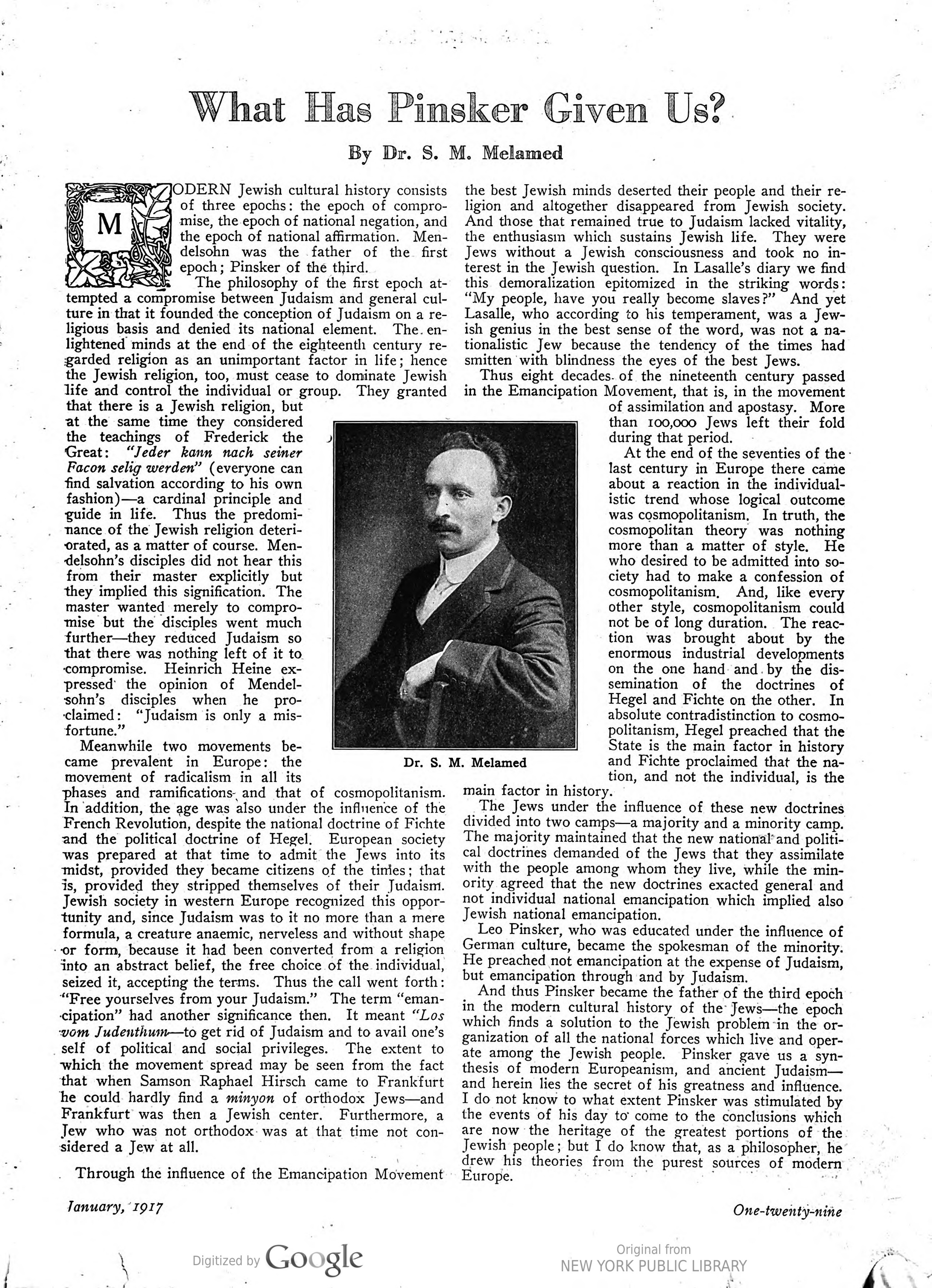
Meanwhile two movements be- (Gaui oS came prevalent in Europe: the Dr. S. movement of radicalism in all its phases and ramifications. and that of cosmopolitanism. In ‘addition, the age was also under the influence of the French Revolution, despite the national doctrine of Fichte and the political doctrine of Hegel. European society was prepared at that time to admit the Jews into its midst, provided they became citizens of the tinies; that is, provided they stripped themselves of their Judaism. Jewish society in western Europe recognized this opportunity and, since Judaism was to it no more than a mere formula, a creature anaemic, nerveless and without shape -or form, because it had been converted from a religion into an abstract belief, the free choice of the individual, seized it, accepting the terms. Thus the call went forth: “Free yourselves from your Judaism.” The term “eman- ‘cipation” had another significance then. It meant “Los ‘vom Judenthum—to get rid of Judaism and to avail one’s self of political and social privileges. The extent to which the movement spread may be seen from the fact that when Samson Raphael Hirsch came to Frankfurt he could hardly find a minyon of orthodox Jews—and Frankfurt was then a Jewish center. Furthermore, a Jew who was not orthodox: was at that time not considered a Jew at all.
Through the influence of the Emancipation Movement
the best Jewish minds deserted their people and their religion and altogether disappeared from Jewish society. And those that remained true to Judaism lacked vitality, the enthusiasm which sustains Jewish life. They were Jews without a Jewish consciousness and took no interest in the Jewish question. In Lasalle’s diary we find this demoralization epitomized in the striking words: “My people, have you really become slaves?” And yet Lasalle, who according to his temperament, was a Jewish genius in the best sense of the word, was not a nationalistic Jew because the tendency of the times had smitten with blindness the eves of the hect Tewe.
Thus eight decades. of the nineteenth century passed in the Emancipation Movement, that is, in the movement of assimilation and apostasy. More than 100,000 Jews left their fold during that period.
At the end of the seventies of the last century in Europe there came about a reaction in the individualistic trend whose logical outcome was cosmopolitanism. In truth, the cosmopolitan theory was nothing more than a matter of style. He who desired to be admitted into society had to make a confession of cosmopolitanism. And, like every other style, cosmopolitanism could not be of long duration. The reaction was brought about by the enormous industrial developments on the one hand and by the dissemination of the doctrines of Hegel and Fichte on the other. In absolute contradistinction to cosmopolitanism, Hegel preached that the State is the main factor in history and Fichte proclaimed that the nation, and not the individual, is the
main factor in history. The Jews under the influence of these new doctrines divided into two camps—a majority and a minority camp. The majority maintained that the new national’and political doctrines demanded of the Jews that they assimilate with the people among whom they live, while the minority agreed that the new doctrines exacted general and not individual national emancipation which implied also © Jewish national emancipation.
Leo Pinsker, who was educated under the influence of German culture, became the spokesman of the minority. He preached not emancipation at the expense of Judaism, but emancipation through and by Judaism.
And thus Pinsker became the father of the third epoch in the modern cultural history of the Jews—the epoch which finds a solution to the Jewish problem-in the organization of all the national forces which live and operate among the Jewish people. Pinsker gave us a synthesis of modern Europeanism, and ancient Judaism— and herein lies the secret of his greatness and influence. I do not know to what extent Pinsker was stimulated by the events of his day to come to the conclusions which are now the heritage of the greatest portions of the Jewish people; but I do know that, as a philosopher, he drew his theories from the purest sources of modern Europe. 2 \ ; ate?