THE MACCABAEAN
The negative and often destructive attitude of the men he raised and educated as teachers in Israel met with his thorough disapproval and was not infrequently a cource af hitterect dieannnintment ta him.
Wise was an opponent of Zionism, yet he at least had the merit of originality and true sincerity in his opposition to the movement, something which cannot be said of many of the Reform Protestrabbiner of our day. Credit should be given him for speaking favorably of the Palestinian colonization scheme, even if he favored it largely from a charity viewpoint only (p. 349). We can afford to forgive him his stricture on Theodor Herzl whom he called a politician (p. 350), remembering that, in his day, Reform, harking back to the old construction placed upon the Reform movement by the early German Reformers was still synonymous with anti-nationalism. Nevertheless, Wise never was guilty of the folly indulged in by so many of his younger colleagues of our time of denying that the Jews constituted a race. He even found it hard not to speak of the Jews as a nation, though he denied that they constituted a nationality. The very first book he published he styled “The History of the Israelitish Nation from Abraham to the Present Time” (p. 143). If he did not state it in so many words he at least implied that the Jews were more than a mere religious community. His statement that “the Jew’s nationality is in his blood” (p. 345) is significant.
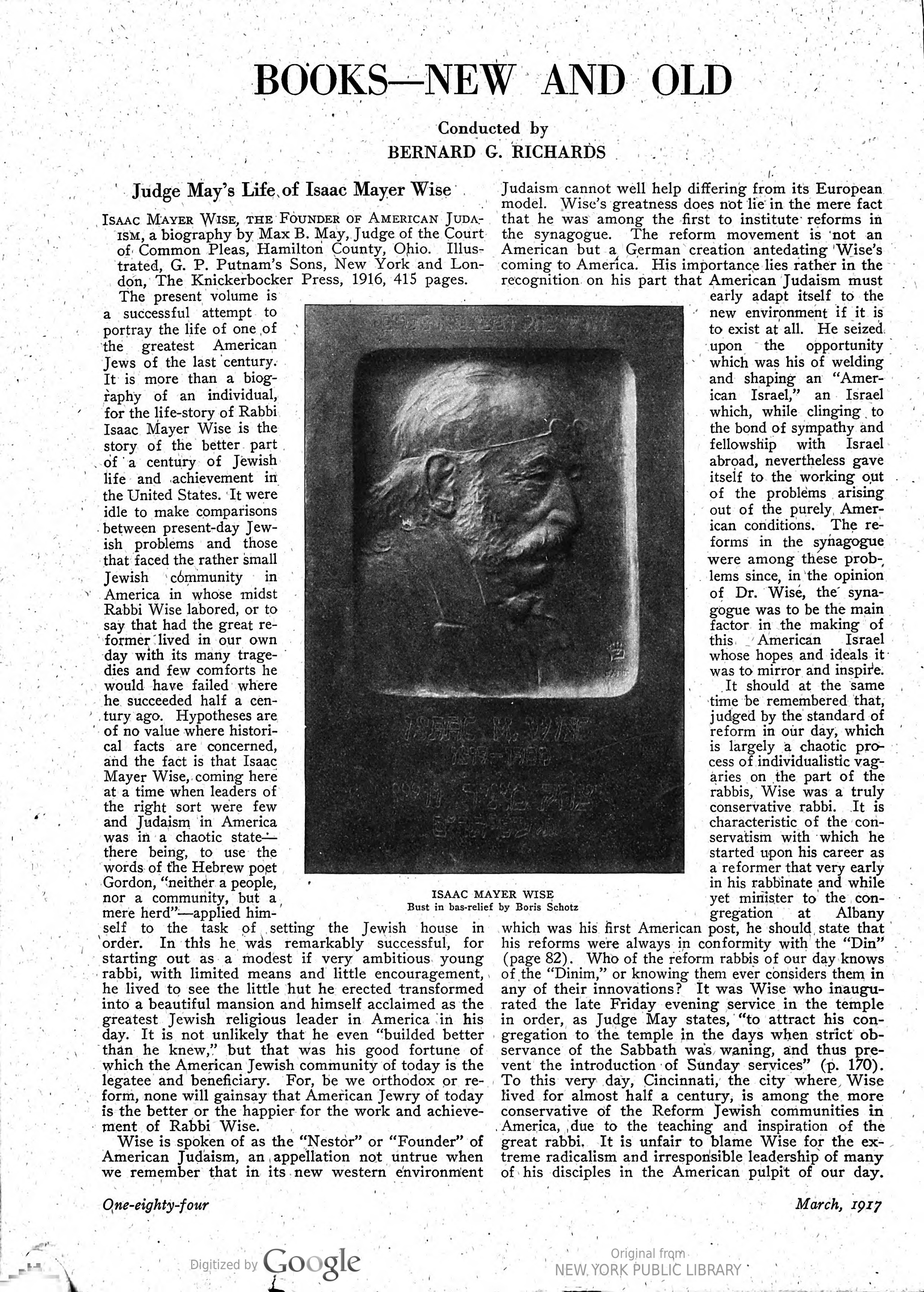
Vineet. הפ אוב a ee ואו SR .יכוי ee tee oe Apropos of this it is of interest to note that the finest likeness of Dr. Wise was made by a Zionist and one of the foremost workers among the handful of idealists who are actually engaged in the rebuilding of the wastes of Palestine. I mean our own Professor Boris Schatz, of Jerusalem, who made a remarkable bust in bas-relief of the old rabbi. A picture from a photograph of this piece of sculpture forms the frontispiece illustration of this book.
ae oe ne er ee, on In the history of American Israel, Rabbi Wise will never be forgotten as the great preacher and wonderful organizer, author of many works, editor for almost half a century of The American Israelite in English and Die Deborah in German, organizer of the Union of American Hebrew Congregations, and founder of the Hebrew Union College and of the Central Conference of American Rabbis. And Mr. May has performed a great and valuable task in giving so lucid an account of the life of his renowned grandfather. To his pupils and friends who were privileged to know him in the flesh, Rabbi Wise will always remain the “Grand Old Man,” the friend and companion no less than the teacher and guide, the man of keen vision and broad sympathies whose unbounded love of humanity and of freedom for all, emanated in greatest measure from the affection he harbored for his own people, for whose enlightenment he toiled and suffered and whose rights and liberties both here and abroad he indefatigably sought to establish and protect.
The Story of an Immigrant Boy
"WITTE ARRIVES," a Novel by Elias Tobenkin, New York, Frederick A. Stokes Company.
N “Witte Arrives,” Mr. Tobenkin, who is a well-known newspaper and magazine writer, tells a simple, direct and straightforward story of the evolution of a Jewish immigrant boy, who grows up
in a small western town and ultimately attains a prominent position in the writing profession. The story is told naturally, without any affectation, with a great deal of sympathy for the life which is depicted and with a certain filial tenderness which is especially notable; but the simplicity of the story often borders on the commonplace and much of the description and characterization fails to escape the obvious and the trite. Mr. Tobenkin writes with feeling, but without distinction. He descends too often to slipshod, haphazard newspaper writing and much of the work is of a sketchy and meagre character. Still, though the new novelist lacks style, his story is essentially true to life and vividly reflects many phases of American-Jewish life. One follows the unfolding of the plot with much interest and a great deal of sympathy for the Wittkofekv familv.
Becoming a reporter first for a small country newspaper and then for a Chicago daily, and being called upon to describe the conditions of the poor, Witte of course must become a socialist. But despite the prevailing attitude in Jewish socialist circles and thanks, perhaps, to a more wholesome western atmosphere, he retains his respect for the traditions and aspirations of his people and throughout the vicissitudes of his career, keeps alive his devotion to his simple old-fashioned parents. It is, of course, a question how much the presence of sincerity can make up for the absence of art, but the intense honesty of purpose, as well as the power of observation and the undoubted talent for delineation already displayed, give much promise for Mr. Tobenkin’s future achievements by which he will ultimately surely “arrive.”
The Literary Landmarks of Jerusalem are among the most important, the most interesting, and the most sacred in the whole history of the literature of the world. David, perhaps, wrote some of the immortal Psalms as he looked from the roof of his palace upon the slopes of the Mount of Olives, with the blue hills of Moab and the silver gleam of the Dead Sea in the distance. Here were written, perhaps, the Songs of Solomon. Here Ezra may, perhaps, have written the Chronicles and his own books of prophecy. Here, perhaps, Nehemiah indited the book that bears his name. Here, perhaps, Isaiah wrote. Here, no doubt, Jeremiah uttered his words of warning, and here, no doubt, he wrote his Lamentations...
These are the Literary Landmarks which survive the crash of empires and the march of Time, which cause the eye to fill and the heart to throb; which made Jerusalem the most imposing, the most memorable place I ever visited—From “Literary Landmarks of Jerusalem,” by Laurence Hutton, New York, Harper & Brothers, 1895.
Books Received
"A HISTORY OF MEDIEVAL JEWISH PHILOSOPHY," by Isaac Husik, New York, Macmillan Co."THINGS SEEN IN PALESTINE," by A. Goodrich-Freer, F.R.S.G.S., New York, E. P. Dutton & Co.