Herman Rosenthal: An Appreciation
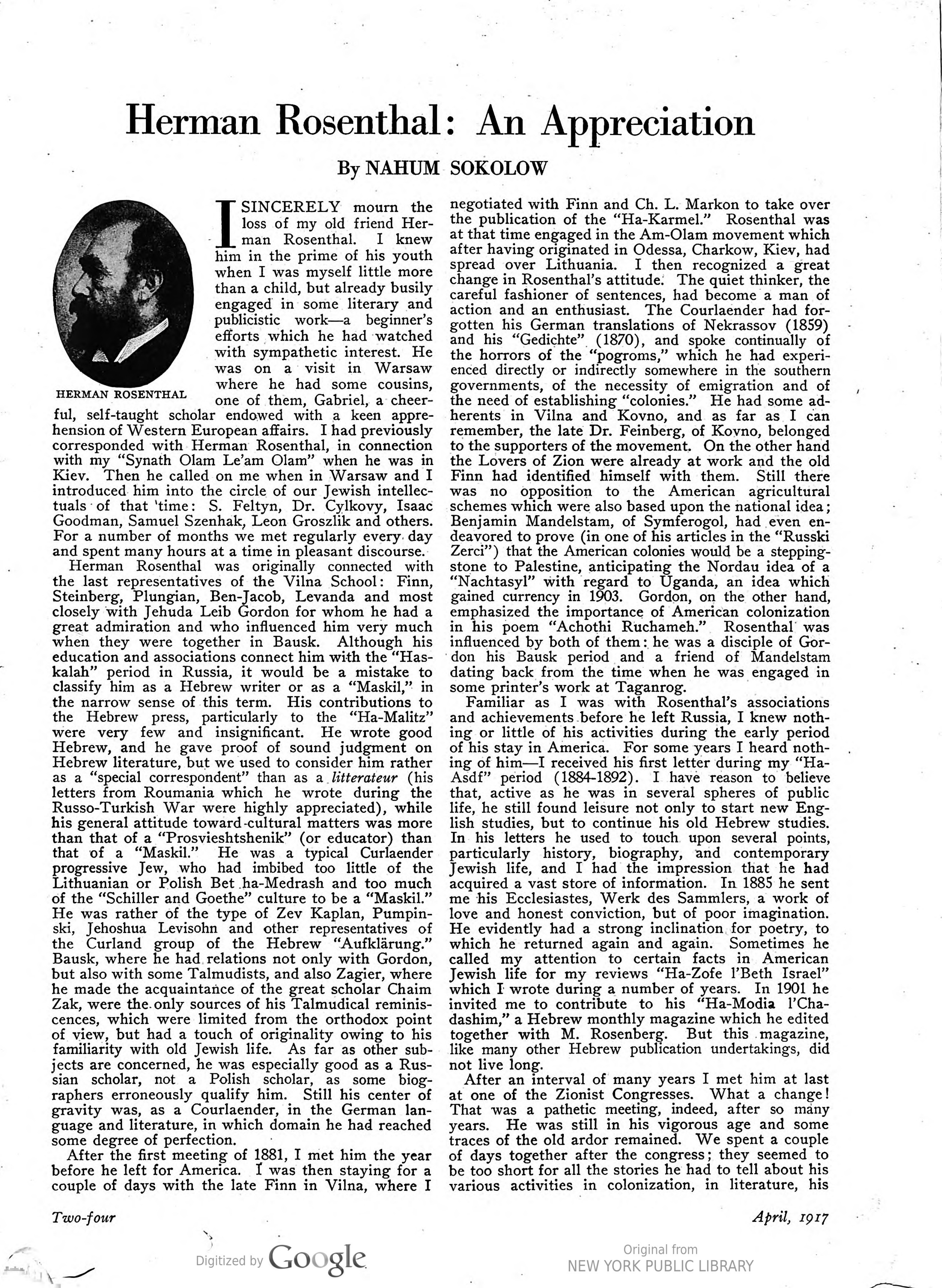
SINCERELY mourn the > י loss of my old friend Her- 7 aa - ן man Rosenthal. I knew a 1 him in the prime of his youth - ₪ ₪ 9 when I was myself little more a % ye vey than a child, but already busily - ies 4 engaged in some literary and 4 i publicistic work—a beginner’s 4 : efforts which he had watched ar with sympathetic interest. He was on a visit in Warsaw where he had some cousins, BES BOSERTEAE one of them, Gabriel, a cheerful, self-taught scholar endowed with a keen apprehension of Western European affairs. I had previously corresponded with Herman Rosenthal, in connection with my “Synath Olam Le’am Olam” when he was in Kiev. Then he called on me when in Warsaw and I introduced. him into the circle of our Jewish intellectuals:of that ‘time: ₪. Feltyn, Dr. Cylkovy, Isaac Goodman, Samuel Szenhak, Leon Groszlik and others. For a number of months we met regularly every. day and spent many hours at a time in pleasant discourse. Herman Rosenthal was originally connected with the last representatives of the Vilna School: Finn, Steinberg, Plungian, Ben-Jacob, Levanda and most closely ‘with Jehuda Leib Gordon for whom he had a great admiration and who influenced him very much when they were together in Bausk. Although his education and associations connect him with the “Haskalah” period in Russia, it would be a mistake to classify him as a Hebrew writer or as a “Maskil,” in the narrow sense of this term. His contributions to the Hebrew press, particularly to the “Ha-Malitz” were very few and insignificant. He wrote good Hebrew, and he gave proof of sound judgment on Hebrew literature, but we used to consider him rather as a “special correspondent” than as a _litterateur (his letters from Roumania which he wrote during the Russo-Turkish War were highly appreciated), while his general attitude toward-cultural matters was more than that of a “Prosvieshtshenik” (or educator) than that of a “Maskil.” He was a typical Curlaender progressive Jew, who had imbibed too little of the Lithuanian or Polish Bet ha-Medrash and too much of the “Schiller and Goethe” culture to be a “Maskil.” He was rather of the type of Zev Kaplan, Pumpin- ski, Jehoshua Levisohn and other representatives of the Curland group of the Hebrew “Aufklarung.” Bausk, where he had _ relations not only with Gordon, but also with some Talmudists, and also Zagier, where he made the acquaintance of the great scholar Chaim Zak, were the.only sources of his Talmudical reminiscences, which were limited from the orthodox point of view, but had a touch of originality owing to his familiarity with old Jewish life. As far as other subjects are concerned, he was especially good as a Russian scholar, not a Polish scholar, as some biographers erroneously qualify him. Still his center of gravity was, as a Courlaender, in the German language and literature, in which domain he had reached some degree of perfection. : 07% קורו Ae cose) ירוט 9 ae mee ב ויוי - ורי 5 בו לי רוע א ב - :> ב
After the first meeting of 1881, I met him the year before he left for America. I was then staying for a couple of days with the late Finn in Vilna, where I
negotiated with Finn and Ch. L. Markon to take over the publication of the “Ha-Karmel.” Rosenthal was at that time engaged in the Am-Olam movement which after having originated in Odessa, Charkow, Kiev, had spread over Lithuania. I then recognized a great change in Rosenthal’s attitude: The quiet thinker, the careful fashioner of sentences, had become a man of action and an enthusiast. The Courlaender had forgotten his German translations of Nekrassov (1859) and his “Gedichte” (1870), and spoke continually of the horrors of the “pogroms,” which he had experienced directly or indirectly somewhere in the southern governments, of the necessity of emigration and of the need of establishing “colonies.” He had some adherents in Vilna and Kovno, and as far as I can remember, the late Dr. Feinberg, of Kovno, belonged to the supporters of the movement. On the other hand the Lovers of Zion were already at work and the old Finn had identified himself with them. Still there Was no opposition to the American agricultural schemes which were also based upon the national idea; Benjamin Mandelstam, of Symferogol, had even endeavored to prove (in one of his articles in the “Russki Zerci”) that the American colonies would be a stepping-stone to Palestine, anticipating the Nordau idea of a “Nachtasyl” with regard to Uganda, an idea which gained currency in 1903. Gordon, on the other hand, emphasized the importance of American colonization in his poem “Achothi Ruchameh.” Rosenthal was influenced by both of them: he was a disciple of Gor- ‘don his Bausk period and a friend of Mandelstam dating back from the time when he was engaged in some printer’s work at Taganrog.
Familiar as I was with Rosenthal's associations and achievements before he left Russia, I knew nothing or little of his activities during the early period of his stay in America. For some years I heard nothing of him—I received his first letter during my "Ha-Asdf" period (1884-1892). I have reason to believe that, active as he was in several spheres of public life, he still found leisure not only to start new English studies, but to continue his old Hebrew studies. In his letters he used to touch upon several points, particularly history, biography, and contemporary Jewish life, and I had the impression that he had acquired a vast store of information. In 1885 he sent me his Ecclesiastes, Werk des Sammlers, a work of love and honest conviction, but of poor imagination. He evidently had a strong inclination for poetry, to which he returned again and again. Sometimes he called my attention to certain facts in American Jewish life for my reviews "Ha-Zofe I'Beth Israel" which I wrote during a number of years. In 1901 he invited me to contribute to his "Ha-Modia I'Chadashim," a Hebrew monthly magazine which he edited together with M. Rosenberg. But this magazine, like many other Hebrew publication undertakings, did not live long.
After an interval of many years 1 met him at last at one of the Zionist Congresses. What a change! That was a pathetic meeting, indeed, after so many years. He was still in his vigorous age and some traces of the old ardor remained. We spent a couple of days together after the congress; they seemed to be too short for all the stories he had to tell about his various activities in colonization, in literature, his