“WITH MALICE TOWARD NONE”
“The Mission” in Dispersion
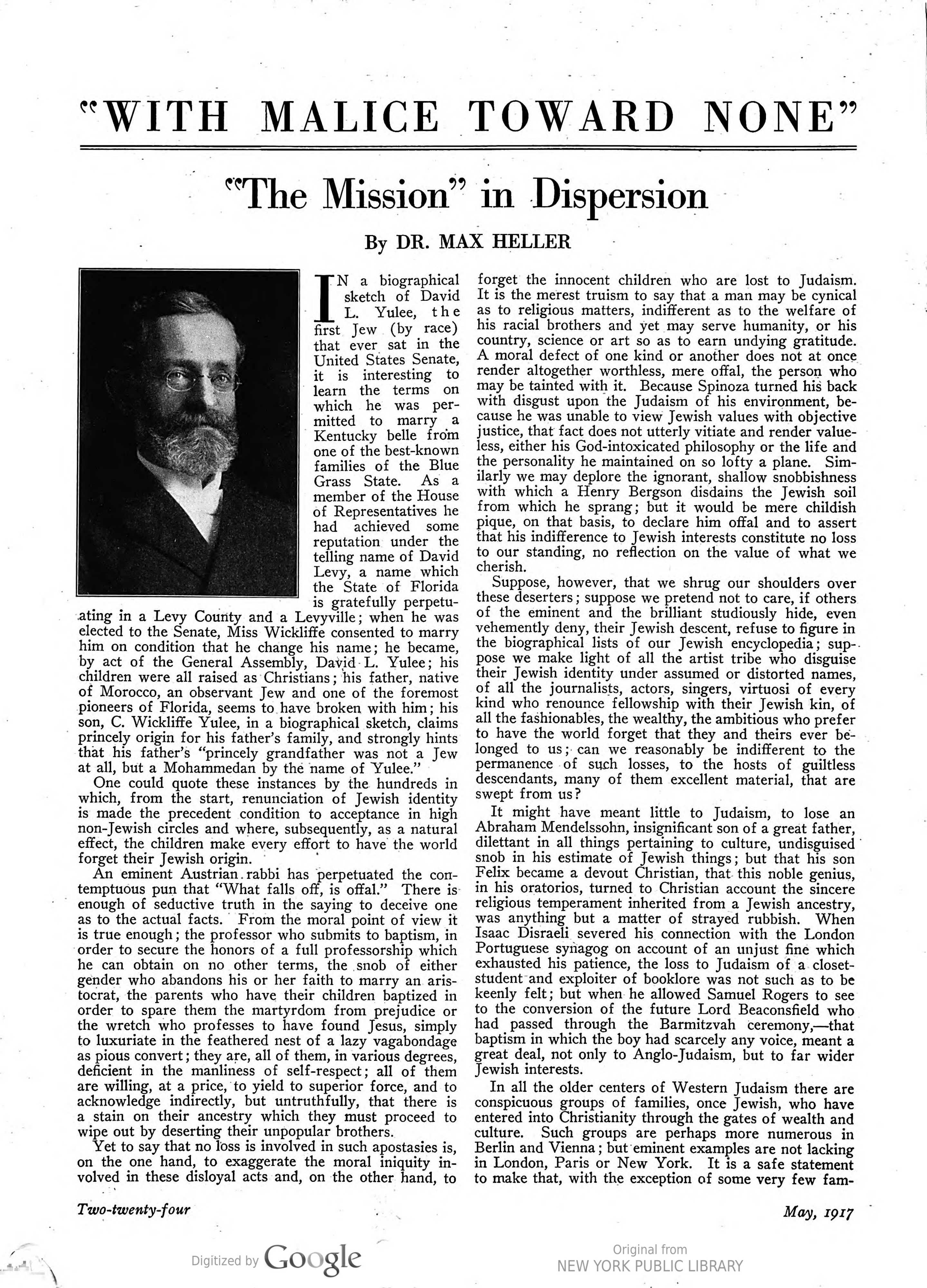
I N a biographical sketch of David L. Yulee, the first Jew (by race) that ever sat in the United States Senate, it is interesting to learn the terms on which he was permitted to marry a Kentucky belle from one of the best-known families of the Blue Grass State. As a member of the House of Representatives he had achieved some reputation under the telling name of David Levy, a name which the State of Florida is gratefully perpetu-
atting in a Levy County and a Levyville; when he was elected to the Senate, Miss Wickliffe consented to marry him on condition that he change his name; he became, by act of the General Assembly, David L. Yulee; his children were all raised as Christians; his father, native of Morocco, an observant Jew and one of the foremost pioneers of Florida, seems to have broken with him; his son, C. Wickliffe Yulee, in a biographical sketch, claims princely origin for his father’s family, and strongly hints that his father’s “princely grandfather was not a Jew at all, but a Mohammedan by the name of Yulee.”
One could quote these instances by the hundreds in which, from the start, renunciation of Jewish identity is made the precedent condition to acceptance in high non-Jewish circles and where, subsequently, as a natural effect, the children make every effort to have the world forget their Jewish origin.
An eminent Austrian.rabbi has perpetuated the contemptuous pun that “What falls off, is offal.’ There is enough of seductive truth in the saying to deceive one as to the actual facts. From the moral point of view it is true enough; the professor who submits to baptism, in order to secure the honors of a full professorship which he can obtain on no other terms, the snob of either gender who abandons his or her faith to marry an aristocrat, the parents who have their children baptized in order to spare them the martyrdom from prejudice or the wretch who professes to have found Jesus, simply to luxuriate in the feathered nest of a lazy vagabondage as pious convert ; they are, all of them, in various degrees, deficient in the manliness of self-respect; all of them are willing, at a price, to yield to superior force, and to acknowledge indirectly, but untruthfully, that there is a stain on their ancestry which they must proceed to wipe out by deserting their unpopular brothers.
Yet to say that no loss is involved in such apostasies is, on the one hand, to exaggerate the moral iniquity involved in these disloyal acts and, on the other hand, to
forget the innocent children who are lost to Judaism. It is the merest truism to say that a man may be cynical as to religious matters, indifferent as to the welfare of his racial brothers and yet may serve humanity, or his country, science or art so as to earn undying gratitude. A moral defect of one kind or another does not at once render altogether worthless, mere offal, the person who may be tainted with it. Because Spinoza turned his back with disgust upon the Judaism of his environment, because he was unable to view Jewish values with objective justice, that fact does not utterly vitiate and render valueless, either his God-intoxicated philosophy or the life and the personality he maintained on so lofty a plane. Similarly we may deplore the ignorant, shallow snobbishness with which a Henry Bergson disdains the Jewish soil from which he sprang; but it would be mere childish pique, on that basis, to declare him offal and to assert that his indifference to Jewish interests constitute no loss to our standing, no reflection on the value of what we cherish.
Suppose, however, that we shrug our shoulders over these deserters; suppose we pretend not to care, if others of the eminent and the brilliant studiously hide, even vehemently deny, their Jewish descent, refuse to figure in the biographical lists of our Jewish encyclopedia; suppose we make light of all the artist tribe who disguise their Jewish identity under assumed or distorted names, of all the journalists, actors, singers, virtuosi of every kind who renounce fellowship with their Jewish kin, of all the fashionables, the wealthy, the ambitious who prefer to have the world forget that they and theirs ever belonged to us; can we reasonably be indifferent to the permanence of such losses, to the hosts of guiltless descendants, many of them excellent material, that are swept from us?
It might have meant little to Judaism, to lose an Abraham Mendelssohn, insignificant son of a great father, dilettant in all things pertaining to culture, undisguised snob in his estimate of Jewish things; but that his son Felix became a devout Christian, that this noble genius, in his oratorios, turned to Christian account the sincere religious temperament inherited from a Jewish ancestry, was anything but a matter of strayed rubbish. When Isaac Disraeli severed his connection with the London Portuguese synagog on account of an unjust fine which exhausted his patience, the loss to Judaism of a closet-student and exploiter of booklore was not such as to be keenly felt; but when he allowed Samuel Rogers to see to the conversion of the future Lord Beaconsfield who had passed through the Barmitzvah ceremony,—that baptism in which the boy had scarcely any voice, meant a great deal, not only to Anglo-Judaism, but to far wider Jewish interests.
In all the older centers of Western Judaism there are conspicuous groups of families, once Jewish, who have entered into Christianity through the gates of wealth and culture. Such groups are perhaps more numerous in Berlin and Vienna; but eminent examples are not lacking in London, Paris or New York. It is a safe statement to make that, with the exception of some very few fam-