The Russian Revolution and Zionism
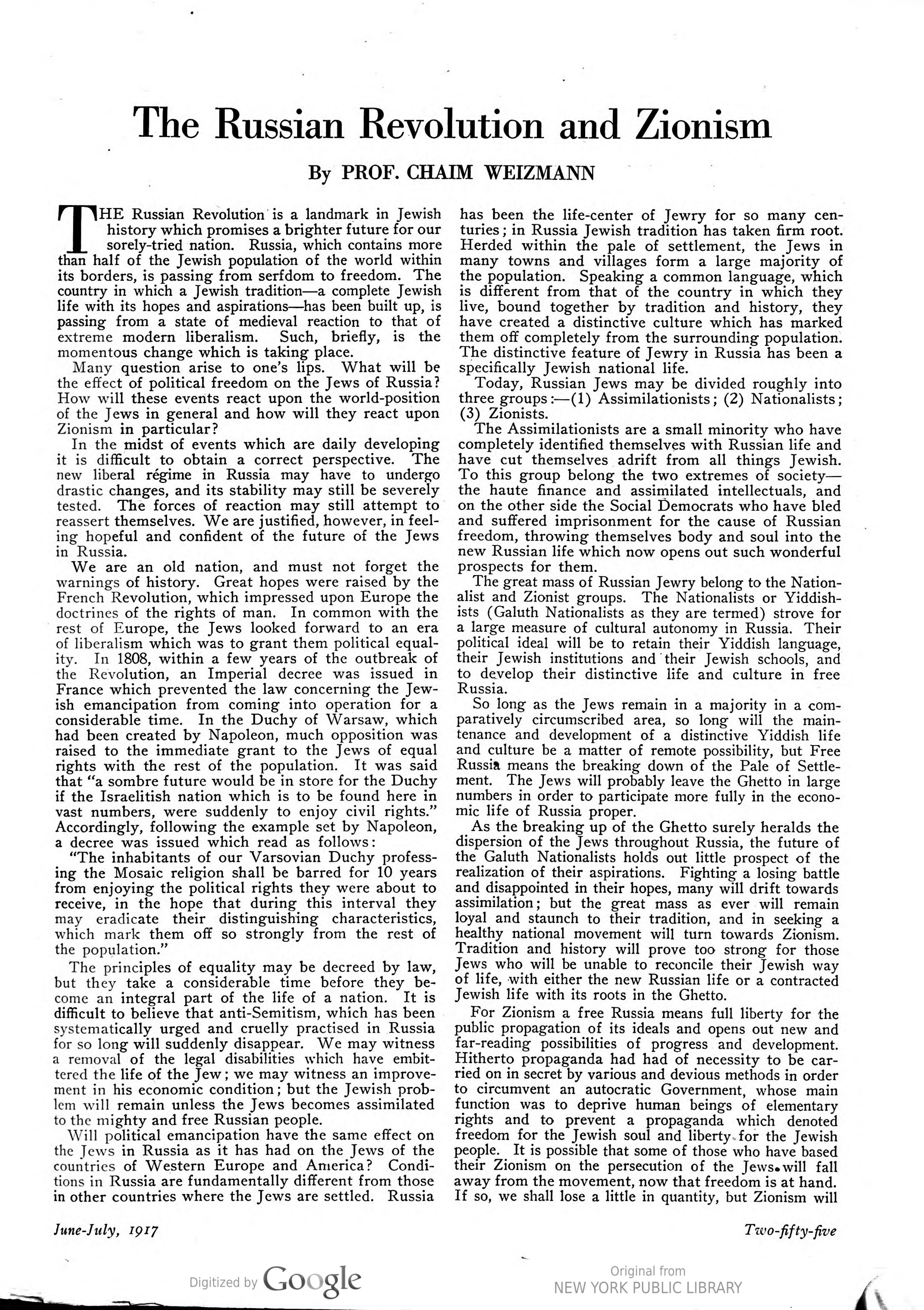
THE Russian Revolution is a landmark in Jewish history which promises a brighter future for our sorely-tried nation. Russia, which contains more than half of the Jewish population of the world within its borders, is passing from serfdom to freedom. The country in which a Jewish tradition—a complete Jewish life with its hopes and aspirations—has been built up, is passing from a state of medieval reaction to that of extreme modern liberalism. Such, briefly, is the momentous change which is taking place.
Many question arise to one's lips. What will be the effect of political freedom on the Jews of Russia? How will these events react upon the world-position of the Jews in general and how will they react upon Zionism in particular?
In the midst of events which are daily developing it is difficult to obtain a correct perspective. The new liberal régime in Russia may have to undergo drastic changes, and its stability may still be severely tested. The forces of reaction may still attempt to reassert themselves. We are justified, however, in feeling hopeful and confident of the future of the Jews in Russia.
We are an old nation, and must not forget the warnings of history. Great hopes were raised by the French Revolution, which impressed upon Europe the doctrines of the rights of man. In common with the rest of Europe, the Jews looked forward to an era of liberalism which was to grant them political equality. In 1808, within a few years of the outbreak of the Revolution, an Imperial decree was issued in France which prevented the law concerning the Jewish emancipation from coming into operation for a considerable time. In the Duchy of Warsaw, which had been created by Napoleon, much opposition was raised to the immediate grant to the Jews of equal rights with the rest of the population. It was said that “a sombre future would be in store for the Duchy if the Israelitish nation which is to be found here in vast numbers, were suddenly to enjoy civil rights.” Accordingly, following the example set by Napoleon, a decree was issued which read as follows:
"The inhabitants of our Varsovian Duchy professing the Mosaic religion shall be barred for 10 years from enjoying the political rights they were about to receive, in the hope that during this interval they may eradicate their distinguishing characteristics, which mark them off so strongly from the rest of the population."
The principles of equality may be decreed by law, but they take a considerable time before they become an integral part of the life of a nation. It is difficult to believe that anti-Semitism, which has been systematically urged and cruelly practised in Russia for so long will suddenly disappear. We may witness a removal of the legal disabilities which have embittered the life of the Jew; we may witness an improvement in his economic condition; but the Jewish problem will remain unless the Jews becomes assimilated to the mighty and free Russian people.
Will political emancipation have the same effect on the Jews in Russia as it has had on the Jews of the countries of Western Europe and America? Conditions in Russia are fundamentally different from those in other countries where the Jews are settled. Russia
has been the life-center of Jewry for so many centuries ; in Russia Jewish tradition has taken firm root. Herded within the pale of settlement, the Jews in many towns and villages form a large majority of the population. Speaking a common language, which is different from that of the country in which they live, bound together by tradition and history, they have created a distinctive culture which has marked them off completely from the surrounding population. The distinctive feature of Jewry in Russia has been a specifically Jewish national life.
Today, Russian Jews may be divided roughly into three groups:—(1) Assimilationists; (2) Nationalists; (3) Zionists.
The Assimilationists are a small minority who have completely identified themselves with Russian life and have cut themselves adrift from all things Jewish. To this group belong the two extremes of society—the haute finance and assimilated intellectuals, and on the other side the Social Democrats who have bled and suffered imprisonment for the cause of Russian freedom, throwing themselves body and soul into the new Russian life which now opens out such wonderful prospects for them.
The great mass of Russian Jewry belong to the Nationalist and Zionist groups. The Nationalists or Yiddishists (Galuth Nationalists as they are termed) strove for a large measure of cultural autonomy in Russia. Their political ideal will be to retain their Yiddish language, their Jewish institutions and their Jewish schools, and to develop their distinctive life and culture in free Russia.
So long as the Jews remain in a majority in a comparatively circumscribed area, so long will the maintenance and development of a distinctive Yiddish life and culture be a matter of remote possibility, but Free Russia means the breaking down of the Pale of Settlement. The Jews will probably leave the Ghetto in large numbers in order to participate more fully in the economic life of Russia proper.
As the breaking up of the Ghetto surely heralds the dispersion of the Jews throughout Russia, the future of the Galuth Nationalists holds out little prospect of the realization of their aspirations. Fighting a losing battle and disappointed in their hopes, many will drift towards assimilation; but the great mass as ever will remain loyal and staunch to their tradition, and in seeking a healthy national movement will turn towards Zionism. Tradition and history will prove too strong for those Jews who will be unable to reconcile their Jewish way of life, with either the new Russian life or a contracted Jewish life with its roots in the Ghetto.
For Zionism a free Russia means full liberty for the public propagation of its ideals and opens out new and far-reading possibilities of progress and development. Hitherto propaganda had had of necessity to be carried on in secret by various and devious methods in order to circumvent an autocratic Government, whose main function was to deprive human beings of elementary rights and to prevent a propaganda which denoted freedom for the Jewish soul and liberty for the Jewish people. It is possible that some of those who have based their Zionism on the persecution of the Jews will fall away from the movement, now that freedom is at hand. If so, we shall lose a little in quantity, but Zionism will