Kinnereth: A Soliloquy
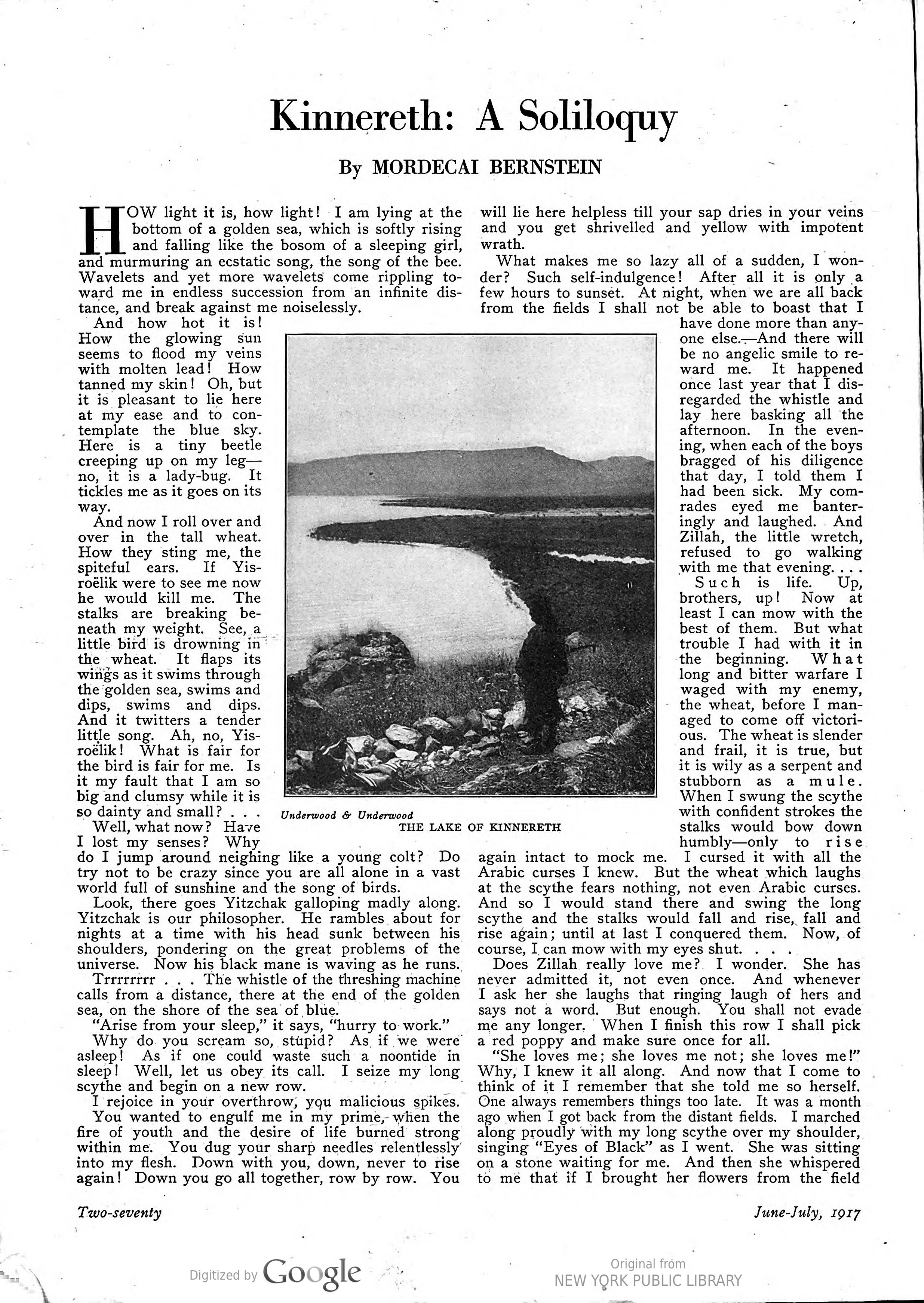
HOW light it is, how light! I am lying at the bottom of a golden sea, which is softly rising and falling like the bosom of a sleeping girl, and murmuring an ecstatic song, the song of the bee. Wavelets and yet more wavelets come rippling toward me in endless succession from an infinite distance, and break against me noiselessly.
And how hot it is! How the glowing sun seems to flood my veins with molten lead! How tanned my skin! Oh, but it is pleasant to lie here at my ease and to contemplate the blue sky. Here is a tiny beetle creeping up on my leg— no, it is a lady-bug. It tickles me as it goes on its way.
And now I roll over and over in the tall wheat. How they sting me, the spiteful ears. If Yisroëlik were to see me now he would kill me. The stalks are breaking beneath my weight. See, a little bird is drowning in the wheat. It flaps its wings as it swims through the golden sea, swims and dips, swims and dips. And it twitters a tender little song. Ah, no, Yisroëlik! What is fair for the bird is fair for me. Is it my fault that I am so big and clumsy while it is so dainty and small? . . .
Well, what now? Have I lost my senses? Why do I jump around neighing like a young colt? Do try not to be crazy since you are all alone in a vast world full of sunshine and the song of birds.
Look, there goes Yitzchak galloping madly along. Yitzchak is our philosopher. He rambles about for nights at a time with his head sunk between his shoulders, pondering on the great problems of the universe. Now his black mane is waving as he runs.
Trrrrrrrrrr . . . The whistle of the threshing machine calls from a distance, there at the end of the golden sea, on the shore of the sea of blue.
"Arise from your sleep," it says, "hurry to work." Why do you scream so, stupid? As if we were asleep! As if one could waste such a noontide in sleep! Well, let us obey its call. I seize my long scythe and begin on a new row.
I rejoice in your overthrow, you malicious spikes. You wanted to engulf me in my prime, when the fire of youth and the desire of life burned strong within me. You dug your sharp needles relentlessly into my flesh. Down with you, down, never to rise again! Down you go all together, row by row. You
will lie here helpless till your sap dries in your veins and you get shrivelled and yellow with impotent wrath.
What makes me so lazy all of a sudden, I wonder? Such self-indulgence! After all it is only a few hours to sunset. At night, when we are all back from the fields I shall not be able to boast that I
have done more than anyone else.—And there will be no angelic smile to reward me. It happened once last year that I disregarded the whistle and lay here basking all the afternoon. In the evening, when each of the boys bragged of his diligence that day, I told them I had been sick. My comrades eyed me banteringly and laughed. And Zillah, the little wretch, refused to go walking with me that evening. . . .
Such is life. Up, brothers, up! Now at least I can mow with the best of them. But what trouble I had with it in the beginning. What long and bitter warfare I waged with my enemy, the wheat, before I managed to come off victorious. The wheat is slender and frail, it is true, but it is wily as a serpent and stubborn as a mule. When I swung the scythe with confident strokes the stalks would bow down humbly—only to rise again intact to mock me.
again intact to mock me. I cursed it with all the Arabic curses I knew. But the wheat which laughs at the scythe fears nothing, not even Arabic curses. And so I would stand there and swing the long scythe and the stalks would fall and rise, fall and rise again; until at last I conquered them. Now, of course, I can mow with my eyes shut. ...
Does Zillah really love me? I wonder. She has never admitted it, not even once. And whenever I ask her she laughs that ringing laugh of hers and says not a word. But enough. You shall not evade me any longer. When I finish this row I shall pick a red poppy and make sure once for all.
"She loves me; she loves me not; she loves me!" Why, I knew it all along. And now that I come to think of it I remember that she told me so herself. One always remembers things too late. It was a month ago when I got back from the distant fields. I marched along proudly with my long scythe over my shoulder, singing "Eyes of Black" as I went. She was sitting on a stone waiting for me. And then she whispered to me that if I brought her flowers from the field