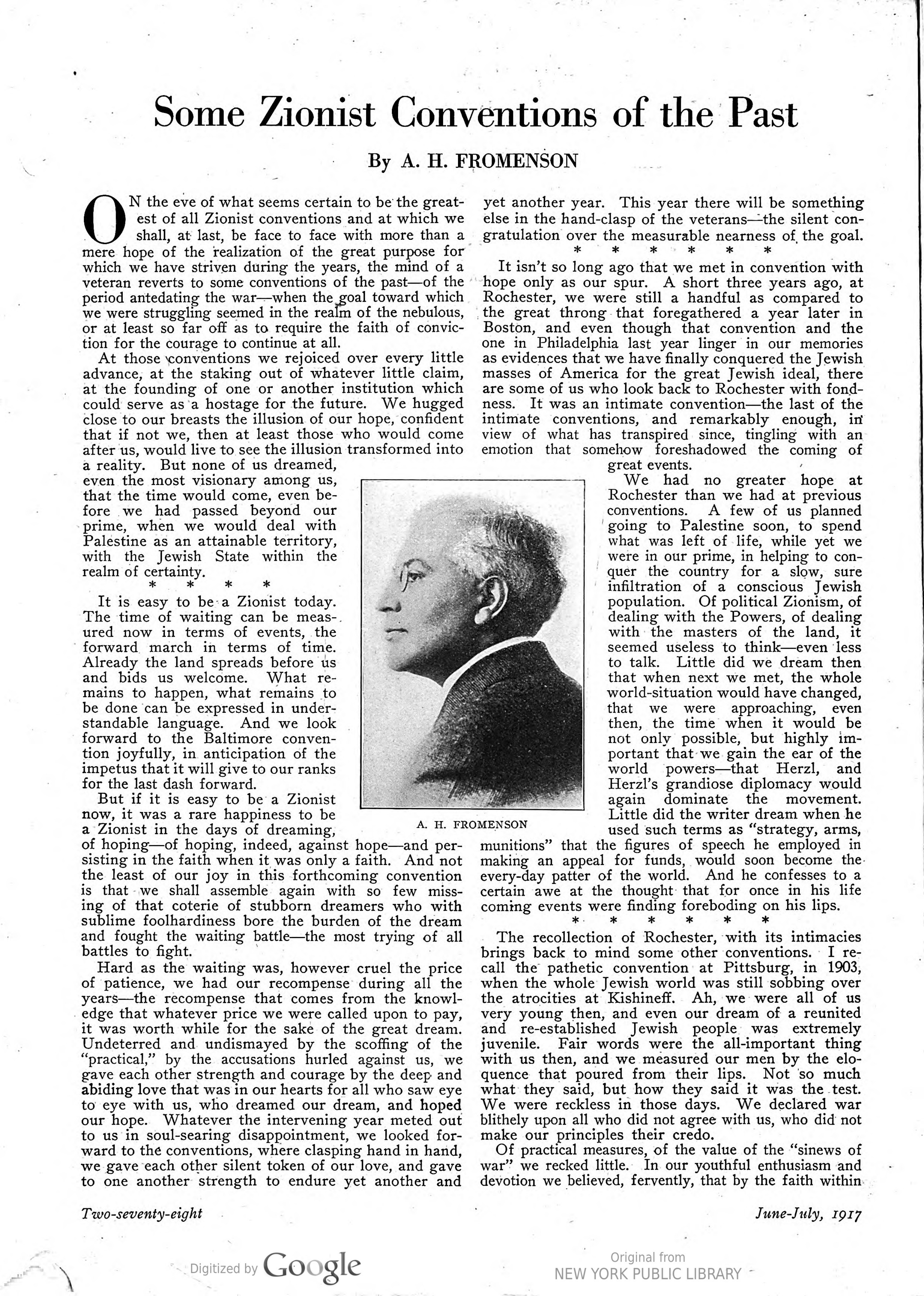
Some Zionist Conventions of the Past
ON the eve of what seems certain to be the greatest of all Zionist conventions and at which we shall, at last, be face to face with more than a mere hope of the realization of the great purpose for which we have striven during the years, the mind of a veteran reverts to some conventions of the past—of the period antedating the war—when the goal toward which we were struggling seemed in the realm of the nebulous, or at least so far off as to require the faith of conviction for the courage to continue at all.
At those conventions we rejoiced over every little advance, at the staking out of whatever little claim, at the founding of one or another institution which could serve as a hostage for the future. We hugged close to our breasts the illusion of our hope, confident that if not we, then at least those who would come after us, would live to see the illusion transformed into a reality. But none of us dreamed, even the most visionary among us, that the time would come, even before we had passed beyond our prime, when we would deal with Palestine as an attainable territory, with the Jewish State within the realm of certainty.
* * *
It is easy to be a Zionist today. The time of waiting can be measured now in terms of events, the forward march in terms of time. Already the land spreads before us and bids us welcome. What remains to happen, what remains to be done can be expressed in understandable language. And we look forward to the Baltimore convention joyfully, in anticipation of the impetus that it will give to our ranks for the last dash forward.
But if it is easy to be a Zionist now, it was a rare happiness to be a Zionist in the days of dreaming, of hoping—of hoping, indeed, against hope—and persisting in the faith when it was only a faith. And not the least of our joy in this forthcoming convention is that we shall assemble again with so few missing of that coterie of stubborn dreamers who with sublime foolhardiness bore the burden of the dream and fought the waiting battle—the most trying of all battles to fight.
Hard as the waiting was, however cruel the price of patience, we had our recompense during all the years—the recompense that comes from the knowledge that whatever price we were called upon to pay, it was worth while for the sake of the great dream. Undeterred and undismayed by the scoffing of the “practical,” by the accusations hurled against us, we gave each other strength and courage by the deep and abiding love that was in our hearts for all who saw eye to eye with us, who dreamed our dream, and hoped our hope. Whatever the intervening year meted out to us in soul-searing disappointment, we looked forward to the conventions, where clasping hand in hand, we gave each other silent token of our love, and gave to one another strength to endure yet another and
yet another year. This year there will be something else in the hand-clasp of the veterans—the silent congratulation over the measurable nearness of the goal.
* * * * *
It isn't so long ago that we met in convention with hope only as our spur. A short three years ago, at Rochester, we were still a handful as compared to the great throng that foregathered a year later in Boston, and even though that convention and the one in Philadelphia last year linger in our memories as evidences that we have finally conquered the Jewish masses of America for the great Jewish ideal, there are some of us who look back to Rochester with fondness. It was an intimate convention—the last of the view of what has transpired since, tingling with an emotion that somehow foreshadowed the coming of great events.
We had no greater hope at Rochester than we had at previous conventions. A few of us planned going to Palestine soon, to spend what was left of life, while yet we were in our prime, in helping to conquer the country for a slow, sure infiltration of a conscious Jewish population. Of political Zionism, of dealing with the Powers, of dealing with the masters of the land, it seemed useless to think—even less to talk. Little did we dream then that when next we met, the whole world-situation would have changed, that we were approaching, even then, the time when it would be not only possible, but highly important that we gain the ear of the world powers—that Herzl, and Herzl's grandiose diplomacy would again dominate the movement. Little did the writer dream when he used such terms as “strategy, arms, munitions” that the figures of speech he employed in making an appeal for funds, would soon become the every-day patter of the world. And he confesses to a certain awe at the thought that for once in his lips.
* * * * *
The recollection of Rochester, with its intimacies brings back to mind some other conventions. I recall the pathetic convention at Pittsburg, in 1903, when the whole Jewish world was still sobbing over the atrocities at Kishineff. Ah, we were all of us very young then, and even our dream of a reunited and re-established Jewish people was extremely juvenile. Fair words were the all-important thing with us then, and we measured our men by the eloquence that poured from their lips. Not so much what they said, but how they said it was the test. We were reckless in those days. We declared war blithely upon all who did not agree with us, who did not make our principles their credo.
Of practical measures, of the value of the “sinews of war” we recked little. In our youthful enthusiasm and devotion we believed, fervently, that by the faith within