"WITH MALICE TOWARD NONE"
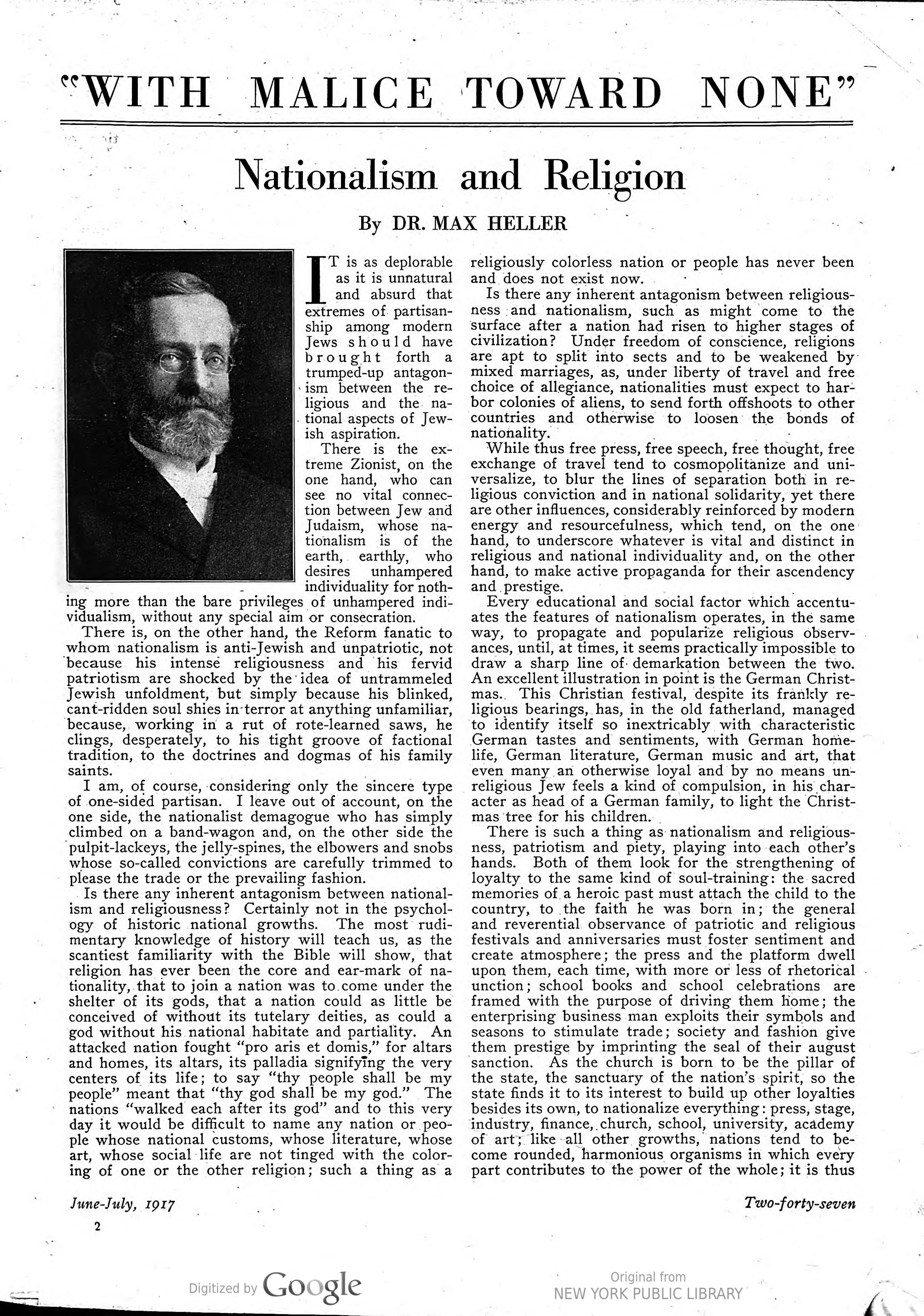
Nationalism and Religion
IT is as deplorable as it is unnatural and absurd that extremes of partisanship among modern Jews should have brought forth a trumped-up antagonism between the religious and the national aspects of Jewish aspiration.
There is the extreme Zionist, on the one hand, who can see no vital connection between Jew and Judaism, whose nationalism is of the earth, earthly, who desires unhampered individuality for noth-
ing more than the bare privileges of unhampered individualism, without any special aim or consecration.
There is, on the other hand, the Reform fanatic to whom nationalism is anti-Jewish and unpatriotic, not ‘because his intense religiousness and his fervid patriotism are shocked by +16 1068 of untrammeled Jewish unfoldment, but simply because his blinked, cant-ridden soul shies in-terror at anything unfamiliar, ‘because,. working in a rut of rote-learned saws, he clings, desperately, to his tight groove of factional tradition, to the doctrines and dogmas of his family saints.
I am, of course, considering only the sincere type of one-sided partisan. I leave out of account, on the one side, the nationalist demagogue who has simply climbed on a band-wagon and, on the other side the ‘pulpit-lackeys, the jelly-spines, the elbowers and snobs whose so-called convictions are carefully trimmed to please the trade or the prevailing fashion.
religiously colorless nation or people has never been and does not exist now.
Is there any inherent antagonism between religiousness and nationalism, such as might come to the surface after a nation had risen to higher stages of civilization? Under freedom of conscience, religions are apt to split into sects and to be weakened by mixed marriages, as, under liberty of travel and free choice of allegiance, nationalities must expect to harbor colonies of aliens, to send forth offshoots to other countries and otherwise to loosen the bonds of nationality. \
While thus free press, free speech, free thought, free exchange of travel tend to cosmopolitanize and uni- versalize, to blur the lines of separation both in religious conviction and in national solidarity, yet there are other influences, considerably reinforced by modern energy and resourcefulness, which tend, on the one hand, to underscore whatever is vital and distinct in religious and national individuality and, on the other hand, to make active propaganda for their ascendency and prestige.
Every educational and social factor which accentuates the features of nationalism operates, in the same way, to propagate and popularize religious observances, until, at times, it seems practically impossible to draw a sharp line of demarkation between the two. An excellent illustration in point is the German Christmas. This Christian festival, despite its frankly religious bearings, has, in the old fatherland, managed to identify itself so inextricably with characteristic German tastes and sentiments, with German homelife, German literature, German music and art, that even many an otherwise loyal and by no means unreligious Jew feels a kind of compulsion, in his character as head of a German family, to light the Christmas tree for his children.
There is such a thing as nationalism and religiousness, patriotism and piety, playing into each other’s hands. Both of them look for the strengthening of loyalty to the same kind of soul-training: the sacred memories of.a heroic past must attach the child to the country, to the faith he was born in; the general and reverential observance of patriotic and religious festivals and anniversaries must foster sentiment and create atmosphere; the press and the platform dwell upon them, each time, with more or less of rhetorical - unction; school books and school celebrations are framed with the purpose of driving them home; the enterprising business man exploits their symbols and seasons to stimulate trade; society and fashion give them prestige by imprinting the seal of their august ‘sanction. As the church is born to be the pillar of the state, the sanctuary of the nation’s spirit, so the state finds it to its interest to build up other loyalties besides its own, to nationalize everything: press, stage, industry, finance, church, school, university, academy of art; like-all other growths, nations tend to become rounded, harmonious organisms in which every part contributes to the power of the whole: it is thus