THE MACCABAEAN
they saw in him. Through him, they were joined with eternity; and therefore he seemed to bind them more closely to us, the young generation, the beginnings of the future. Their great love for him seemed but an expression of their undying love for an undying people. For he was the one hope.
What can you tell me of him, when you speak in your language? Facts, figures, points and programs! What avail they?
No, I will rather go back to my father.
What concern of mine if the Turk refuses to issue a charter? And what care I if he visited Von Plehve? Let him have done whatever he has done; let him have said whatever he has said—I make no such inquiries.
I wanted to know but one thing:
Did he yet live on?
He could have gone along a thousand different ways; he could have done a thousand different things. Those that were before him wrought differently.
Those that will follow him will do other work. It is not important what and how they do—what is important is that they are.
Important it is that every few generations, in a new form, Messiah appears; that every few generations he is born anew; that he lives in our blood, and comes to tell us that he lives.
One time he may burn the god Baal with the fires of heaven; another time inspire an uprising against the Romans; still another, go to the Sultan to demand back the land of our fathers, or call congresses, and stand before the kings of the world. It is all the same. As long as he is with us—as long as Messiah lives!
And he lives in every generation. And in every generation, too, is to be found the strong, plain, believing Jew, who clings to the wheels of his carriage and cries out:
"David, King of Israel, live forever!"
And the footsteps of Messiah are to be heard in every generation.
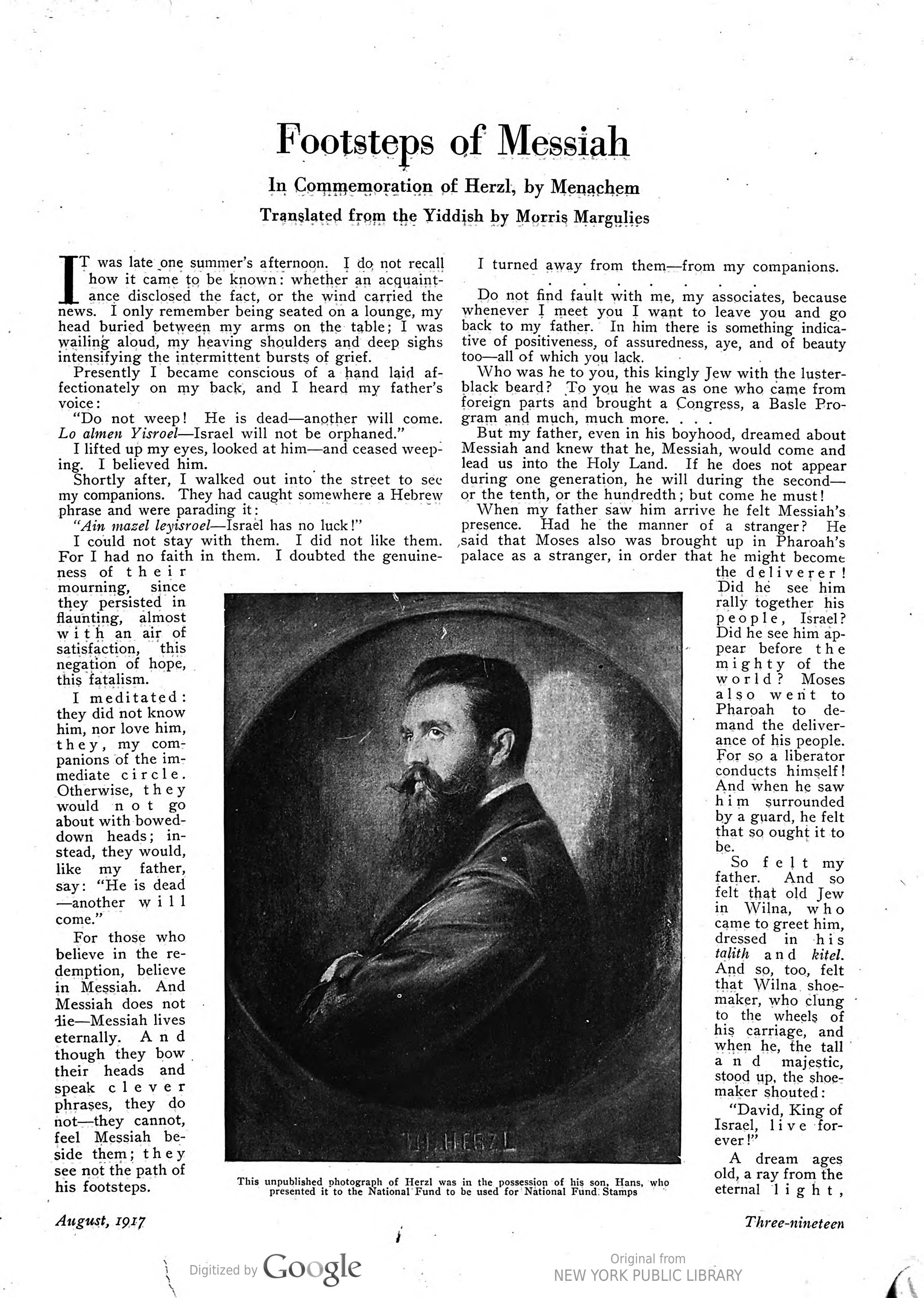
The Leadership of Herzl
WHEN the time drew near for Moses to relinquish his leadership of the people, he chose as his successor a man in whom was spirit; a man, as the rabbis tell us, who knew the spirit of every man and understood how to speak to each according to his bent of mind. It is a rare gift in any leader to know the minds of the common people, and no chancellor or prime minister can retain his position when he is out of touch and out of sympathy with the people. He is a poor leader who prescribes to the people what they should wish. If at any time the wish and the longing of our people became articulate, that any who had ears might hear, it is at the present crisis in the world's history. We have behind us a century of Jewish emancipation. It is a long enough period to afford an insight into what it has brought of good and of evil. And if at the end of it, even with the Russian freedom that has come to our brethren, the Jewish people stands fearful of the consequences and of the dangers to its very existence, the fault is neither in us or in our neighbors. Even husband and wife, after years of wrangling and patching up, may find it a relief to separate. There is an incompatibility of temper between the environment and ourselves that our neighbors know only too well. There is a rift in our soul which makes us unhappy. We want to be whole Jews, not half Jews, half somebody else. These Jews who do not feel that such a rift exists shall not be disturbed. The fewest went up to build the waste places of Zion in the days of Ezra and Nehemiah, the majority remained behind. In the Roman times the Jews had many fatherlands, but one mother country. Agrippa, the last ruler the Jewish nation has had, was perhaps no model Jew on the religious side, yet he was acclaimed as brother; while another, who had religion enough and to spare for millions to swear by his name, but ruthlessly assailed the prerogatives of the Jewish nation, was rejected.
There have been at all times Palestinian Jews and
dispersion Jews, national Jews and international Jews. Whether there can be a national organization for Jews in any land of the dispersion, depends largely on the country and its political and social make-up. What may be unfeasible and undesirable in America, may be practical in Poland, for instance. Just because everywhere else the Jews must form a minority, we Zionits clamor for the one land where the Jews may constitute the majority and where alone a full national, Jewish life becomes possible. Palestine is just now within the grasp of the Jewish people. For any Jew to obstruct the path to the land of the fathers is treason, treason to the cause of the Jewish people, treason to the cause of Judaism.
We stand by the Basle platform. That platform voices the undying hope of the Jewish people. And therein lies its potency, its authoritativeness. It alone answers to the deepest yearnings of the Jewish people. The emancipation formula, needful as it is for the Jew of the dispersion, came from without, from the French Revolution. Self-emancipation is the keynote of the Basle platform, and it comes from within. It is indeed a renewal of the covenant of Sinai when a slave-people was made free. At the foot of that mount was the first Jewish assemblage held, and it was an assemblage of the whole people.
And for the man who, as no one else since the days of Nehemiah, had the spirit in him to discern the mind of the Jewish people, that unforgettable leader who like a second Ezra, raised the banner of the Jew, who gave his life for the cause of true Jewish enfranchisement, who, despite the protests and cavillings and many obstructions, possessed and retained the singular vision that the time was ripe for the securing of the Jewish home, who taught us the big outlook, the free demeanor, the wisdom of speaking openly and above board, the dreamer who inspired the potentates of the earth with the practicability of his solution of the Jewish problem, for the founder of political Zionism we entertain sentiments of reverence so rare in a proverbially sober-minded people.