THE MACCABAEAN
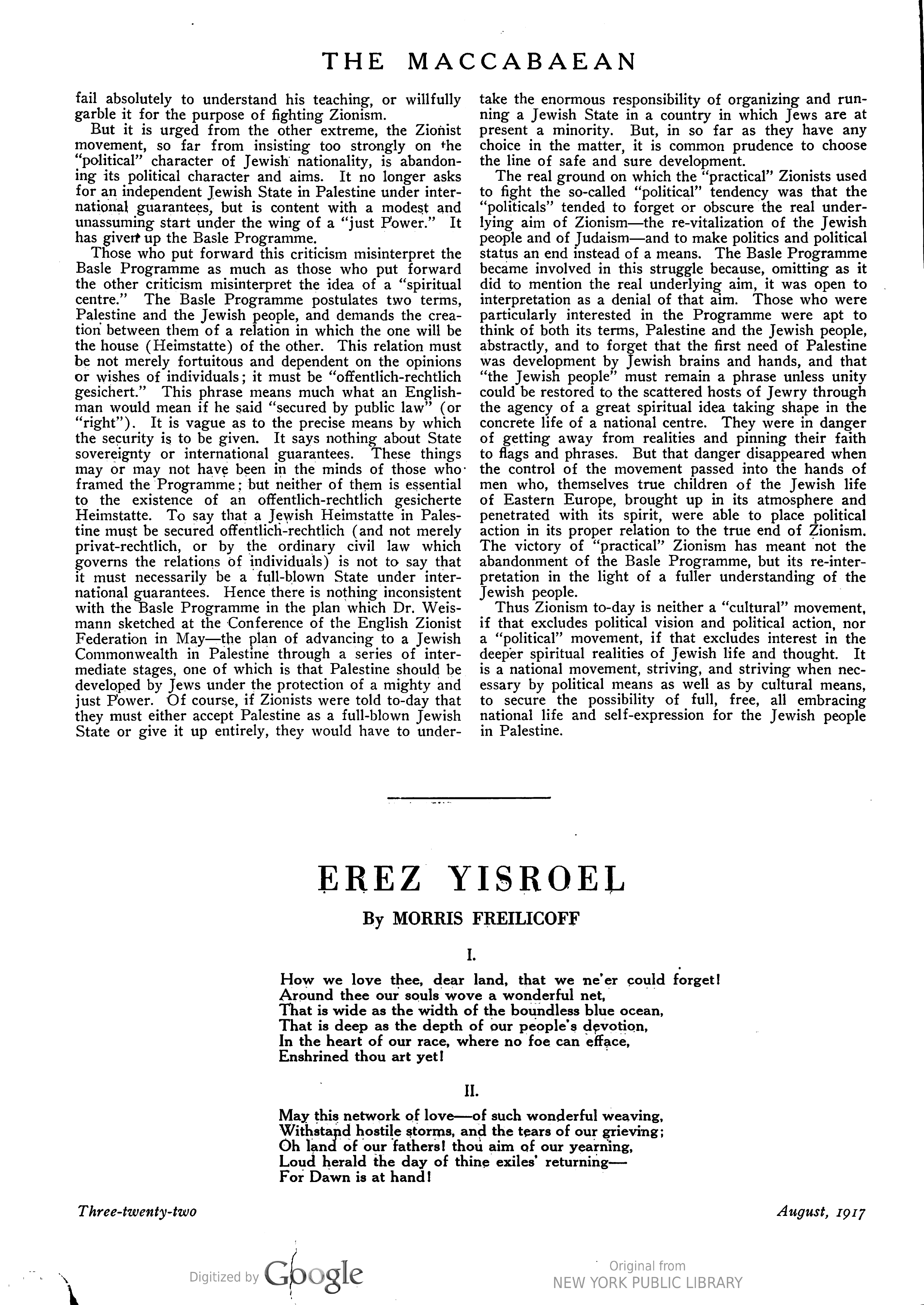
fail absolutely to understand his teaching, or willfully garble it for the purpose of fighting Zionism.
But it is urged from the other extreme, the Zionist movement, so far from insisting too strongly on the "political" character of Jewish nationality, is abandoning its political character and aims. It no longer asks for an independent Jewish State in Palestine under international guarantees, but is content with a modest and unassuming start under the wing of a "just Power." It has given up the Basle Programme.
Those who put forward this criticism misinterpret the Basle Programme as much as those who put forward the other criticism misinterpret the idea of a "spiritual centre." The Basle Programme postulates two terms, Palestine and the Jewish people, and demands the creation between them of a relation in which the one will be the house (Heimstatte) of the other. This relation must be not merely fortuitous and dependent on the opinions or wishes of individuals; it must be "offentlich-rechtlich gesichert." This phrase means much what an Englishman would mean if he said "secured by public law" (or "right"). It is vague as to the precise means by which the security is to be given. It says nothing about State sovereignty or international guarantees. These things may or may not have been in the minds of those who framed the Programme; but neither of them is essential to the existence of an offentlich-rechtlich gesicherte Heimstatte. To say that a Jewish Heimstatte in Palestine must be secured offentlich-rechtlich (and not merely privat-rechtlich, or by the ordinary civil law which governs the relations of individuals) is not to say that it must necessarily be a full-blown State under international guarantees. Hence there is nothing inconsistent with the Basle Programme in the plan which Dr. Weismann sketched at the Conference of the English Zionist Federation in May—the plan of advancing to a Jewish Commonwealth in Palestine through a series of intermediate stages, one of which is that Palestine should be developed by Jews under the protection of a mighty and just Power. Of course, if Zionists were told to-day that they must either accept Palestine as a full-blown Jewish State or give it up entirely, they would have to under-
take the enormous responsibility of organizing and running a Jewish State in a country in which Jews are at present a minority. But, in so far as they have any choice in the matter, it is common prudence to choose the line of safe and sure development.
The real ground on which the "practical" Zionists used to fight the so-called "political" tendency was that the "politicals" tended to forget or obscure the real underlying aim of Zionism—the revitalization of the Jewish people and of Judaism—and to make politics and political status an end instead of a means. The Basle Programme became involved in this struggle because, omitting as it did to mention the real underlying aim, it was open to interpretation as a denial of that aim. Those who were particularly interested in the Programme were apt to think of both its terms, Palestine and the Jewish people, abstractly, and to forget that the first need of Palestine was development by Jewish brains and hands, and that "the Jewish people" must remain a phrase unless unity could be restored to the scattered hosts of Jewry through the agency of a great spiritual idea taking shape in the concrete life of a national centre. They were in danger of getting away from realities and pinning their faith to flags and phrases. But that danger disappeared when the control of the movement passed into the hands of men who, themselves true children of the Jewish life of Eastern Europe, brought up in its atmosphere and penetrated with its spirit, were able to place political action in its proper relation to the true end of Zionism. The victory of "practical" Zionism has meant not the abandonment of the Basle Programme, but its re-interpretation in the light of a fuller understanding of the Jewish people.
Thus Zionism to-day is neither a "cultural" movement, if that excludes political vision and political action, nor a "political" movement, if that excludes interest in the deeper spiritual realities of Jewish life and thought. It is a national movement, striving, and striving when necessary by political means as well as by cultural means, to secure the possibility of full, free, all embracing national life and self-expression for the Jewish people in Palestine.
EREZ YISROEL
I.
II.
May this network of love—of such wonderful weaving,Withstand hostile storms, and the tears of our grieving;Oh land of our fathers! thou aim of our yearning,Loud herald the day of thine exiles' returning—For Dawn is at hand!
How we love thee, dear land, that we ne'er could forget!Around thee our souls wove a wonderful net,That is wide as the width of the boundless blue ocean,That is deep as the depth of our people's devotion,In the heart of our race, where no foe can efface,Enshrined thou art yet!