“WITH MALICE TOWARD NONE”
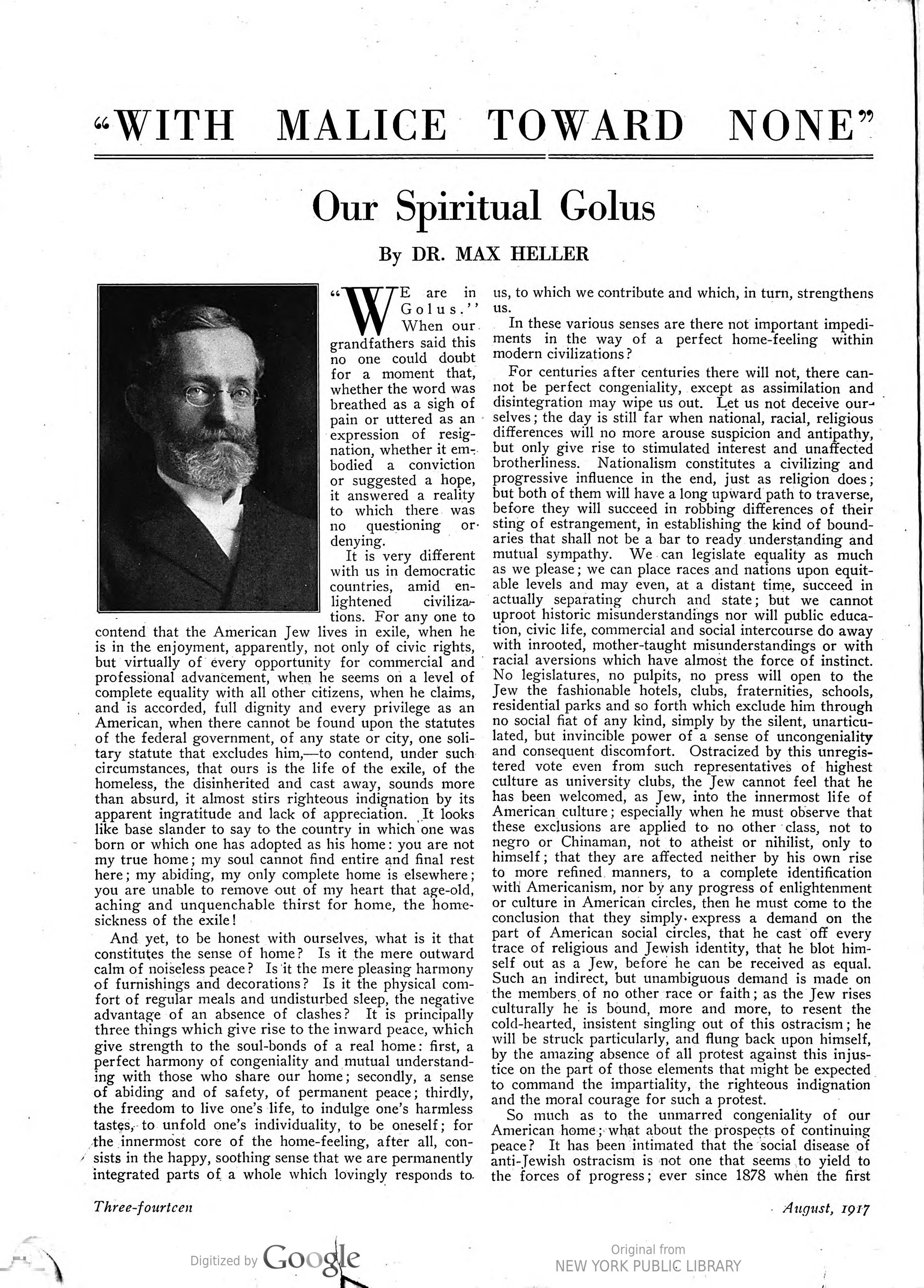
Our Spiritual Golus
2 15 816 in Golus.’’ When our. grandfathers said this no one could doubt for a moment that, whether the word was breathed as a sigh of pain or uttered as an expression of resignation, whether it em-. bodied a conviction or suggested a hope, it answered a reality to which there. was no questioning or- denvine.
It is very different with us in democratic countries, amid enlightened civilizations. For any one to
a מ יק ריק - See אי Ee לקו לי contend that the American Jew lives in exile, when he is in the enjoyment, apparently, not only of civic rights, but virtually of évery opportunity for commercial and professional advancement, when he seems on a level of complete equality with all other citizens, when he claims, and is accorded, full dignity and every privilege as an American, when there cannot be found upon the statutes of the federal government, of any state or city, one solitary statute that excludes him,—to contend, under such circumstances, that ours is the life of the exile, of the homeless, the disinherited and cast away, sounds more than absurd, it almost stirs righteous indignation by its apparent ingratitude and lack of appreciation. It looks like base slander to say to the country in which one was born or which one has adopted as his home: you are not my true home; my soul cannot find entire and final rest here; my abiding, my only complete home is elsewhere ; you are unable to remove out of my heart that age-old, aching and unquenchable thirst for home, the home-sickness of the exile!
And yet, to be honest with ourselves, what is it that constitutes the sense of home? Is it the mere outward calm of noiseless peace? Is ‘it the mere pleasing harmony of furnishings and decorations? Is it the physical comfort of regular meals and undisturbed sleep, the negative advantage of an absence of clashes? It is principally three things which give rise to the inward peace, which give strength to the soul-bonds of a real home: first, a perfect harmony of congeniality and mutual understanding with those who share our home; secondly, a sense of abiding and of safety, of permanent peace; thirdly, the freedom to live one’s life, to indulge one’s harmless 185065, 10 unfold one’s individuality, to be oneself; for the innermost core of the home-feeling, after all, consists in the happy, soothing sense that we are permanently integrated parts of a whole which lovingly responds to.
us, to which we contribute and which, in turn, strengthens 115
us. In these various senses are there not important impediments in the way of a perfect home-feeling within modern civilizations?
For centuries after centuries there will not, there cannot be perfect congeniality, except as assimilation and disintegration may wipe us out. Let us not deceive ourselves ; the day is still far when national, racial, religious differences will no more arouse suspicion and antipathy, but only give rise to stimulated interest and unaffected brotherliness. Nationalism constitutes a civilizing and progressive influence in the end, just as religion does; but both of them will have a long upward path to traverse, before they will succeed in robbing differences of their sting of estrangement, in establishing the kind of boundaries that shall not be a bar to ready understanding and mutual sympathy. We.can legislate equality as much as we please; we can place races and nations upon equitable levels and may even, at a distant time, succeed in actually separating church and state; but we cannot uproot historic misunderstandings nor will public education, civic life, commercial and social intercourse do away with inrooted, mother-taught misunderstandings or with racial aversions which have almost the force of instinct. No legislatures, no pulpits, no press will open to the Jew the fashionable hotels, clubs, fraternities, schools, residential parks and so forth which exclude him through no social fiat of any kind, simply by the silent, unarticu- lated, but invincible power of a sense of uncongeniality and consequent discomfort. Ostracized by this unregistered vote even from such representatives of highest culture as university clubs, the Jew cannot feel that he has been welcomed, as Jew, into the innermost life of American culture; especially when he must observe that these exclusions are applied to no other ‘class, not to negro or Chinaman, not to atheist or nihilist, only to himself; that they are affected neither by his own rise to more refined. manners, to a complete identification with Americanism, nor by any progress of enlightenment or culture in American circles, then he must come to the conclusion that they simply: express a demand on the part of American social circles, that he cast off every trace of religious and Jewish identity, that he blot himself out as a Jew, before he can be received as equal. Such an indirect, but unambiguous demand is made on the members of no other race or faith; as the Jew rises culturally he is bound, more and more, to resent the cold-hearted, insistent singling out of this ostracism; he will be struck particularly, and flung back upon himself, by the amazing absence of all protest against this injustice on the part of those elements that might be expected to command the impartiality, the righteous indignation and the moral courage for such a protest. _
So much as to the unmarred congeniality of our American home; what about the prospects of continuing peace? It has been intimated that the social disease of anti-Jewish ostracism is not one that seems to yield to the forces of progress; ever since 1878 when the first