Reform Rabbis and Zionism
THROUGH the columns of the Jewish press, it has gone out that the anti-Zionists scored another victory at the Buffalo Assembly. This would not be memorable, even if it were true. The truth is that the Buffalo Assembly of the Central Conference of American Rabbis was the first in which it became necessary for the leaders of the anti-Zionist forces to moderate and qualify their opposition in order to avert defeat. In fact, nothing less than a compromise, compounded by a master of the art which rabbis style conciliation rather than compromise, prevented the passage of a resolution which would definitely have ended the reign of anti-Zionist proscription—not to say terrorism—within the ranks of the Reform Jewish Ministry. The President of the Conference had, in his annual message, thundered against Zionism, after the orthodox manner which prevails in Reform Jewish circles, and perhaps not without personal zest fired by the recent impressive Zionist demonstration in his city of Baltimore. The President's message might have been ignored had it not been for the practice which obtains in the Central Conference of reaffirming upon the basis of committee recommendations those features of the President's message which require to be taken seriously. The Committee on the Message, crowded, if not packed, with anti-Zionists, offered the Conference for adoption another collection of gems from unreported anti-Zionist sermons, dealing, however, be it said to the credit of their sagacity, far less scornfully than usual with the Zionist evildoers, though the Presidential imputation with respect to the irreligiousness of Zionism was abated rather than withdrawn. Though unacceptable to Zionists, the report marked an approach, if not return, to that intellectual sobriety which one expects of a company of scholarly theologians.
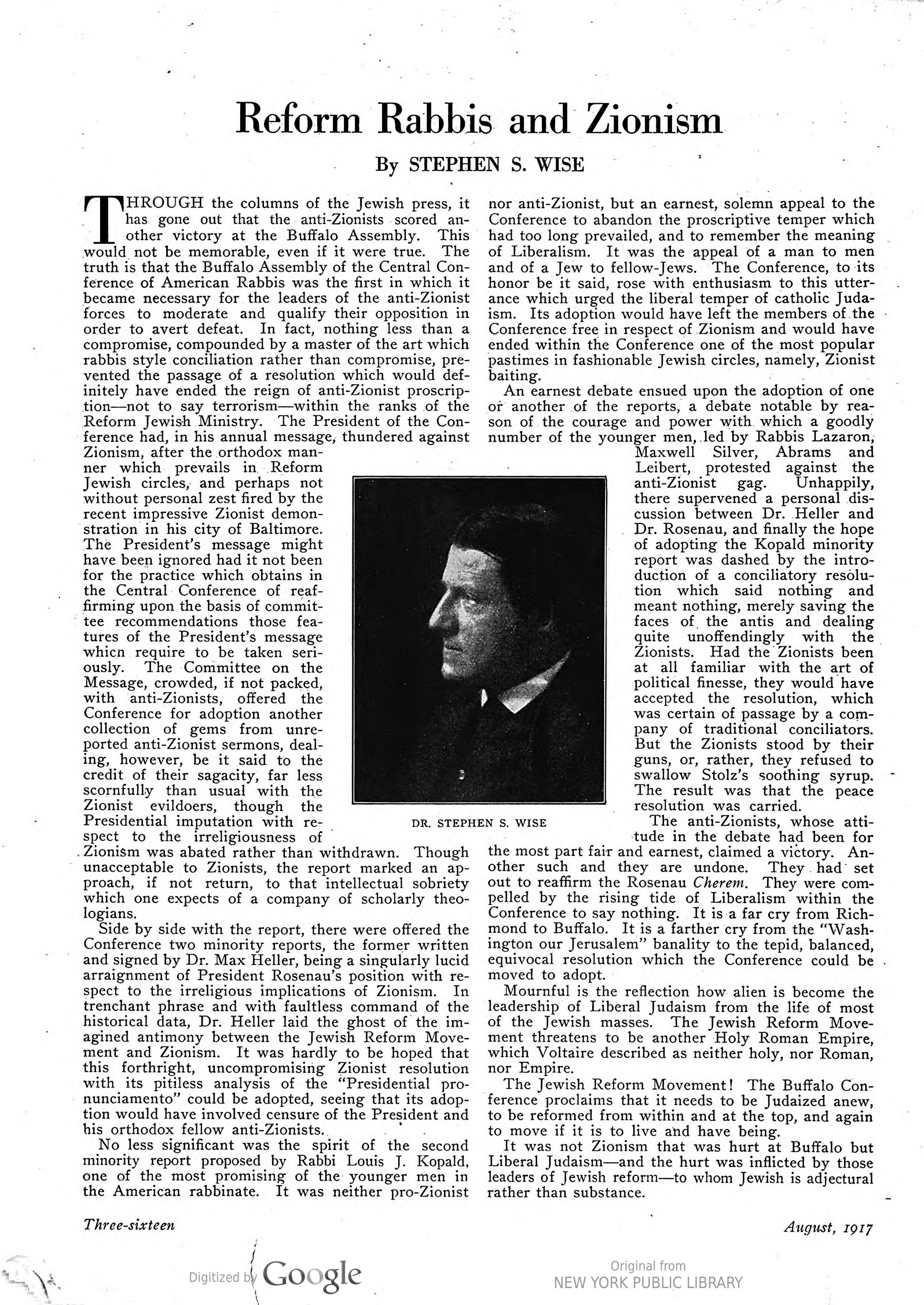
Side by side with the report, there were offered the Conference two minority reports, the former written and signed by Dr. Max Heller, being a singularly lucid arraignment of President Rosenau's position with respect to the irreligious implications of Zionism. In trenchant phrase and with faultless command of the historical data, Dr. Heller laid the ghost of the imagined antimony between the Jewish Reform Movement and Zionism. It was hardly to be hoped that this forthright, uncompromising Zionist resolution with its pitiless analysis of the "Presidential pronunciamento" could be adopted, seeing that its adoption would have involved censure of the President and his orthodox fellow anti-Zionists.
No less significant was the spirit of the second minority report proposed by Rabbi Louis J. Kopald, one of the most promising of the younger men in the American rabbinate. It was neither pro-Zionist
nor anti-Zionist, but an earnest, solemn appeal to the Conference to abandon the proscriptive temper which had too long prevailed, and to remember the meaning of Liberalism. It was the appeal of a man to men and of a Jew to fellow-Jews. The Conference, to its honor be it said, rose with enthusiasm to this utterance which urged the liberal temper of catholic Judaism. Its adoption would have left the members of the Conference free in respect of Zionism and would have ended within the Conference one of the most popular pastimes in fashionable Jewish circles, namely, Zionist baiting.
An earnest debate ensued upon the adoption of one or another of the reports, a debate notable by reason of the courage and power with which a goodly number of the younger men, led by Rabbis Lazaron,
Maxwell Silver, Abrams and Leibert, protested against the anti-Zionist gag. Unhappily, there supervened a personal discussion between Dr. Heller and Dr. Rosenau, and finally the hope of adopting the Kopald minority report was dashed by the introduction of a conciliatory resolution which said nothing and meant nothing, merely saving the faces of the antis and dealing quite unoffendingly with the Zionists. Had the Zionists been at all familiar with the art of political finesse, they would have accepted the resolution, which was certain of passage by a company of traditional conciliators. But the Zionists stood by their guns, or, rather, they refused to swallow Stolz's soothing syrup. The result was that the peace resolution was carried.
The anti-Zionists, whose attitude in the debate had been for the most part fair and earnest, claimed a victory. Another such and they are undone. They had set out to reaffirm the Rosenau Cherem. They were compelled by the rising tide of Liberalism within the Conference to say nothing. It is a far cry from Richmond to Buffalo. It is a farther cry from the "Washington our Jerusalem" banality to the tepid, balanced, equivocal resolution which the Conference could be moved to adopt.
Mournful is the reflection how alien is become the leadership of Liberal Judaism from the life of most of the Jewish masses. The Jewish Reform Movement threatens to be another Holy Roman Empire, which Voltaire described as neither holy, nor Roman, nor Empire.
The Jewish Reform Movement! The Buffalo Conference proclaims that it needs to be Judaized anew, to be reformed from within and at the top, and again to move if it is to live and have being.
It was not Zionism that was hurt at Buffalo but Liberal Judaism—and the hurt was inflicted by those leaders of Jewish reform—to whom Jewish is adjectural rather than substance.