Footsteps of Messiah
IT was late one summer's afternoon. I do not recall how it came to be known: whether an acquaintance disclosed the fact, or the wind carried the news. I only remember being seated on a lounge, my head buried between my arms on the table; I was wailing aloud, my heaving shoulders and deep sighs intensifying the intermittent bursts of grief.
Presently I became conscious of a hand laid affectionately on my back, and I heard my father's voice:
“Do not weep! He is dead—another will come. Lo almen Yisroel—lIsrael will not be orphaned.”
I lifted up my eyes, looked at him—and ceased weeping. I believed him.
Shortly after, I walked out into the street to sec my companions. They had caught somewhere a Hebrew phrase and were parading it:
"Ain mazel leyisroel—Israel has no luck!"
I could not stay with them. I did not like them. For I had no faith in them. I doubted the genuineness of their mourning, since they persisted in flaunting, almost with an air of satisfaction, this negation of hope, this fatalism.
I meditated: they did not know him, nor love him, they, my companions of the immediate circle. Otherwise, they would not go about with bowed-down heads; instead, they would, like my father, say: "He is dead—another will come."
For those who believe in the redemption, believe in Messiah. And Messiah does not die —Messiah lives eternally. And though they bow their heads and speak clever phrases, they do not—they cannot, feel Messiah beside them; they see not the path of his footsteps.
Translated from the Yiddish by Morris Margulies
I turned away from them—from my companions.
Do not find fault with me, my associates, because whenever I meet you I want to leave you and go back to my father. In him there is something indicative of positiveness, of assuredness, aye, and of beauty too—all of which you lack.
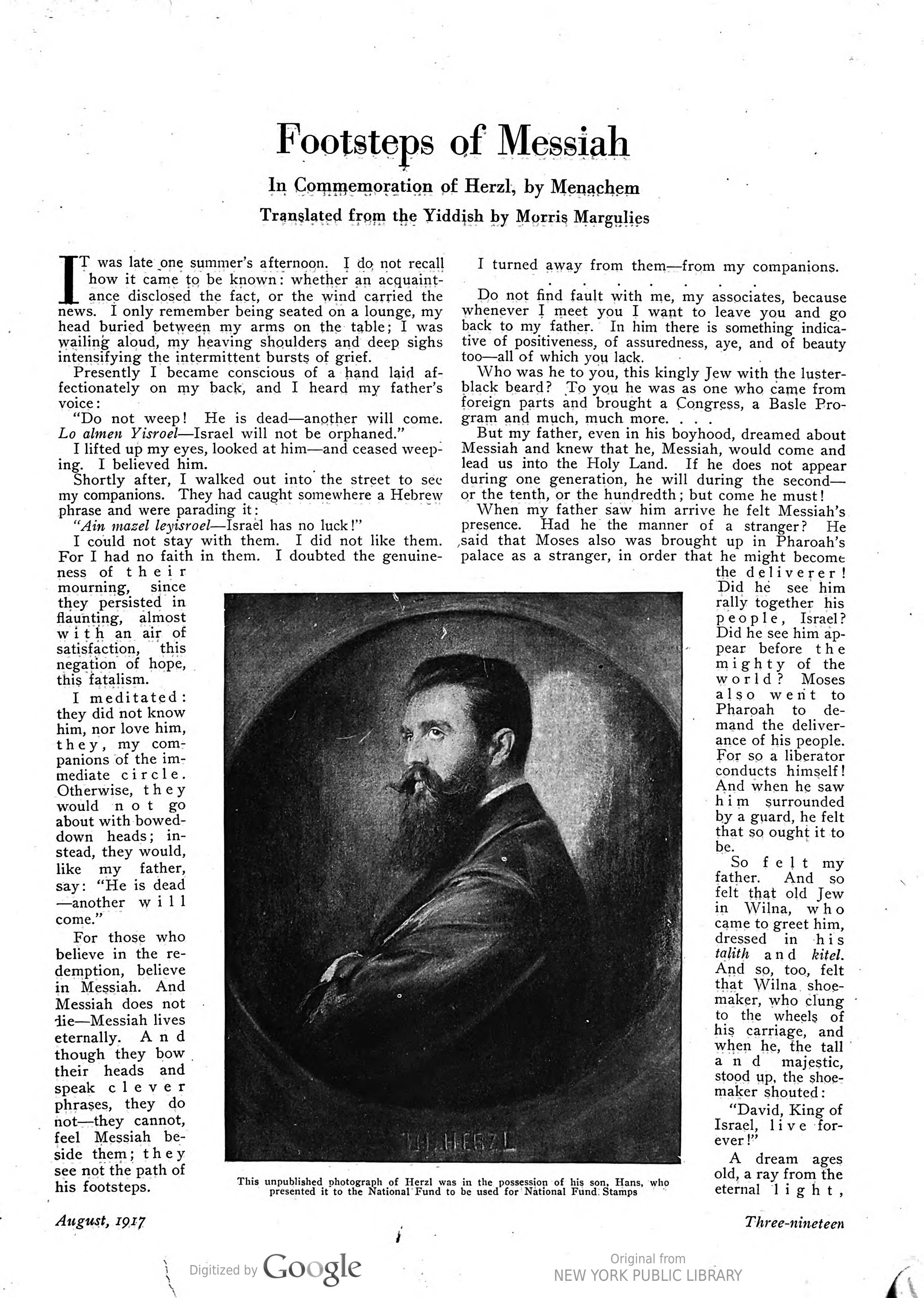
Who was he to you, this kingly Jew with the luster- black beard? To you he was as one who came from foreign parts and brought a Congress, a Basle Program and much, much more. . . .
But my father, even in his boyhood, dreamed about Messiah and knew that he, Messiah, would come and lead us into the Holy Land. If he does not appear during one generation, he will during the second—or the tenth, or the hundredth; but come he must!
When my father saw him arrive he felt Messiah's presence. Had he the manner of a stranger? He said that Moses also was brought up in Pharoah's palace as a stranger, in order that he might become
the deliverer! Did he see him rally together his people, Israel? Did he see him appear before the mighty of the world? Moses also went to Pharoah to demand the deliverance of his people. For so a liberator conducts himself! And when he saw him surrounded by a guard, he felt that so ought it to be.
So felt my father. And so felt that old Jew in Wilna, who came to greet him, dressed in his talith and kitel. And so, too, felt that Wilna shoemaker, who clung to the wheels of his carriage, and when he the tall and majestic, stood up, the shoemaker shouted:
"David, King of Israel, live forever!"
A dream ages old, a ray from the eternal light,