“WITH MALICE TOWARD NONE”
A Parting of the Ways
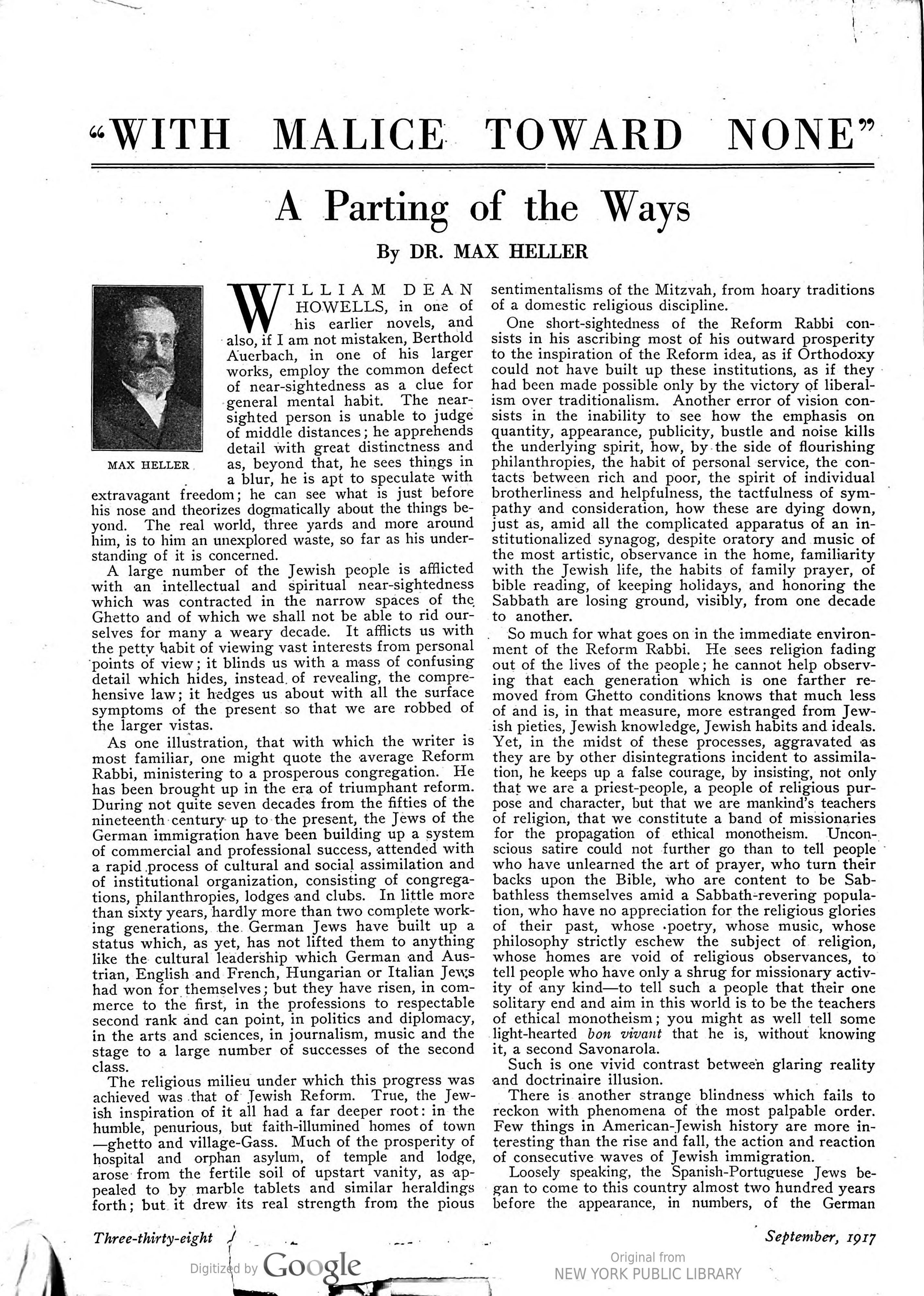
WILLIAM DEAN HOWELLS, in one of his earlier novels, and also, if I am not mistaken, Berthold Auerbach, in one of his larger works, employ the common defect of near-sightedness as a clue for general mental habit. The near-sighted person is unable to judge of middle distances; he apprehends detail with great distinctness and MAX HELLER as, beyond that, he sees things in a blur, he is apt to speculate with extravagant freedom; he can see what is just before his nose and theorizes dogmatically about the things beyond. The real world, three yards and more around him, is to him an unexplored waste, so far as his understanding of it is concerned.
A large number of the Jewish people is afflicted with an intellectual and spiritual near-sightedness which was contracted in the narrow spaces of the Ghetto and of which we shall not be able to rid ourselves for many of a weary decade. It afflicts us with the petty habit of viewing vast interests from personal points of view; it blinds us with a mass of confusing detail which hides, instead of revealing, the comprehensive law; it hedges us about with all the surface symptoms of the present so that we are robbed of the larger vistas.
As one illustration, that with which the writer is most familiar, one might quote the average Reform Rabbi, ministering to a prosperous congregation. He has been brought up in the era of triumphant reform. During not quite seven decades from the fifties of the nineteenth century up to the present, the Jews of the German immigration have been building up a system of commercial and professional success, attended with a rapid process of cultural and social assimilation and of institutional organization, consisting of congregations, philanthropies, lodges and clubs. In little more than sixty years, hardly more than two complete working generations, the German Jews have built up a status which, as yet, has not lifted them to anything like the cultural leadership which German and Austrian, English and French, Hungarian or Italian Jews had won for themselves; but they have risen, in commerce to the first, in the professions to respectable second rank and can point, in politics and diplomacy, in the arts and sciences, in journalism, music and the stage to a large number of successes of the second class.
The religious milieu under which this progress was achieved was that of Jewish Reform. True, the Jewish inspiration of it all had a far deeper root: in the humble, penurious, but faith-illumined homes of town {
sentimentalisms of the Mitzvah, from hoary traditions of a domestic religious discipline.
One shortsightedness of the Reform Rabbi consists in his ascribing most of his outward prosperity to the inspiration of the Reform idea, as if Orthodoxy could not have built up these institutions, as if they had been made possible only by the victory of liberalism over traditionalism. Another error of vision consists in the inability to see how the emphasis on quantity, appearance, publicity, bustle and noise kills the underlying spirit, how, by the side of flourishing philanthropies, the habit of personal service, the contacts between rich and poor, the spirit of individual brotherliness and helpfulness, the tactfulness of sympathy and consideration, how these are dying down, just as, amid all the complicated apparatus of an institutionalized synagog, despite oratory and music of the most artistic, observance in the home, familiarity with the Jewish life, the habits of family prayer, of bible reading, of keeping holidays, and honoring the Sabbath are losing ground, visibly, from one decade to another.
So much for what goes on in the immediate environment of the Reform Rabbi. He sees religion fading out of the lives of the people; he cannot help observing that each generation which is one farther removed from Ghetto conditions knows that much less of and is, in that measure, more estranged from Jewish pieties, Jewish knowledge, Jewish habits and ideals. Yet, in the midst of these processes, aggravated as they are by other disintegrations incident to assimilation, he keeps up a false courage, by insisting, not only that we are a priest-people, a people of religious purpose and character, but that we are mankind's teachers of religion, that we constitute a band of missionaries for the propagation of ethical monotheism. Unconscious satire could not further go than to tell people who have unlearned the art of prayer, who turn their backs upon the Bible, who are content to be Sabbathless themselves amid a Sabbath-revering population, who have no appreciation for the religious glories of their past, whose poetry, whose music, whose philosophy strictly eschew the subject of religion, whose homes are void of religious observances, to tell people who have only a shrug for missionary activity of any kind—to tell such a people that their one solitary end and aim in this world is to be the teachers of ethical monotheism; you might as well tell some light-hearted bon vivant that he is, without knowing it, a second Savonarola.
Such is one vivid contrast between glaring reality and doctrinaire illusion.
There is another strange blindness which fails to reckon with phenomena of the most palpable order. Few things in American-Jewish history are more interesting than the rise and fall, the action and reaction of consecutive waves of Jewish immigration.
Loosely speaking, the Spanish-Portuguese Jews began to come to this country almost two hundred years before the appearance, in numbers, of the German