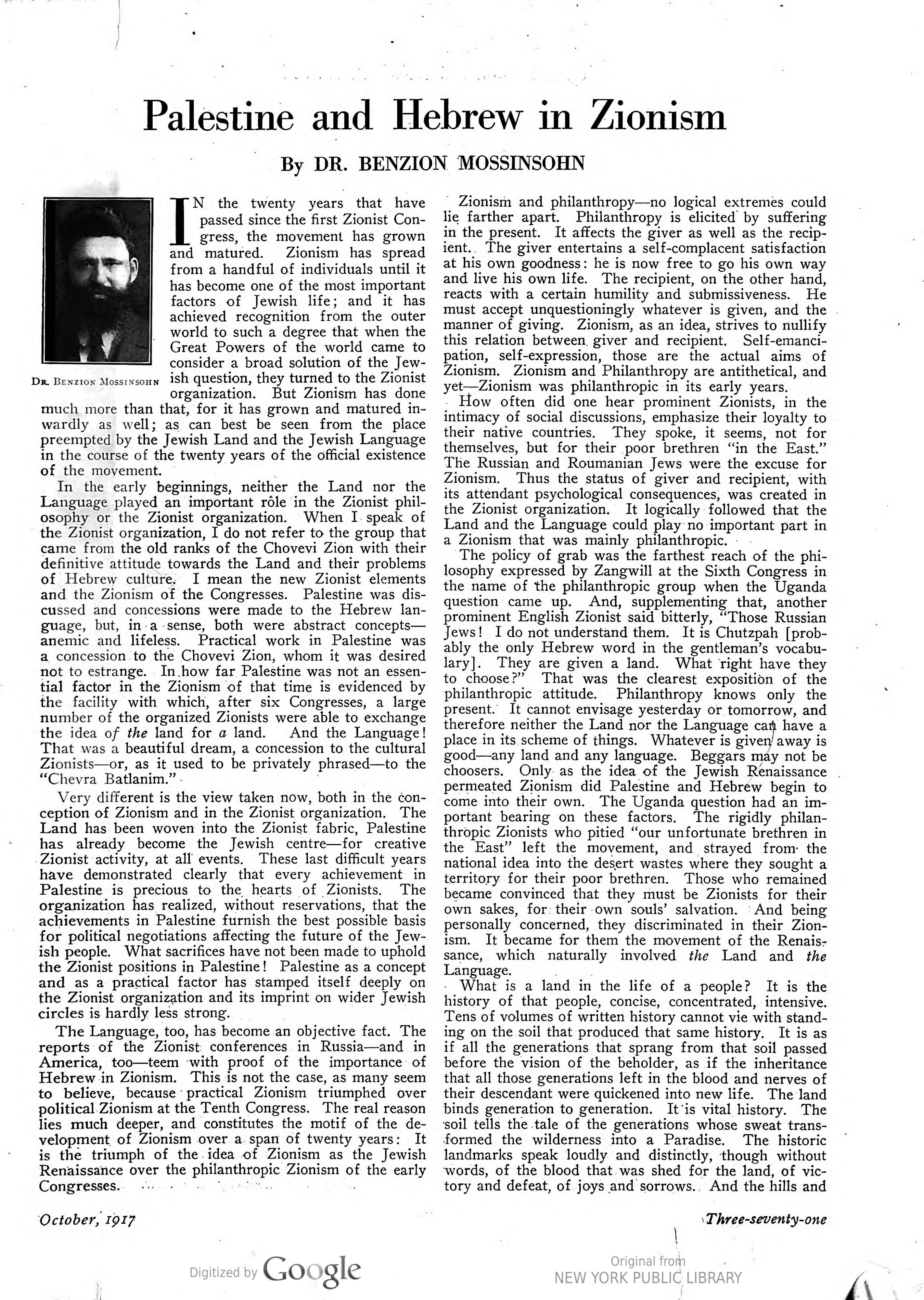
Palestine and Hebrew in Zionism
IN the twenty years that have passed since the first Zionist Congress, the movement has grown and matured. Zionism has spread from a handful of individuals until it has become one of the most important factors of Jewish life; and it has achieved recognition from the outer world to such a degree that when the Great Powers of the world came to consider a broad solution of the Jewish question, they turned to the Zionist organization. But Zionism has done
In the early beginnings, neither the Land nor the Language played an important rôle in the Zionist philosophy or the Zionist organization. When I speak of the Zionist organization, I do not refer to the group that came from the old ranks of the Chovevi Zion with their definitive attitude towards the Land and their problems of Hebrew culture. I mean the new Zionist elements and the Zionism of the Congresses. Palestine was discussed and concessions were made to the Hebrew language, but, in a sense, both were abstract concepts—anemic and lifeless. Practical work in Palestine was a concession to the Chovevi Zion, whom it was desired not to estrange. In how far Palestine was not an essential factor in the Zionism of that time is evidenced by the facility with which, after six Congresses, a large number of the organized Zionists were able to exchange the idea of the land for a land. And the Language! That was a beautiful dream, a concession to the cultural Zionists—or, as it used to be privately phrased—to the "Chevra Batlanim."
Very different is the view taken now, both in the conception of Zionism and in the Zionist organization. The Land has been woven into the Zionist fabric, Palestine has already become the Jewish centre—for creative Zionist activity, at all events. These last difficult years have demonstrated clearly that every achievement in Palestine is precious to the hearts of Zionists. The organization has realized, without reservations, that the achievements in Palestine furnish the best possible basis for political negotiations affecting the future of the Jewish people. What sacrifices have not been made to uphold the Zionist positions in Palestine! Palestine as a concept and as a practical factor has stamped itself deeply on the Zionist organization and its imprint on wider Jewish circles is hardly less strong.
The Language, too, has become an objective fact. The reports of the Zionist conferences in Russia—and in America, too—teem with proof of the importance of Hebrew in Zionism. This is not the case, as many seem to believe, because practical Zionism triumphed over political Zionism at the Tenth Congress. The real reason lies much deeper, and constitutes the motif of the development of Zionism over a span of twenty years: It is the triumph of the idea of Zionism as the Jewish Renaissance over the philanthropic Zionism of the early Congresses.
Zionism and philanthropy—no logical extremes could lie farther apart. Philanthropy is elicited by suffering in the present. It affects the giver as well as the recipient.. The giver entertains a self-complacent satisfaction at his own goodness: he is now free to go his own way and live his own life. The recipient, on the other hand, reacts with a certain humility and submissiveness. He must accept unquestioningly whatever is given, and the manner of giving. Zionism, as an idea, strives to nullify this relation between. giver and recipient. Self-emancipation, self-expression, those are the actual aims of Zionism. Zionism and Philanthropy are antithetical, and yet—Zionism was philanthropic in its early years.
- How often did one hear prominent Zionists, in the intimacy of social discussions, emphasize their loyalty to their native countries. They spoke, it seems, not for themselves, but for their poor brethren “in the East.” The Russian and Roumanian Jews were the excuse for Zionism. Thus the status of giver and recipient, with its attendant psychological consequences, was created in the Zionist organization. It logically followed that the Land and the Language could play no important part in a Zionism that was mainly philanthropic. - -
The policy of grab was the farthest reach of the philosophy expressed by Zangwill at the Sixth Congress in the name of the philanthropic group when the Uganda question came up. And, supplementing that, another prominent English Zionist said bitterly, "Those Russian Jews! I do not understand them. It is Chutzpah [probably the only Hebrew word in the gentleman's vocabulary]. They are given a land. What right have they to choose?" That was the clearest exposition of the philanthropic attitude. Philanthropy knows only the present. It cannot envisage yesterday or tomorrow, and therefore neither the Land nor the Language can have a place in its scheme of things. Whatever is given away is good —any land and any language. Beggars may not be choosers. Only as the idea of the Jewish Renaissance permeated Zionism did Palestine and Hebrew begin to come into their own. The Uganda question had an important bearing on these factors. The rigidly philanthropic Zionists who pitied "our unfortunate brethren in the East" left the movement, and strayed from the national idea into the desert wastes where they sought a territory for their poor brethren. Those who remained became convinced that they must be Zionists for their own sakes, for their own souls' salvation. And being personally concerned, they discriminated in their Zionism. It became for them the movement of the Renaissance, which naturally involved the Land and the Language.
What is a land in the life of a people? It is the history of that people, concise, concentrated, intensive. Tens of volumes of written history cannot vie with standing on the soil that produced that same history. It is as if all the generations that sprang from that soil passed before the vision of the beholder, as if the inheritance that all those generations left in the blood and nerves of their descendant were quickened into new life. The land binds generation to generation. It is vital history. The soil tells the tale of the generations whose sweat transformed the wilderness into a Paradise. The historic landmarks speak loudly and distinctly, though without words, of the blood that was shed for the land, of victory and defeat, of joys and sorrows. And the hills and