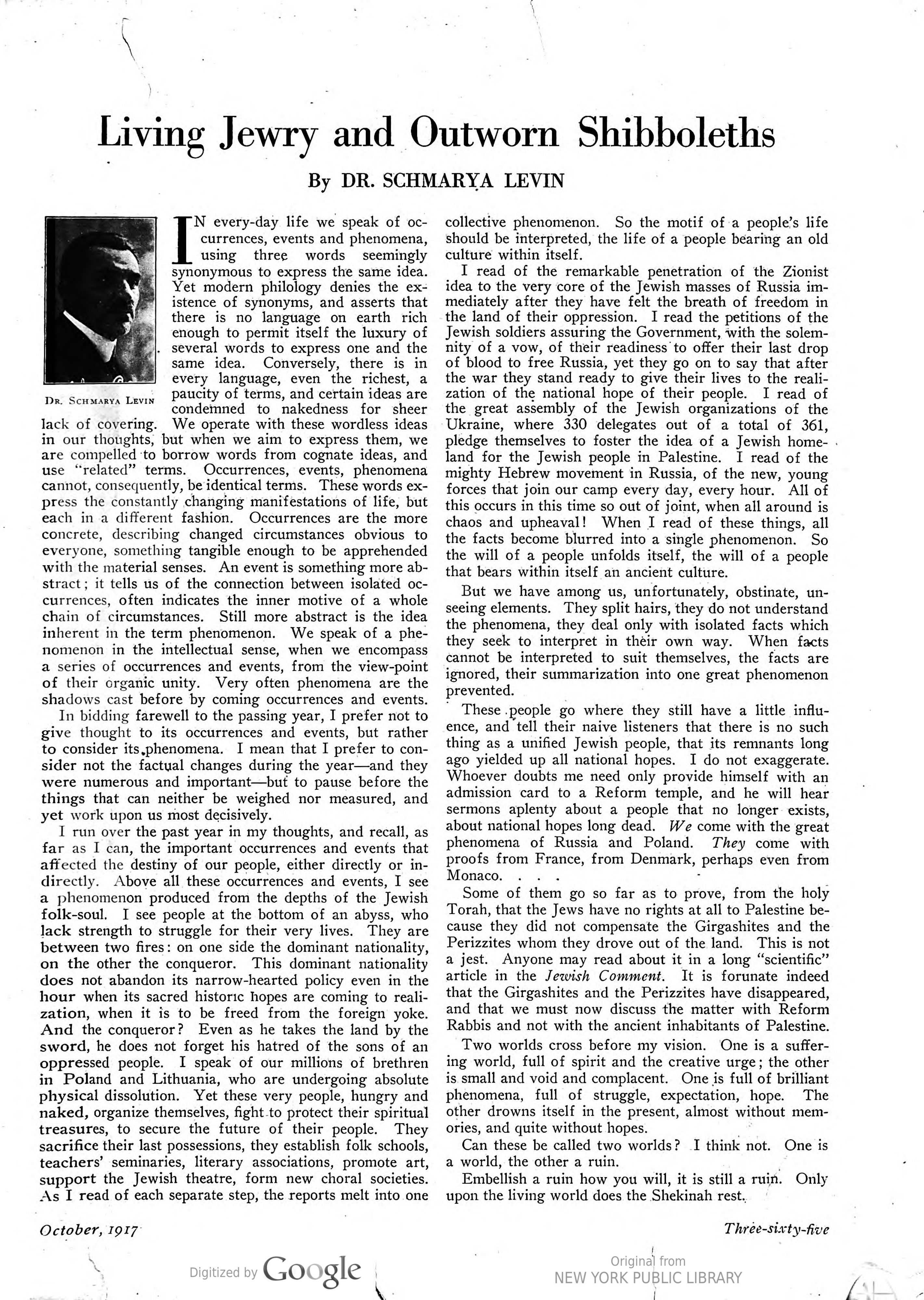
Living Jewry and Outworn Shibboleths
IN every-day life we speak of occurrences, events and phenomena, using three words seemingly synonymous to express the same idea. Yet modern philology denies the existence of synonyms, and asserts that there is no language on earth rich enough to permit itself the luxury of several words to express one and the same idea. Conversely, there is in every language, even the richest, a paucity of terms, and certain ideas are condemned to nakedness for sheer lack of covering. We operate with these wordless ideas in our thoughts, but when we aim to express them, we are compelled to borrow words from cognate ideas, and use "related" terms. Occurrences, events, phenomena cannot, consequently, be identical terms. These words express the constantly changing manifestations of life, but each in a different fashion. Occurrences are the more concrete, describing changed circumstances obvious to everyone, something tangible enough to be apprehended with the material senses. An event is something more abstract; it tells us of the connection between isolated occurrences, often indicates the inner motive of a whole chain of circumstances. Still more abstract is the idea inherent in the term phenomenon. We speak of a phenomenon in the intellectual sense, when we encompass a series of occurrences and events, from the viewpoint of their organic unity. Very often phenomena are the shadows cast before by coming occurrences and events.
In bidding farewell to the passing year, I prefer not to give thought to its occurrences and events, but rather to consider its phenomena. I mean that I prefer to consider not the factual changes during the year—and they were numerous and important—but to pause before the things that can neither be weighed nor measured, and yet work upon us most decisively.
I run over the past year in my thoughts, and recall, as far as I can, the important occurrences and events that affected the destiny of our people, either directly or indirectly. Above all these occurrences and events, I see a phenomenon produced from the depths of the Jewish folk-soul. I see people at the bottom of an abyss, who lack strength to struggle for their very lives. They are between two fires: on one side the dominant nationality, on the other the conqueror. This dominant nationality does not abandon its narrow-hearted policy even in the hour when its sacred historic hopes are coming to realization, when it is to be freed from the foreign yoke. And the conqueror? Even as he takes the land by the sword, he does not forget his hatred of the sons of an oppressed people. I speak of our millions of brethren in Poland and Lithuania, who are undergoing absolute physical dissolution. Yet these very people, hungry and naked, organize themselves, fight to protect their spiritual treasures, to secure the future of their people. They sacrifice their last possessions, they establish folk schools, teachers' seminaries, literary associations, promote art, support the Jewish theatre, form new choral societies. As I read of each separate step, the reports melt into one
collective phenomenon. So the motif of a people's life should be interpreted, the life of a people bearing an old culture within itself.
I read of the remarkable penetration of the Zionist idea to the very core of the Jewish masses of Russia immediately after they have felt the breath of freedom in the land of their oppression. I read the petitions of the Jewish soldiers assuring the Government, with the solemnity of a vow, of their readiness to offer their last drop of blood to free Russia, yet they go on to say that after the war they stand ready to give their lives to the realization of the national hope of their people. I read of the great assembly of the Jewish organizations of the Ukraine, where 330 delegates out of a total of 361, pledge themselves to foster the idea of a Jewish homeland for the Jewish people in Palestine. I read of the mighty Hebrew movement in Russia, of the new, young forces that join our camp every day, every hour. All of this occurs in this time so out of joint, when all around is chaos and upheaval! When I read of these things, all the facts become blurred into a single phenomenon. So the will of a people unfolds itself, the will of a people that bears within itself an ancient culture.
But we have among us, unfortunately, obstinate, unseeing elements. They split hairs, they do not understand the phenomena, they deal only with isolated facts which they seek to interpret in their own way. When facts cannot be interpreted to suit themselves, the facts are ignored, their summarization into one great phenomenon prevented.
These people go where they still have a little influence, and tell their naive listeners that there is no such thing as a unified Jewish people, that its remnants long ago yielded up all national hopes. I do not exaggerate. Whoever doubts me need only provide himself with an admission card to a Reform temple, and he will hear sermons aplently about a people that no longer exists, about national hopes long dead. We come with the great phenomena of Russia and Poland. They come with proofs from France, from Denmark, perhaps even from Monaco.
Some of them go so far as to prove, from the holy Torah, that the Jews have no rights at all to Palestine because they did not compensate the Girgashites and the Perizzites whom they drove out of the land. This is not a jest. Anyone may read about it in a long "scientific" article in the Jewish Comment. It is fortunate indeed that the Girgashites and the Perizzites have disappeared, and that we must now discuss the matter with Reform Rabbis and not with the ancient inhabitants of Palestine.
Two worlds cross before my vision. One is a suffering world, full of spirit and the creative urge; the other is small and void and complacent. One is full of brilliant phenomena, full of struggle, expectation, hope. The other drowns itself in the present, almost without memories, and quite without hopes.
Can these be called two worlds? I think not. One is a world, the other a ruin.
Embellish a ruin how you will, it is still a ruin. Only upon the living world does the Shekinah rest.