THE MACCABAEAN
percentage phosphorus deposits—as much as 86-89 per cent of tricalcic phosphate, bearing favorable comparison not only with the phosphates of Tunis and Algeria but even with those of Florida—and the deposits of the bitumen series, ranging from slightly bituminous limestones to almost chemically pure asphalt, which would indicate that petroleum might be found in the anticlinals if properly searched for. Thus, Palestine will be spared the rush of objectionable elements which usually follow in the wake of valuable mineral finds.
But if from the mineral point of view the limestone formation is a poor one, it is, on the other hand, full of promise from the agricultural point of view. On this point some emphasis must be laid, as in this matter the views of European agriculturalists, accustomed to conditions in the humid and temperate regions, widely and fundamentally differ from those held by agronomists trained in the arid and semi-arid regions.
No rock can, under the influence of Palestinian sun and heat, compare with the limestone in rapidity of disintegration, thus making swiftly available abundant new elements for the formation of a rich soil of perpetual fertility. No soil, more than the spongy calcareous soil, can be as quickly permeated by the heavy downpours of rain usual in Palestine and similar countries, and no other soil than the calcareous one has such a high capillarity, making available the inexhaustible stores of underground water for the deep rooting plants of the arid and semi-arid regions. Thus a continual luxuriant growth is maintained under a glowing sun, an intense light and a warm air, with not a drop of rain for six or seven months consecutively.
North African agronomists and American South-
western agronomists are well aware of the importance of a well-watered or well-cultivated calcareous soil. And thus, to quote the United States official publication again, “because of its diversified geologic formations the country presents a great variety of soils, but fortunately the calcareous element predominates, for it is this element which is of the greatest importance in the soils of arid and semi-arid regions, being second to water only, which is indispensable for maintaining animal and vegetable life.”
111%. But if every agronomist of standing and experience in _the arid and semi-arid regions will feel inclined to write an apologia of the limestone, praising its highly beneficial fertilizing value, it is nevertheless true, as some scientists have put it, “that were it not for the limestone there would be no deserts.” Indeed the limestone formation favors the desert extension if the amount of water available from rain or otherwise is insufficient to maintain even scant life. What are the rainfall and climate of Palestine from this special point of view? “In Palestine, just as in California, we have a dry, warm season and a humid and more temperate one. The rainy season extends from October to May, and the dry season from May to October. The rainfall varies according to the locality, from less than six inches in the extreme south near the ‘Egyptian frontier, where rains are insufficient and uncertain, to more than forty inches in the north of the country. Palestine is even more favored than California with regard to the winter temperature. Although the thermometer rises as high in summer in Palestine as in California, with extremes of 110 degrees to 115 degrees Fahr., though not so often, it very rarely drops in winter to the freezing point.”
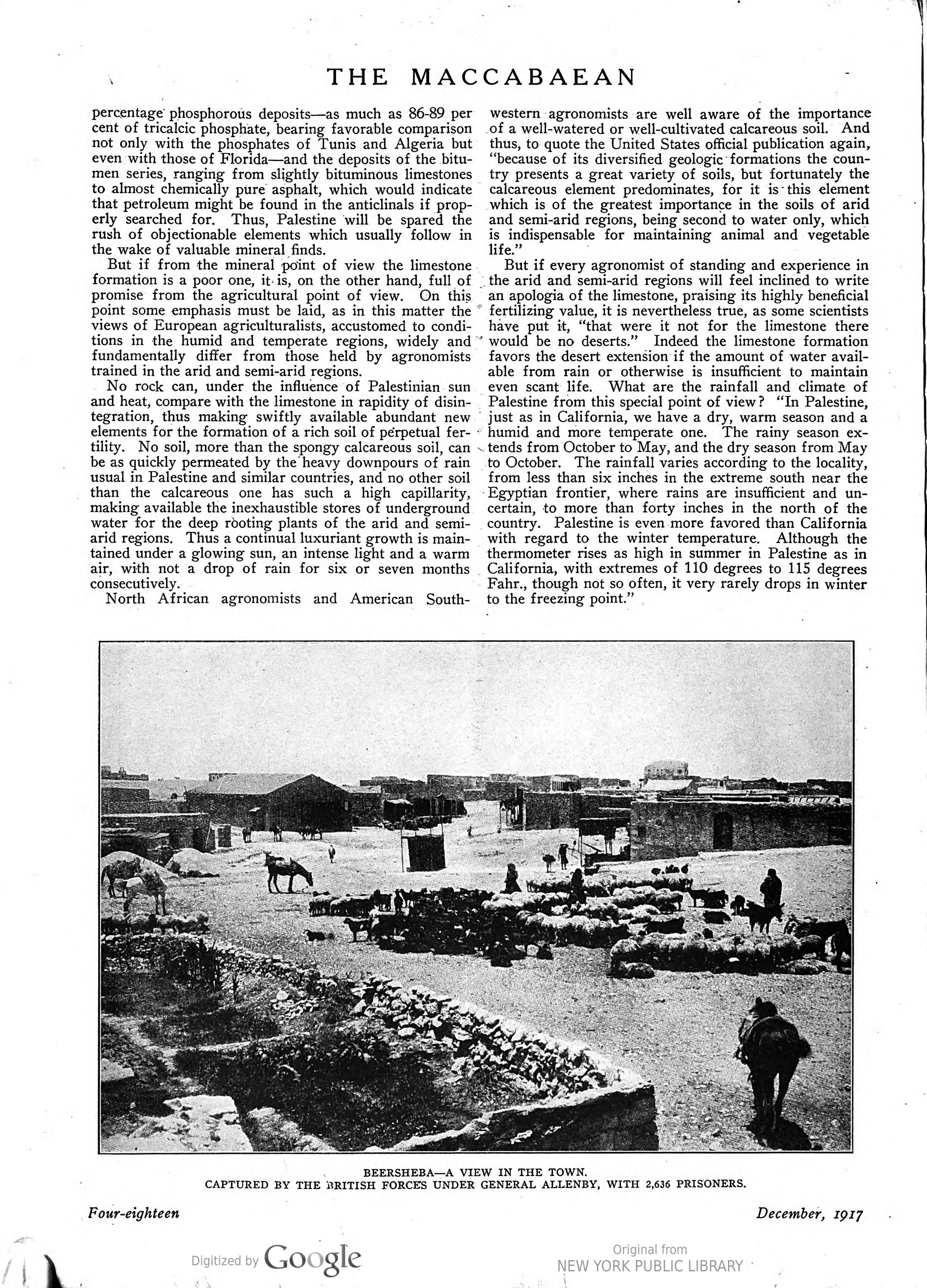
CAPTURED BY THE BRITISH FORCES UNDER GENERAL ALLENBY, WITH 2,636 PRISONERS.