The Jewish Land and the Holy Places
IT has long been a favorite argument of the anti-Zionists that the Christians of all lands would never be willing to let the Holy Land pass under Jewish control. As a matter of fact, the Declaration of the British Government was made with the consent of Catholic as well as Protestant prelates.
It is even more interesting to note that at the very moment when Jerusalem was captured, when religious sentiment was so solemn and tense, many Christians, clergymen and laymen, expressed themselves whole-heartedly in favor of allowing Palestine to become a Jewish land, and, moreover, referred to the significance of Jerusalem in its relation to the Jewish past and especially to the Jewish future.
The explanation of the phenomenon is to be found in the answer which the Zionists have always used in refutation, namely, that one must distinguish between the Jewish Land and the Holy Places. Palestine, the Jewish Land, in its fullest extent covers an area of about 30,000 square miles, whereas all the Holy Places together take up at most a score of square miles. The Christians will not be afraid to entrust them to the newly-established Jewish nation, for they know that it is not for purposes of religious propaganda that the Jews want a homeland. (Did not those Jews who believe that our people has a religious mission eliminate Zion and Jerusalem from their prayer-books and from their hearts?) The Jews will not have any political dealings outside of Palestine which will depend upon the possession of the Holy Places; therefore, they are the neutrals, the non-partisans, where other religions and religious sects are concerned. The Jews, who have suffered so acutely from intolerance, will know better than anyone else how to respect the things which others hold sacred, and how to welcome the pilgrims as guests in their country.
~The arguments regarding the Holy Places are based on the prevailing ignorance of the rudiments of Palestinian geography. In the old days the Jews prayed for Eretz Isroel, and now they make propaganda for Palestine—but they never really learned anything about the country.
Let us deal with concrete geographical facts instead of with theories; the enlarged boundaries of the Palestine, which 18 the prospective Jewish homeland, extend northward beyond Mount Hermon, southward to the Vadi EIl- Arish and the Gulf of Akaba, and eastward to the Arabian Desert. The western boundary is formed by the Mediterranean.
A glance at the map serves to convince us how little space the Moslem and Christian Holy Places occupy in this area.
In enumerating the Holy Places in the various parts of the country we cannot include any but those which are hallowed from a general religious standpoint, not those which have acquired legendary sanctity in the eyes of a single village or local group.
The Moslem Holy Places are few and far between; they consist in the tombs of several local sheikhs and the legendary tombs of the Jewish patriarchs and prophets. These tombs, which are surrounded by small mounds, do not take up more than several square miles of land throughout Palestine.
The Christian religion holds sacred several places in Palestine. The story of Jesus centered around the town of Nazareth, a few spots along the banks of Gennesaret, a small section of Bethlehem, several points near Jericho and along the Jordan, and finally certain parts of Jerusalem, to which we shall recur later on. Then there are the points associated with the lives of the disciples of Jesus, and the other founders, teachers, and martyrs of Christianity ; the house and garden of Simon the Tanner in Jaffa, part of the ruins of ancient Caesarea, and a number of unimportant places. Finally, near Ramleh and Tiberias, there are the fields where the Crusaders waged their most famous battles. All these Holy Places do not cover more than ten square miles.
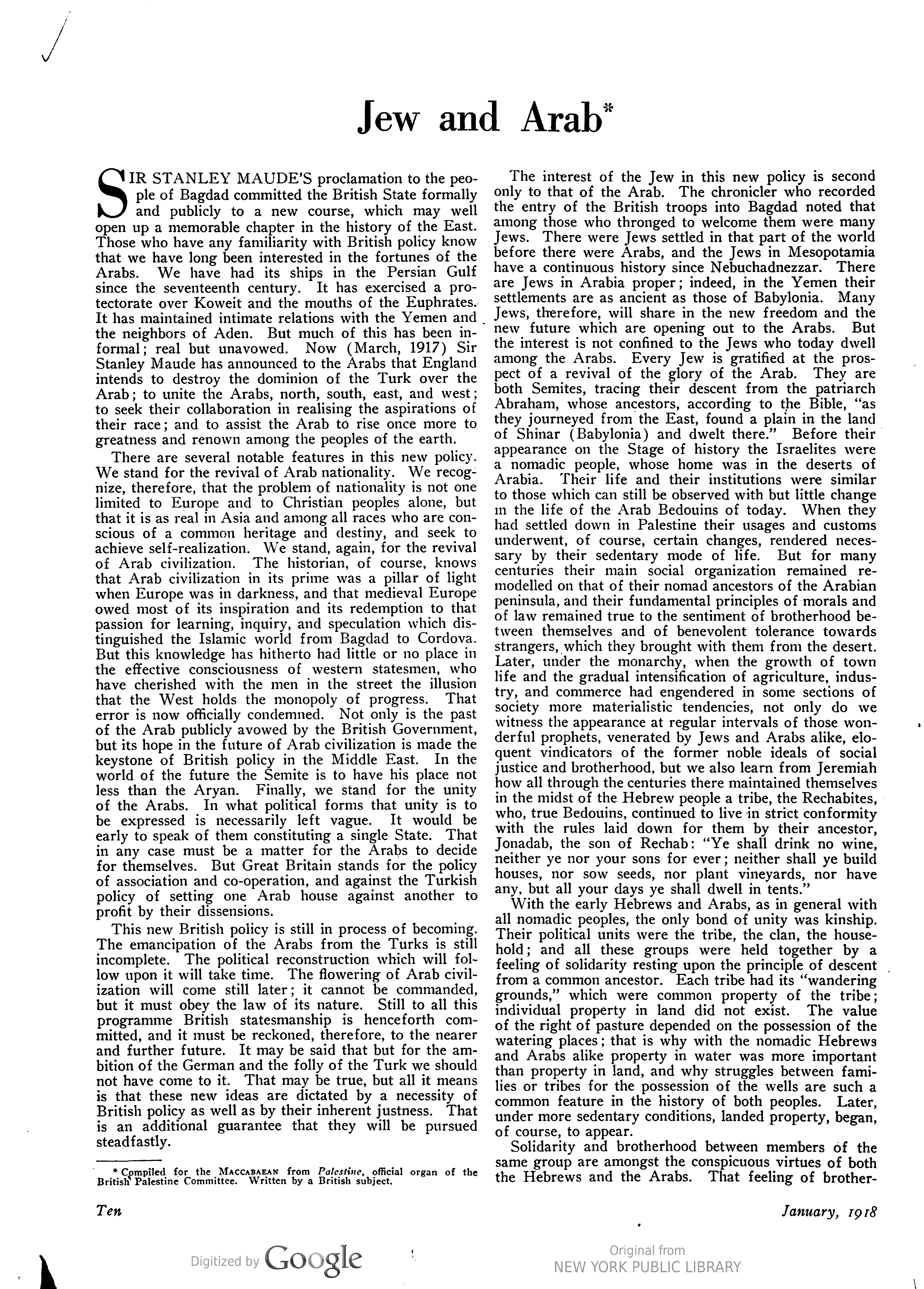
It remains for us to consider Jerusalem itself, which is holy to all three religions alike. But the "holy city"
comprises only that part of Jerusalem which lies within the old rampart, except for several inconsiderable points in the immediate vicinity. Here again there is an area not exceeding two square miles. In the last decade a number of more or less modern Jewish quarters have been constructed around. the old Jerusalem. On the lovely hills and in the charming valleys which encircle the city we shall be able to lay out hundreds of streets, boulevards, and parkways. That will be the secular, modern, living city, a great center for industry and commerce, as well as the political and cultural center of the new Jewish nation.
The Holy Places, historical monuments, will lend the Jewish land a peculiar charm and attractiveness. Thousands upon thousands of tourists will flock to visit them, just as thousands of others who . will come to enjoy the com-~ forts of a mild winter and ' the early spring. :