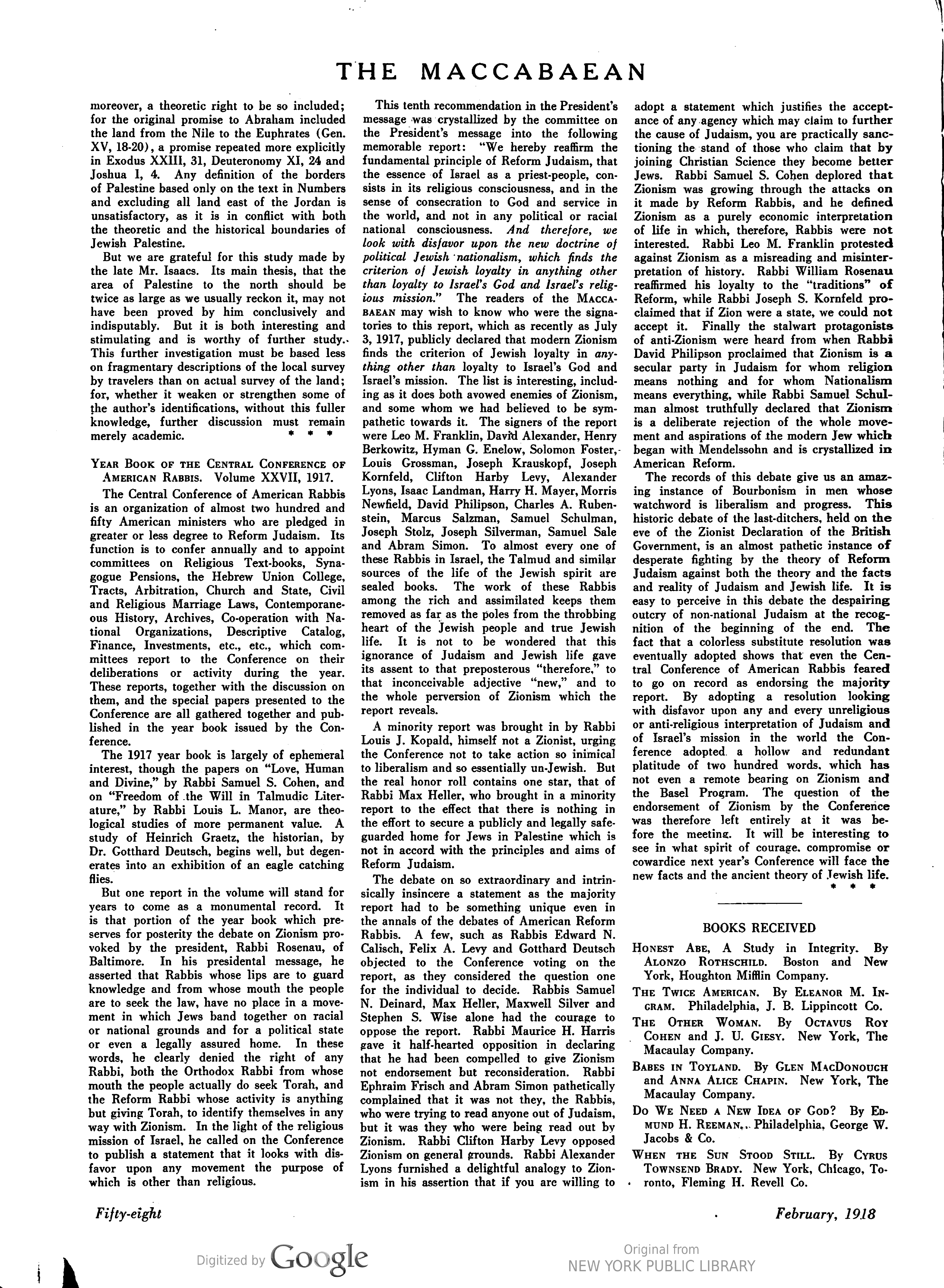
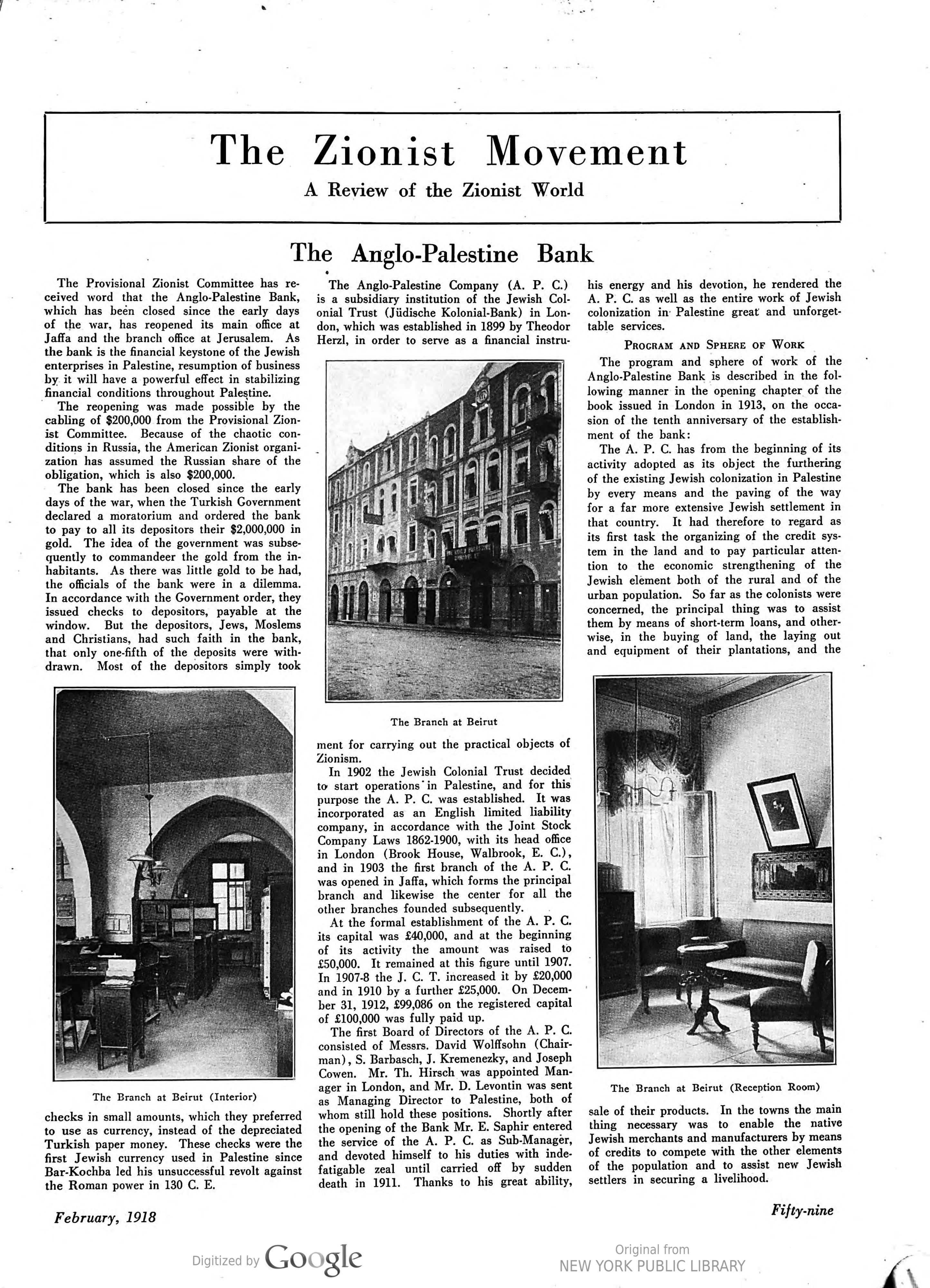
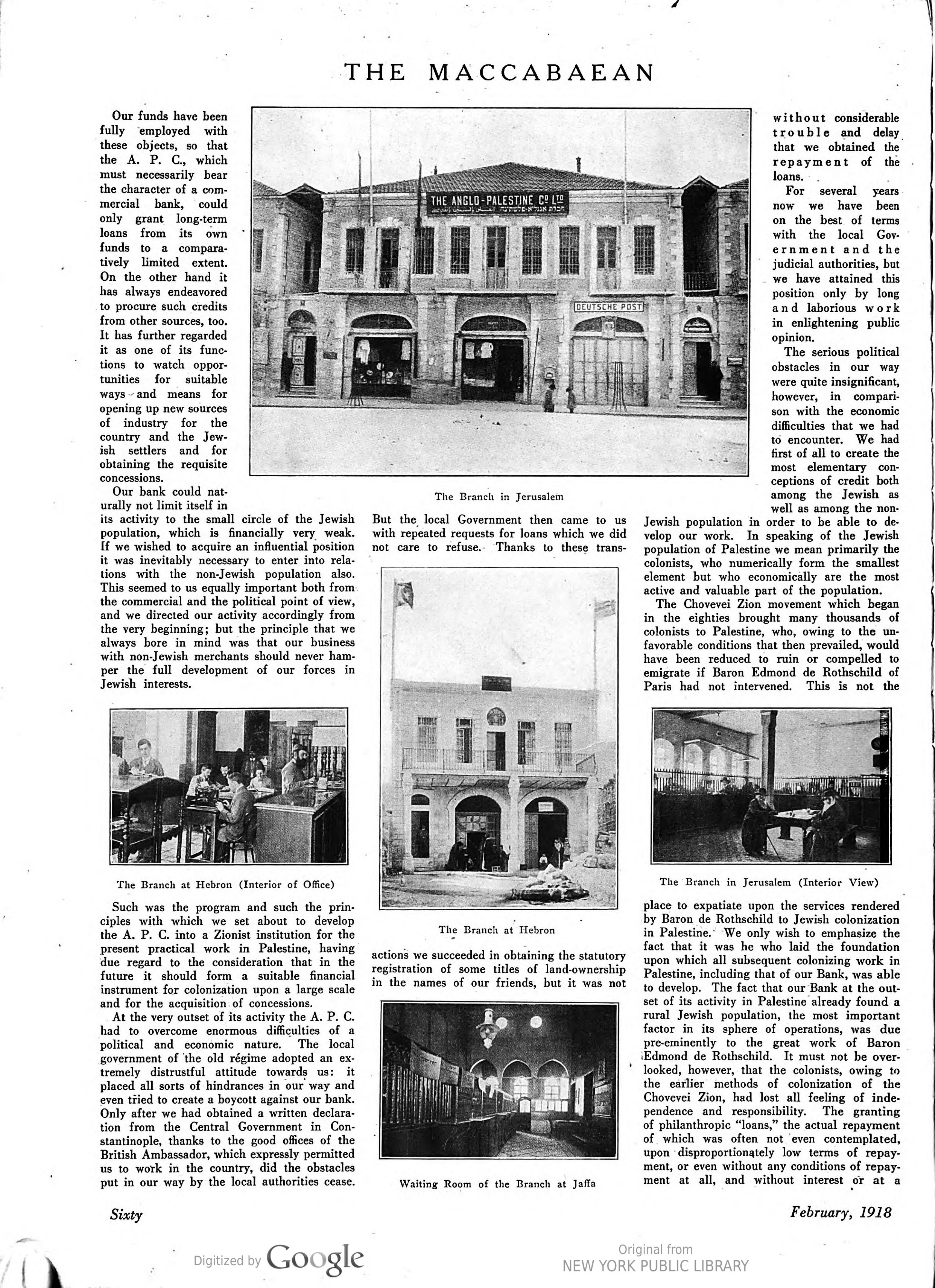
The Anglo-Palestine Bank
The Provisional Zionist Committee has 16- ceived word that the Anglo-Palestine Bank, which has been closed since the early days of the war, has reopened its main office at Jaffa and the branch office at Jerusalem. As the bank is the financial keystone of the Jewish enterprises in Palestine, resumption of business by. it will have a powerful effect in stabilizing financial conditions throughout Palestine.
The reopening was made possible by the cabling of $200,000 from the Provisional Zionist Committee. Because of the chaotic conditions in Russia, the American Zionist organization has assumed the Russian share of the obligation. which is also $200.000.
The bank has been closed since the early days of the war, when the Turkish Government declared a moratorium and ordered the bank to pay to all its depositors their $2,000,000 in gold. The idea of the government was subsequently to commandeer the gold from the inhabitants. As there was little gold to be had, the officials of the bank were in a dilemma. In accordance with the Government order, they issued checks to depositors, payable at the window. But the depositors, Jews, Moslems and Christians, had such faith in the bank, that only one-fifth of the deposits were withdrawn. Most of the depositors simply took
The Anglo-Palestine Company (A. P. C.) is a subsidiary institution of the Jewish Colonial Trust (Jüdische Kolonial-Bank) in London, which was established in 1899 by Theodor Herzl, in order to serve as a financial instru-
ment for carrying out the practical objects of Zionism.
In 1902 the Jewish Colonial Trust decided to start operations in Palestine, and for this purpose the A. P. C. was established. It was incorporated as an English limited liability company, in accordance with the Joint Stock Company Laws 1862-1900, with its head office in London (Brook House, Walbrook, E. C.), and in 1903 the first branch of the A. P. C. was opened in Jaffa, which forms the principal branch and likewise the center for all the other branches founded subsequently.
At the formal establishment of the A. P. C. its capital was £40,000, and at the beginning of its activity the amount was raised to £50,000. It remained at this figure until 1907. In 1907-8 the J. C. T. increased it by £20,000 and in 1910 by a further £25,000. On December 31, 1912, £99,086 on the registered capital of £100,000 was fully paid up.
The first Board of Directors 01 the A. ©. U. consisted of Messrs. David Wolffsohn (Chairman), S. Barbasch, J. Kremenezky, and Joseph Cowen. Mr. Th. Hirsch was appointed Manager in London, and Mr. D. Levontin was sent as Managing Director to Palestine, both of whom still hold these positions. Shortly after the opening of the Bank Mr. E. Saphir entered the service of the A. P. C. as Sub-Manager, and devoted himself to his duties with indefatigable zeal until carried off by sudden death in 1911. Thanks to his great ability,
checks in small amounts, which they preferred to use as currency, instead of the depreciated Turkish paper money. These checks were the first Jewish currency used in Palestine since Bar-Kochba led his unsuccessful revolt against the Roman power in 130 C. E.
his energy and his devotion, he rendered the A. P. C. as well as the entire work of Jewish colonization in Palestine great and unforgettable services.
PROGRAM AND SPHERE OF WORK
The program and sphere of work of the Anglo-Palestine Bank is described in the following manner in the opening chapter of the book issued in London in 1913, on the occasion of the tenth anniversary of the establishment of the hank:
The A. P. C. has from the beginning of its activity adopted as its object the furthering of the existing Jewish colonization in Palestine by every means and the paving of the way for a far more extensive Jewish settlement in that country. It had therefore to regard as its first task the organizing of the credit system in the land and to pay particular attention to the economic strengthening of the Jewish element both of the rural and of the urban population. So far as the colonists were concerned, the principal thing was to assist them by means of short-term loans, and otherwise, in the buying of land, the laying out and equipment of their plantations, and the
sale of their products. In the towns the main thing necessary was to enable the native Jewish merchants and manufacturers by means of credits to compete with the other elements of the population and to assist new Jewish settlers in securing a livelihood.