THE MACCABAEAN
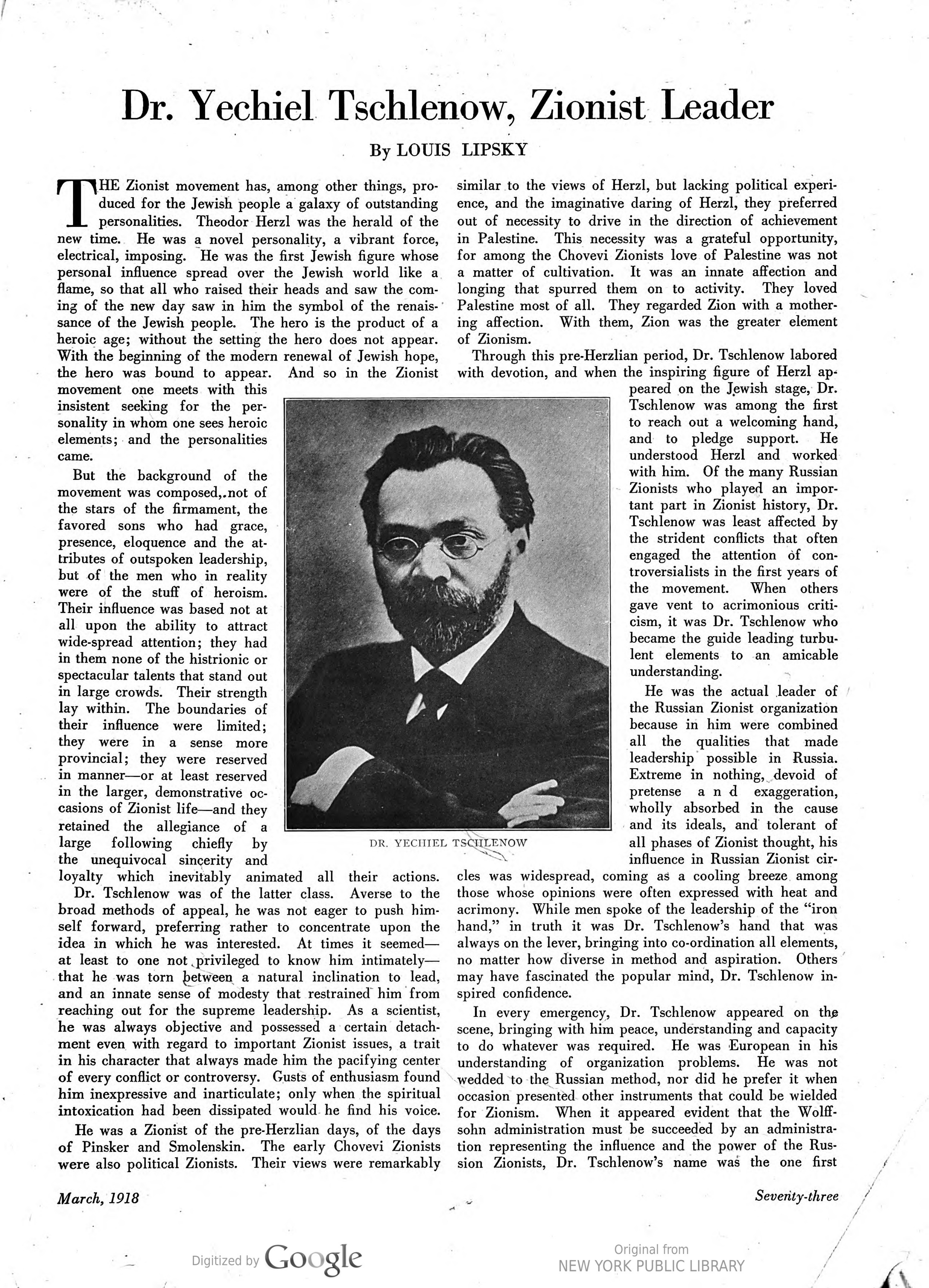
thought of by all, friends of the Russian contingent, as well as its foes. His was the name that could be conjured with to bring about a solid front. But at that time, it was impossible to create the situation that made his entrance into the actual leadership of the movement politically feasible, and it was not until the Vienna Congress that he became vice-chairman of the Inner Actions Comite. All were hopeful that with him at the helm, a powerful, new force would spread its influence into all parts of the Zionist organization. With that devotion which characterized his entire career, he gave up his lucrative practice in Moscow and prepared to take charge of the Zionist affairs in Berlin. Only a few brief months did he remain in Berlin, when the Great War broke out, and as a Russian subject, he was forced to return to Moscow.
He plunged into the nerve-racking work of relief. He saw about him the debris of the great war, and felt within himself a superhuman fury to overcome the enormous difficulties of Jewish life. He became the head of the Moscow relief section, and led in the work through the wearing time preceding the outbreak of the revolution. Day and night, thoughtless of his life, he labored for the war-sufferers. The symptoms of incurable disease made themselves mainfest. But he did not cease his labors. He
seemed to work with redoubled zeal, feeling that if his life was to be cut off, at least he would put in a good day's work before he departed.
At the same time, he was intimately taken up with the progress of the movement. Out of the war there had come unprecedented opportunities. The Committee in London needed advice and guidance. This he gave regardless of the physical consequences to himself. He took charge of the work in Copenhagen, and frequently moved from Copenhagen to London and back again, in spite of the physical hardships of travel. The consolidation of the Zionist organization was affected largely through his influence, for he represented the tie that bound together the Zionists of Russia, Germany, and the neutral European countries. When, finally, the British Government was prepared to issue its Declaration, he had the supreme happiness of being present at the consummation of his effective work.
Honor to the memory of a valiant, dignified Zionist leader! Honor to the memory of a real hero, who gave all that a man may give for the cause in which he had faith. May the memory of Dr. Tschlenow be a spur to the Jewish people in realization of the dream that inspired his life!
The Two Ravens
Translated from the Hebrew of Saul Tchernichovsky
EARLY in the morning, as darkness slipt out, A raven to his fellow made a great shout: "Raven, O Raven, now where shall we go? Shall we feast on the plain or the seashore below? Shall we prey in the forest, to deserts take flight, Feed under the green tree or gorge on the height?"
THE raven to his fellow did loudly declare: “We'll fly to Judaea, to the wilderness there; We'll go up to Zion. On the steep mountain side, Pierced by the foe’s sword, a poet has died. The warm blood still sings in his heart like a bell, And spattered with red are the stones where he fell, And still with a smile are his white lips aglow; But rolled in the dust lies the sword of his foe.
OE'LL fly to the man; on his shoulder we'll sit:Large are his eyes, and we'll pick every bit,Tear out all his curls that are glossy and black;To cover our babies we'll carry them back.Of the hairs in his beard what is softest and bestWe may use very well to repair our old nest."
HIS couch is made now among gravel and dust, As where tempests have raged or where swords have been thrust, Yet his pillow is wide—as the plain spreading wide He sleeps—and he marks not the tears of his bride. Where his white bones are spread only birds gather ‘round, Foxes are howling and antelopes bound.