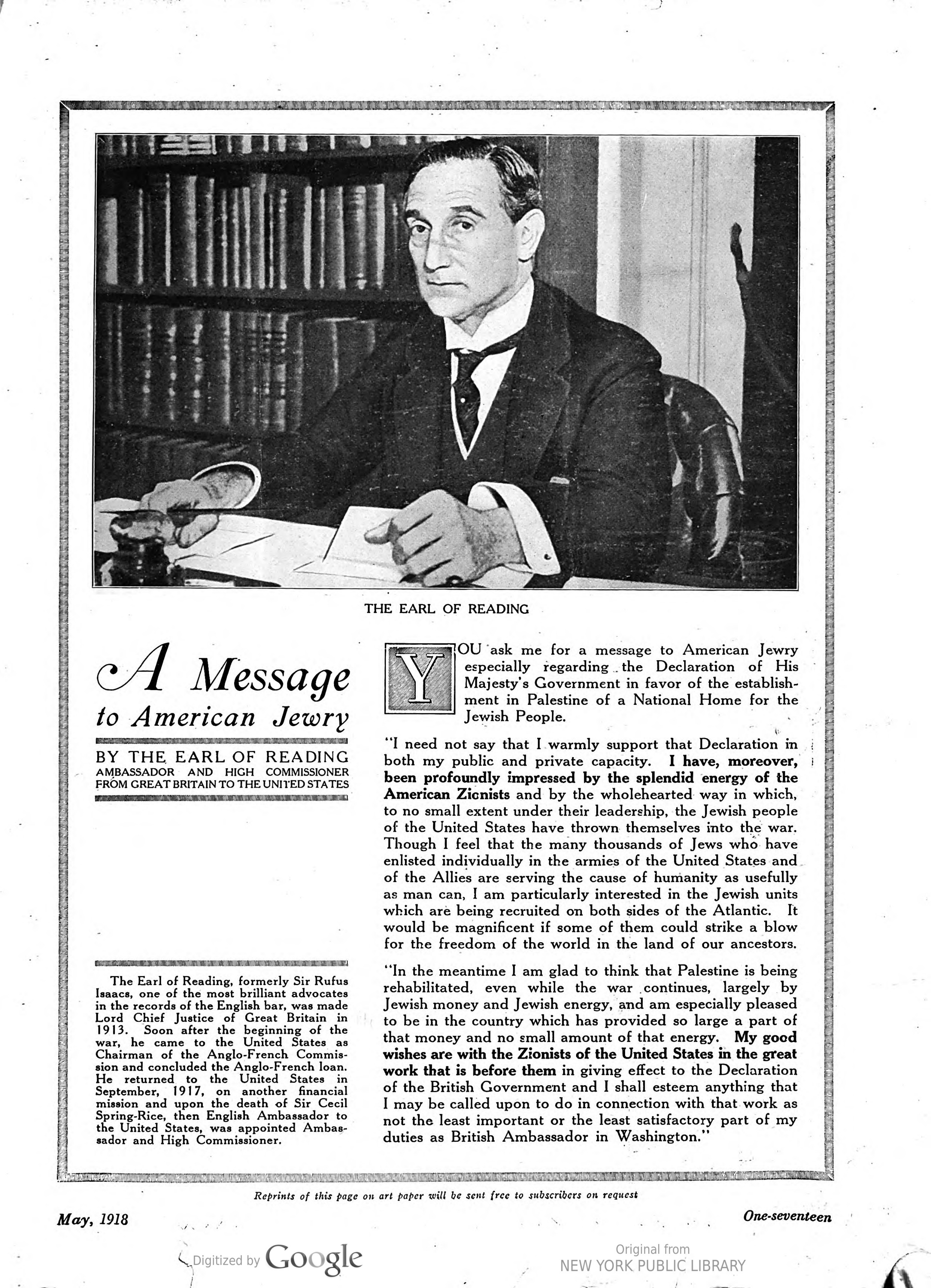
A Message to American Jewry
BY THE EARL OF READING AMBASSADOR AND HIGH COMMISSIONER FROM GREAT BRITAIN TO THE UNITED STATES
The Earl of Reading, formerly Sir Rufus Isaacs, one of the most brilliant advocates in the records of the English bar, was made Lord Chief Justice of Great Britain in 1913. Soon after the beginning of the war, he came to the United States as Chairman of the Anglo-French Commission and concluded the Anglo-French loan. He returned to the United States in September, 1917, on another financial mission and upon the death of Sir Cecil Spring-Rice, then English Ambassador to the United States, was appointed Ambassador and High Commissioner.
Reprints of this page on art paper will be sent free to subscribers on request
YOU ask me a message to American Jewry especially regarding the Declaration of His Majesty's Government in favor of the establishment in Palestine of a National Home for the Jewish People.
“I need not say that I warmly support that Declaration in both my public and private capacity. I have, moreover, been profoundly impressed by the splendid energy of the American Zicnists and by the wholehearted way in which, to no small extent under their leadership, the Jewish people of the United States have thrown themselves into the war. Though I feel that the many thousands of Jews who. have enlisted individually in the armies of the United States and of the Allies are serving the cause of humanity as usefully as man can, I am particularly interested in the Jewish units which are being recruited on both sides of the Atlantic. It would be magnificent if some of them could strike a blow for the freedom of the world in the land of our ancestors.
“In the meantime I am glad to think that Palestine is being rehabilitated, even while the war continues, largely by Jewish money and Jewish energy, and am especially pleased to be in the country which has provided so large a part of that money and no small amount of that energy. My good wishes are with the Zionists of the United States in the great work that is before them in giving effect to the Declaration of the British Government and I shall esteem anything that I may be called upon to do in connection with that work as not the least important or the least satisfactory part of my duties as British Ambassador in Washington.”