The Maccabaean
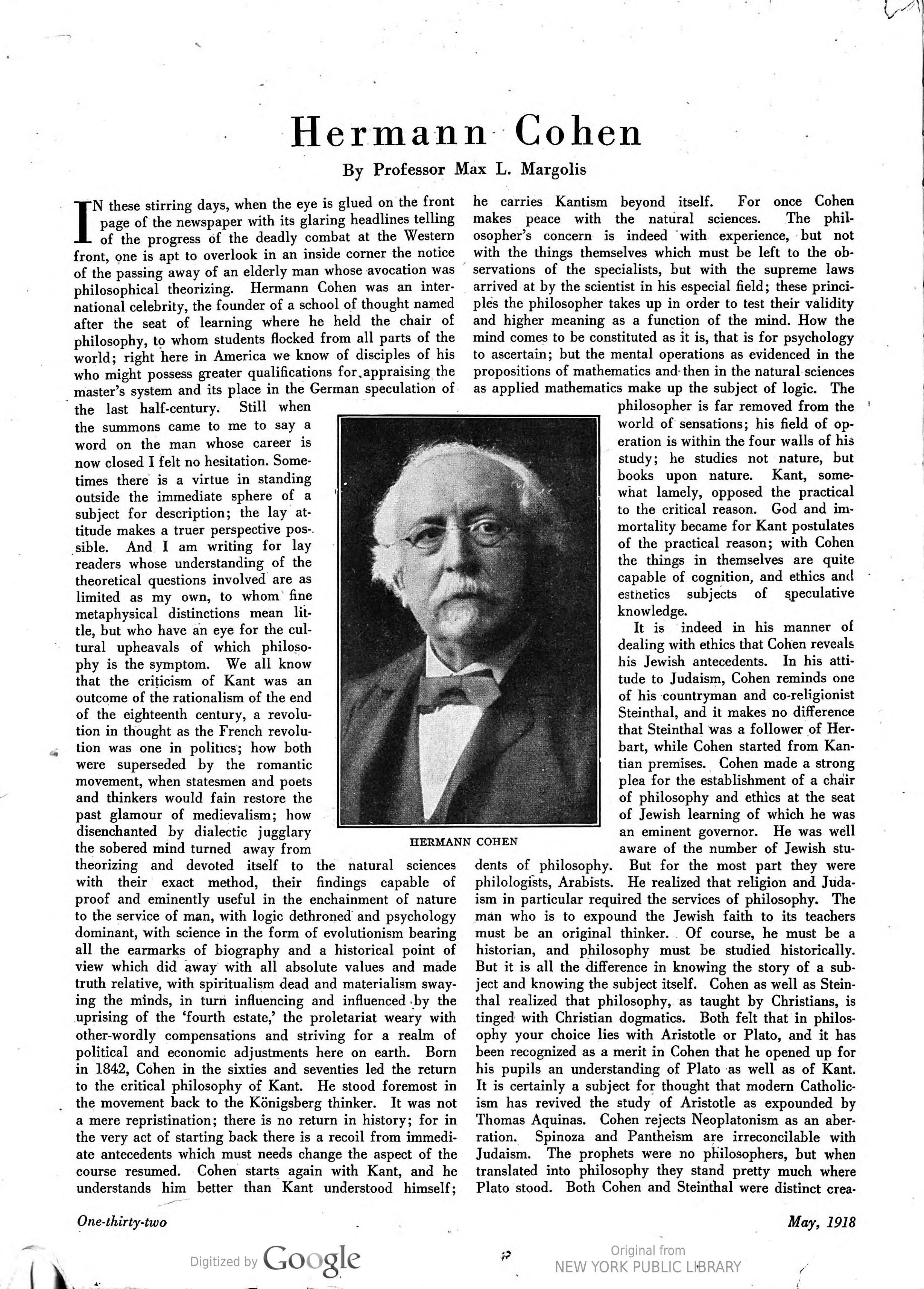
tures of German civilization. You cannot imagine them outside Germany. Yet they stand with their innermost thoughts upon the basis of Judaism. Cohen realizes the danger to Judaism from the Christian environment. He is well aware of that insidious force of imitation. Not only the Jew, but also Judaism is in danger of becoming Christianized. By the force of his philosophic insight he stands as an eminent peak. From the heights he overlooks the confusion of thought. It does not reach him. He is able to appraise the value of the opposing system. He takes the most favorable view of Christianity. He rightly idealizes it. But with just as much right he idealizes Judaism. The weight of ceremonialism he casts overboard. He reverts to prophetic Judaism, as continued by the men of the Haggadah and then by the medieval rationalist. The center of Christianity is the God-man. The center of Judaism is the One uncomparable holy God. History is applied ethics. In history the ethical idea is to work itself out. The Jewish Messiah is as different from the Christ of the daughter-religion as only two extremes can be. He brushes aside the eschatological notions about the Messiah. He emphasizes the Messianic times above the personal Messiah. Cohen repudiates the Neo-Catholicism of Bergson. But his own God is as impersonal as is his Messiah. Both are in the Platonic sense ideas. God is the Idea of world perfection. Only by holding fast to the Jewish idea of God as the One who works out the supreme ethical good in and through history does the Jew justify his separatism with all the sacrifices and martyrdom it entails. Cohen is supremely alive to the importance of the Psychological moment in keeping up the Jewish identity. He wants a Jewish atmosphere in the synagogue. He attaches great importance to the retention of the Hebrew language in the liturgy. With the ceremonies gradually disappearing, with the processes of assimilation along politico-national lines gaining ground and entailing the cultural identity in the realm of esthetic emotions, we may guard our religious individuality solely by means of a mental, spiritual individuality, and for that purpose there is but one remedy, to keep our feeling for the Hebrew language in which our religious truths are clothed. No translation will avail. Here, as nowhere else, the protagonist of what generally passes for assimilation and the foe of Jewish nationalism, transcends his own reasoning. For if the psychological continuity of Jewish individuality on the mental side is to be maintained, it follows conclusively that the difficulties in the dispersion are well nigh in-
Marching On To Palestine—By NORMAN WINESTINE. (Continued from page 131)
London tells in the same breath of a list of army terms in Hebrew and of the receptions given by Chief-Rabbi Hertz and Lord Rothschild to the first legionaries to arrive in England from America.
Something entirely different from the old Golus spirit, and antagonistic to it, has developed—the man of battle. Our preservation in the Golus has been to some extent a habit of slinking around corners. We have been tenacious and have not been uprooted when the storm broke over our heads, but we have often secured the right to live by begging and bribery. It was never possible to do anything
surmountable. I for one subscribe to Cohen's thesis that only by adhering to the Jewish cardinal doctrine of the Unity of God does a Jew remain a Jew. I also recollect Cohen's remark that many Jews who wean themselves free from it are at the bottom of the souls impregnated with it and with nothing else. But if the maintenance of the Jewish protestant attitude against the Christian weltanschauung is at all to be safeguarded, if in order to save our religious individuality we must surround it by a cultural, psychological, mental individuality, we cannot hope to accomplish it anywhere except in a land of our own. You cannot feed the Jewish soul upon a few crumbs of Hebrew in an abbreviated prayerbook. Only in the Hebrew language such Jewish asseverations (I am quoting from Cohen), as Job's triumphant outcry, "My Redeemer liveth," such prayers as "Purify our hearts and sanctify us through Thy commandments," or the Messianic fundamental thought "Give the fear of Thee upon all Thy creatures, that they may all be made into one society," or our Alenu prayer for which we have suffered so much, only in the Hebrew can the true meaning of Ehad, One, be understood. But for an adequate comprehension of all that the Jew must be at home in the whole range of Hebrew speech. To enter fully into spirit of a language requires a wide reading of the literature which is written in it. And the highest achievement is only thinkable in an environment where Hebrew shall be the speech of the people. For the sake of the religious identity of the Jew, for the sake of its highest faith and hope, for the very sake of the Messianic times which Cohen rightly regards as the supreme Jewish work for humanity, the restoration becomes a necessity. Cohen was a child of his age and environment. But he builded well for future. His limitations, grounded in the times in which he lived, will be forgotten. But his lasting contribution to Jewish thought and the impassioned appeal to loyalty will be carried into aftertimes; they will steady the weak-kneed Jew in the diaspora and steel him for continued stubborn resistance in the face of all odds; and the Jew who returns to create that very psychological milieu without which Judaism as a religion cannot subsist will take that heritage along with the best products of the Jewish endeavor of the diaspora which, as Cohen well points out, began with Saadya. We remember Cohen not merely as the leader back to Kant, but as the leader back to the prophets; and back to the prophets we shall go, in the prophet's own home.
else, but the result has not been a pleasant one. We have been pacifists, not because we were strong, but because we were weak. The war is a war of Kulturs. The armies of the world are fighting, because their national souls are in conflict. And the Jews are fighting as representatives of every Kultur except their own. The Jewish legionaries have felt this as a reproach, and in order that that reproach might not continue they have gone to represent us. Numerically this is not significant. One battalion, in term of rifles, cannot redeem a nation. But one battalion, two, or three battalions, in terms of the sturdiness and courage they represent, is of the highest importance. It is the symbol of Jewish independence and self-reliance, a result of the new spirit, and a promise of still greater things for the future.